Impacted Members/Scientists: Request a membership waiver, seek meeting support, and other resources. Learn more. For the latest public policy updates, please visit this page.




16 January 2025
AAS Names Recipients of 2025 Awards & Prizes
16 January 2025 (Updated 21 January with HEAD prizewinners)
PRESS RELEASE
** Contact details appear below. **
The American Astronomical Society (AAS), a major international organization of professional astronomers, today announced the recipients of some of its 2025 prizes for outstanding achievements in research and education.
The 2025 Henry Norris Russell Lectureship, celebrating a career of eminence in astronomical research, goes to Marcia Rieke (University of Arizona) for her fundamental contributions to infrared astronomy in space and on the ground, especially in the construction of JWST and its NIRCam instrument. Rieke is also recognized for her observations of galaxies and their active nuclei in the local and distant universe, and for her national leadership in decadal planning and other policy activities.
The Dannie Heineman Prize for outstanding mid-career work in astrophysics is given jointly by the AAS and the American Institute of Physics. For 2025, the prize goes to Priyamvada Natarajan (Yale University) for her groundbreaking contributions to the study of dark matter and black hole physics. Her foundational work using gravitational lensing has advanced our knowledge of substructure — the distribution of dark matter on small scales within galaxy clusters — positioning it as a powerful cosmological probe. Her work modeling the first black hole seeds and their environments has transformed our understanding of the formation, fueling, and feedback processes of supermassive black holes and facilitated direct comparisons with multi-wavelength observations.
This year's Annie Jump Cannon Award in Astronomy, for outstanding research and promise for future research by a female researcher within five years after earning her PhD, goes to Maya Fishbach (University of Toronto) for major contributions to the field of gravitational-wave astrophysics and cosmology, including inference of the black-hole merger rate and its implications for the formation of stellar-mass black holes, their host galaxies, and the expansion history of the universe.
The 2025 Helen B. Warner Prize is awarded for observational or theoretical research by a young astronomer to Susan Clark (Stanford University) for seminal contributions to our understanding of cosmic magnetism, and for the development of innovative observational techniques for studying the interstellar medium and cosmological foregrounds. These advances have provided a deeper understanding of gas and dust properties in the Milky Way and beyond.
The 2025 Newton Lacy Pierce Prize, which is awarded for outstanding achievement in observational astronomical research based on measurements of radiation from an astronomical object, goes to Andrew Vanderburg (Massachusetts Institute of Technology) for foundational advancements in the study of planetary systems around white dwarf stars, and for innovation in using deep neural networks to identify exoplanets in photometric data. Vanderburg has demonstrated that planetary accretion can enrich white dwarfs, discovered giant planets orbiting white dwarfs, and leveraged machine learning to enable the rapid identification and release of new exoplanet discoveries. This work has yielded insights into the dynamics of material orbiting white dwarfs and the fates of planets after their parent stars evolve.

James Green (University of Colorado Boulder) is receiving the Joseph Weber Award for Astronomical Instrumentation for his numerous contributions to instrumentation in ultraviolet space astronomy, including the Far Ultraviolet Spectroscopic Explorer (FUSE) and the Cosmic Origins Spectrograph (COS) instruments on the Hubble Space Telescope.
The AAS Education Prize recognizes outstanding contributions to the education of the public, students, and/or the next generation of professional astronomers. For 2025, the recipient is Puragra (Raja) GuhaThakurta (University of California, Santa Cruz) for the breadth and innovation of his outreach, education, and mentoring work, including programs that reach a wide range of learners, both in his local community and worldwide. Projects such as “Shadow the Scientists” provide novel and beneficial ways for scientists, students, and members of the public to interact.
The 2025 Chambliss Amateur Achievement Award, which recognizes an achievement in astronomical research made by someone not employed in the field of astronomy in a professional capacity, goes to Richard Donnerstein (University of Arizona) for his significant contributions to the detection of diffuse, low surface brightness galaxies as part of the Systematically Measuring Ultra-Diffuse Galaxies (SMUDGes) Project.
The 2025 Chambliss Astronomical Writing Award for astronomy writing for an academic audience, specifically textbooks at either the upper-division undergraduate or graduate level, is awarded to Dragan Huterer (University of Michigan) for the textbook A Course in Cosmology: From Theory to Practice (2023 Cambridge University Press), an approachable overview of the relevant techniques currently used by both observational and theoretical cosmologists.
Special Honors for the 245th AAS Meeting
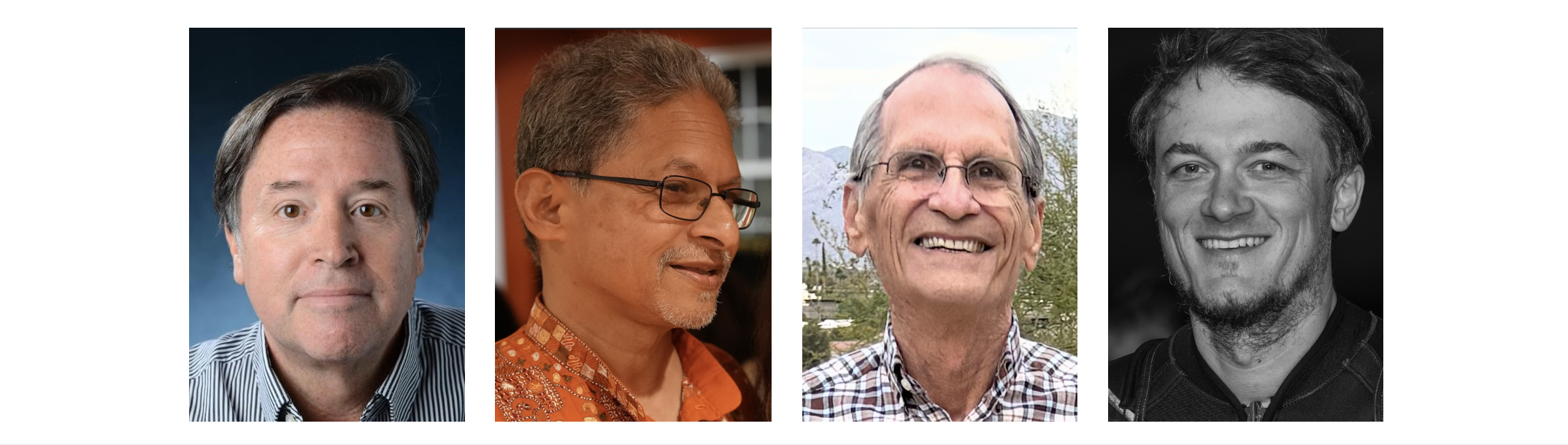
The Society’s Vice Presidents select two special invited lecturers that traditionally bookend the AAS’s winter meeting: the Fred Kavli Plenary Lecturer and the Lancelot M. Berkeley–New York Community Trust Prize lecturer.
For the 245th meeting, the Vice Presidents selected David Charbonneau (Harvard University) to give the Fred Kavli Plenary Lecture, honoring him for foundational work in the field of exoplanets, from the discovery of the first transit to major advancements in our understanding of exoplanet atmospheres.
The Lancelot M. Berkeley–New York Community Trust Prize is awarded for highly meritorious work in advancing the science of astronomy, and this year’s prize goes to the collaboration of scientists and engineers supporting the Astropy Project, a community effort to develop a free and open-source core software package for astronomy using the Python programming language, as well as to foster interoperability between other Python astronomy packages. The annual Berkeley prize winner is chosen by the three AAS Vice Presidents, in consultation with the Editor in Chief of the AAS journals, to honor significant research published within the preceding 12 months. The Astropy collaboration is honored for the body of publications describing the project since its first release.
AAS Division Prizes
Most of the AAS’s six subject-specific divisions also award prizes. The Laboratory Astrophysics Division (LAD) recently announced some of its 2025 awardees. LAD’s highest honor, the Laboratory Astrophysics Prize for significant contributions to laboratory astrophysics over an extended period of time, was awarded to Michael McCarthy (Center for Astrophysics | Harvard & Smithsonian) this year in recognition of his contributions to the field of high-resolution spectroscopy of reactive molecules relevant to astronomy, chemistry, and the atmosphere. Chintan Shah (Johns Hopkins University) was selected to receive the 2025 LAD Early Career Award in recognition of his contributions in the field of modeling and X-ray/ultraviolet spectroscopy of atoms in astrophysical plasma environments.
The Solar Physics Division (SPD) has also announced its 2025 prizewinners. The SPD’s highest honor, the George Ellery Hale Prize, is awarded to James Klimchuk (NASA Goddard) for his transformative scientific contributions to the understanding of the Sun's hot atmosphere. Holly R. Gilbert (NSF’s National Center for Atmospheric Research) will receive the inaugural Irene González Hernández Prize, which recognizes a mid-career scientists, for her groundbreaking work on solar prominences. And the 2025 Karen Harvey Prize, which recognizes individuals in the early stages of their professional career, goes to Lisa Upton (Southwest Research Institute) for significant contributions to understanding large-scale solar flows and magnetic flux transport over the solar cycle.
The Historical Astronomy Division (HAD) recently announced the winner of the Donald E. Osterbrock Book Award, awarded every two years to the author(s) of a book judged to advance the field of the history of astronomy or to bring history of astronomy to light. For 2025, the Osterbrock Award winner is Seb Falk for his book The Light Ages: The Surprising Story of Medieval Science, published in the US by W. W. Norton in 2020.
Finally, the High Energy Astrophysics Division has announced its 2025 prizewinners. The 2025 Bruno Rossi Prize has been awarded to Maura McLaughlin (West Virginia University), Xavier Siemens (Oregon State University), and the North American Nanohertz Observatory for Gravitational Waves (NANOGrav) for finding evidence of the stochastic gravitational wave background. The Distinguished Career Prize goes to Dan McCammon (University of Wisconsin-Madison) for his pioneering work on the development of microcalorimeters; the Mid-Career Prize goes to Esra Bulbul (Max Planck Institute for Extraterrestrial Physics) for her singular role in the success of the eROSITA Clusters and Cosmology team results; and the Early-Career Prize is awarded to Carolyn Kierans (NASA Goddard Space Flight Center) for exceptional leadership as the Principal Investigator of the ComPair balloon mission. The Dissertation Prize is awarded to Marcus DuPont (PhD at New York University) for discovering novel explosion geometries and computing their dynamics and observational signatures as high energy astrophysical transients. And the Innovation Prize goes to the Swift Science Operations Team for the development of novel operations procedures for the Neil Gehrels Swift Observatory.
Buchalter Cosmology Prizes
Ari Buchalter (CEO, Place Exchange) is an astrophysicist-turned-entrepreneur who remains keenly interested in cosmology. In 2014 he created the Buchalter Cosmology Prizes to reward new ideas or discoveries that have the potential to produce breakthrough advances in our understanding of the origin, structure, and evolution of the universe beyond current standard cosmological models. The 2024 winners of the Buchalter prizes are as follows: The $10,000 First Prize was awarded to the Canadian Hydrogen Intensity Mapping Experiment (CHIME) Collaboration for their work entitled "Detection of Cosmological 21 cm Emission with the Canadian Hydrogen Intensity Mapping Experiment," published in The Astrophysical Journal. Receiving the $5,000 Second Prize are Nathaniel Craig (University of California, Santa Barbara; Kavli Institute for Theoretical Physics), Daniel Green (University of California, San Diego), Joel Meyers (Southern Methodist University), and Surjeet Rajendran (Johns Hopkins University) for their work entitled "No νs Is Good News." The $2,500 Third Prize was awarded to Nhat-Minh Nguyen (Leinweber Center for Theoretical Physics, University of Michigan; Kavli Institute for Physics and Mathematics of the Universe, University of Tokyo), and Fabian Schmidt, Beatriz Tucci, Martin Reinecke, and Andrija Kostić (Max Planck Institute for Astrophysics) for their work entitled "How Much Information Can Be Extracted from Galaxy Clustering at the Field Level?" For more information about these prizewinning articles, see the Buchalter Cosmology Prize website.
Contacts

Images of the AAS prizewinners are available from Crystal Tinch, AAS Communications & Engagement Coordinator.
The American Astronomical Society (AAS), established in 1899, is a major international organization of professional astronomers, astronomy educators, and amateur astronomers. Its membership of approximately 8,000 also includes physicists, geologists, engineers, and others whose interests lie within the broad spectrum of subjects now comprising the astronomical sciences. The mission of the AAS is to enhance and share humanity’s scientific understanding of the universe as a diverse and inclusive astronomical community, which it achieves through publishing, meetings, science advocacy, education and outreach, and training and professional development.