Impacted Members/Scientists: Request a membership waiver, seek meeting support, and other resources. Learn more. For the latest public policy updates, please visit this page.




28 April 2026
Proposed Federal Science Cuts Threaten Our Future. We Went to Congress to Fight Back.
Dr. Dan Peluso
Griffin Academy High School, SETI Institute
It's 1958, and President Eisenhower just signed the National Defense Education Act in response to the Soviet Union's launch of Sputnik. A national surge of resources flows to every level of education — K–12, undergraduate, and graduate — to forge an elite generation of STEM workers capable of competing on a new global stage defined by science and space exploration. Federal dollars reach US states directly for labs, equipment, teacher training, and cultivating the next generation of science talent. Public K–12 school teachers aren’t just delivering curriculum on the sidelines, but are treated as partners to co-create it alongside professional STEM researchers (Jolly, 2009) to propel this new national effort. In this shining moment, America believes its teachers and scientists are worth investing in and fighting for.
Fast-forward 68 years. It’s April 2026, and the White House just released the President’s Budget Request (PBR) for fiscal year 2027 (FY27). If approved as is by Congress, the PBR will do serious harm to American science and science education. Last week, the American Astronomical Society (AAS) and the American Association of Physics Teachers (AAPT) traveled to Washington, DC, to share our concerns and to fight back. These cuts would stymie American innovation and scientific progress, hurt our global competitiveness and economy, and further cripple our already struggling STEM workforce pipeline.
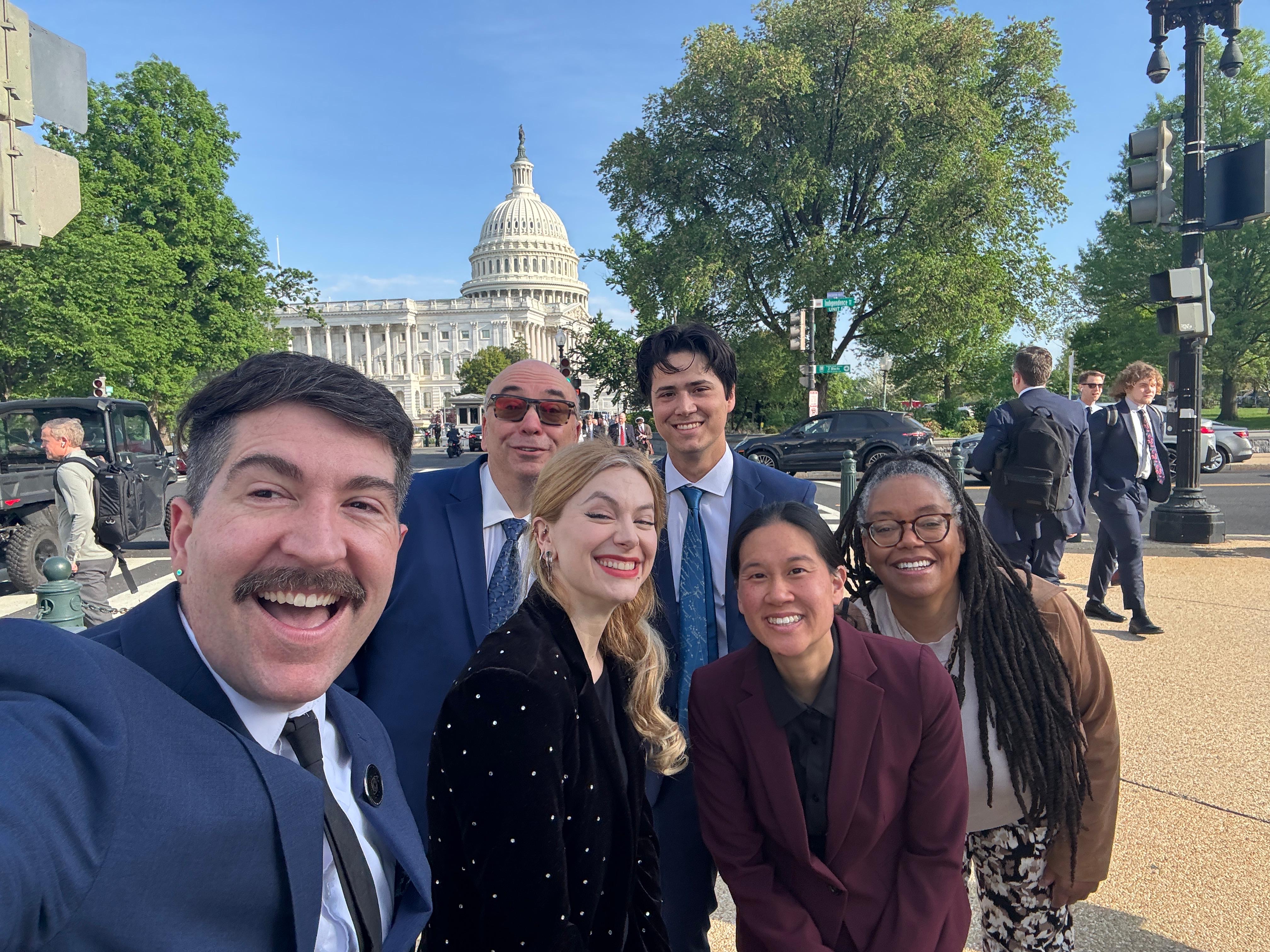
Here is some of what is in the White House’s proposed cuts within the PBR FY27:
- 47% cut to NASA science (this also includes the termination of NASA’s Office of STEM Engagement)
- 55% cut to the National Science Foundation (NSF; this also includes a 64% cut to NSF STEM Education)
- 13% cut to the Department of Energy (DOE) Office of Science
These are not line-item reductions. They are structural dismantlings that would derail active scientific missions and research, destabilize the current scientific workforce, and gut the already struggling pipelines training the next generation of American STEM professionals.
Further, even though the space sector has expanded voluminously since 1958 and is now projected to be a $1.8 trillion global industry by 2035 (World Economic Forum & McKinsey & Company, 2024), many researchers are concerned about US students’ science performance, their interest in entering the STEM workforce, and the strength of our K–12 STEM pipeline. On the heels of the recent NASA Artemis II mission, the demand is concrete and relevant: NASA's Artemis program projects a need for 10,000 STEM graduates, and workforce officials have signaled that supply will likely fall short (Butow et al., 2020; Dreier, 2026). California — the most populated state in the US — was already failing its STEM pipeline before the current proposed federal cuts, producing only ~11 qualified physics teachers per year against a need of 227, meeting less than 5% of demand and ranking 39th in the nation (PhysTEC, 2020).
If we are not supporting a robust, innovative, and diverse STEM pipeline at the K–12 level, and the current political climate is driving away the international talent that has long fueled American innovation, then who will go to university to study STEM and become future scientific leaders, innovators, and professionals? What will happen to the US economy if we stop investing in our future, knowing that American economic prosperity and STEM innovation have always been inseparable?
Many may argue that education belongs only in the hands of the states and that the federal government should stay out, but science education is not a state-level issue. It is a global competitiveness issue. If the US wants to compete on the global stage and be a leader on the ground and in space, then it needs to invest in STEM education at all levels. Regardless of your feelings about Eisenhower's National Defense Education Act, its investments galvanized the country, defined a national zeitgeist, inspired a generation through the Apollo era, and took the US along a path that launched it as a global leader in STEM and economic prosperity. Today, our federal leadership wants to take us somewhere else entirely. The FY27 PBR is not a minor trim. It is a historic reversal. Where are they taking us?
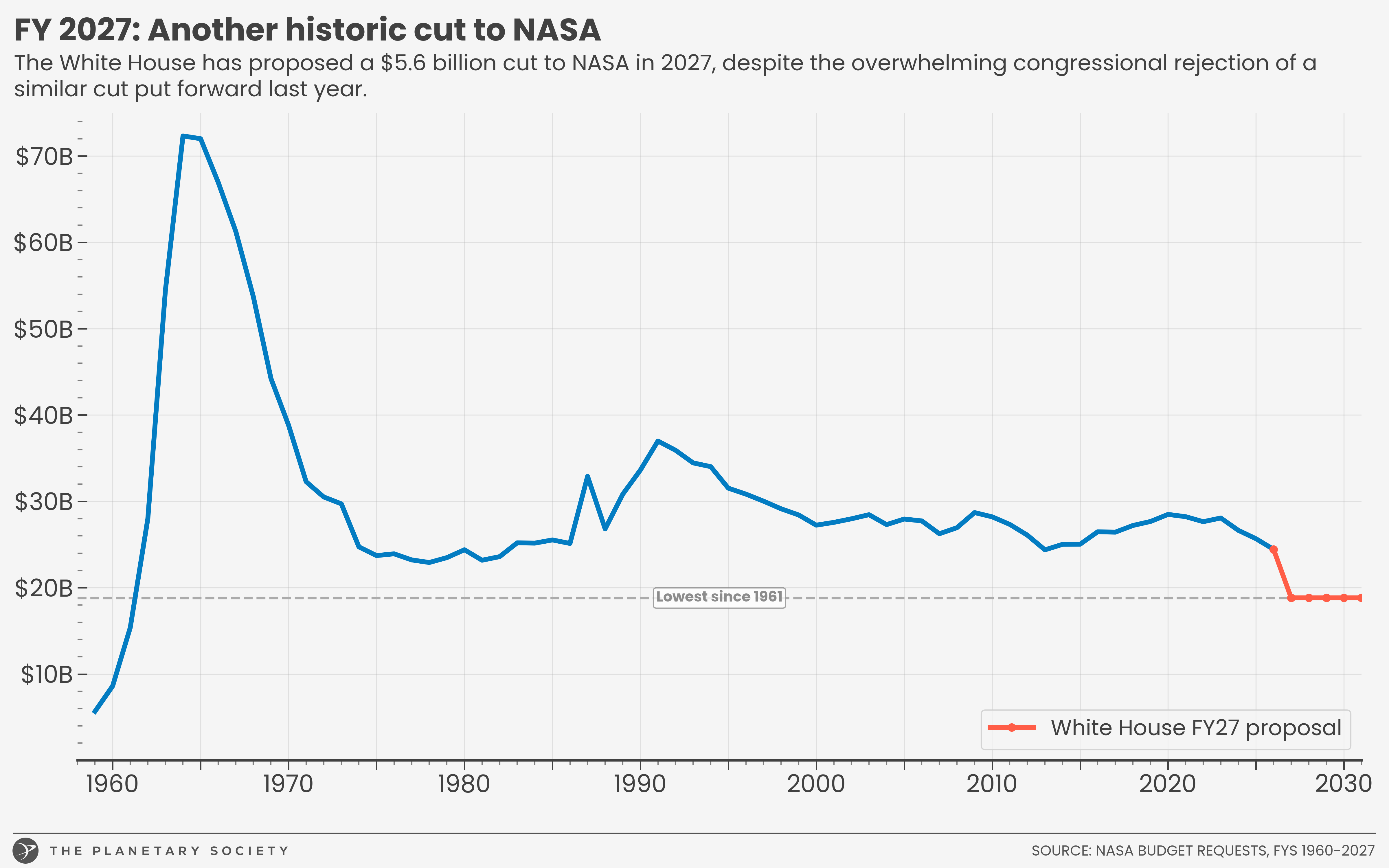
AAS and AAPT Fight Back to Save Science
Each year, the AAS selects scientists and educators from across the country to engage in Congressional Visits Day (CVD), where participants spend two days training with leaders from NASA, NSF, and DOE, sharpening their message with congressional staffers, and then on the third day taking that message directly to Capitol Hill. This year, the AAS partnered with AAPT to broaden CVD participation among our nation's science teachers, helping communicate the critical importance of science and education programs to Congress.
I was selected to participate in CVD for my unique position as both a scientific researcher (PhD astronomer and Affiliate Researcher with the SETI Institute) and a public high school astronomy teacher at Griffin Academy High School in Vallejo, California. I saw this as a rare opportunity to learn about federal science funding and advocacy firsthand, share the impact of these proposed cuts on my research and teaching, and bring the voices of my school's faculty and students directly to Congress.
Before leaving for DC, I surveyed Griffin Academy's faculty and staff. Every respondent rated federal investment in both STEM research and STEM education as important or critically important. Three themes emerged clearly:
- Resource gaps: Students lack basic lab equipment, functioning technology, and materials that schools in wealthier communities take for granted.
- Teacher capacity: Educators are stretched thin without adequate time, staffing, or professional development to meet diverse student needs.
- Equity: In communities like Vallejo, every year of inadequate investment widens the gap further.
Griffin Technology Academies Superintendent Nick Driver spoke to what adequate scientific investment could mean for our students at Griffin Academy: "Our students currently do not have the full resources to become scientifically literate. Without more scientific grant funding, we will fall behind countries that are investing in science like China. We want students from low-income backgrounds like those in Vallejo to be able to win the science jobs of the future."
I ran a similar survey with my high school astronomy and physics students. The results echoed their teachers, and were just as urgent:
- Access and inspiration: Students described astronomy as the class that reignited career dreams they'd abandoned.
- Missing classes entirely: Multiple physics students flagged having no chemistry teacher, which is a gap that will follow them into college.
- Being heard: "The voice of the American youth should be heard by those which represent us." — Griffin Academy student
Worth noting: Astronomy was dropped from the standard US curriculum in 1892 and never restored despite our current booming space economy and surging public interest in space and astronomy. Today less than 12% of US high schools offer it (Krunenaker, 2009). Griffin only recently added astronomy, and already students are writing to their senators about why it matters.
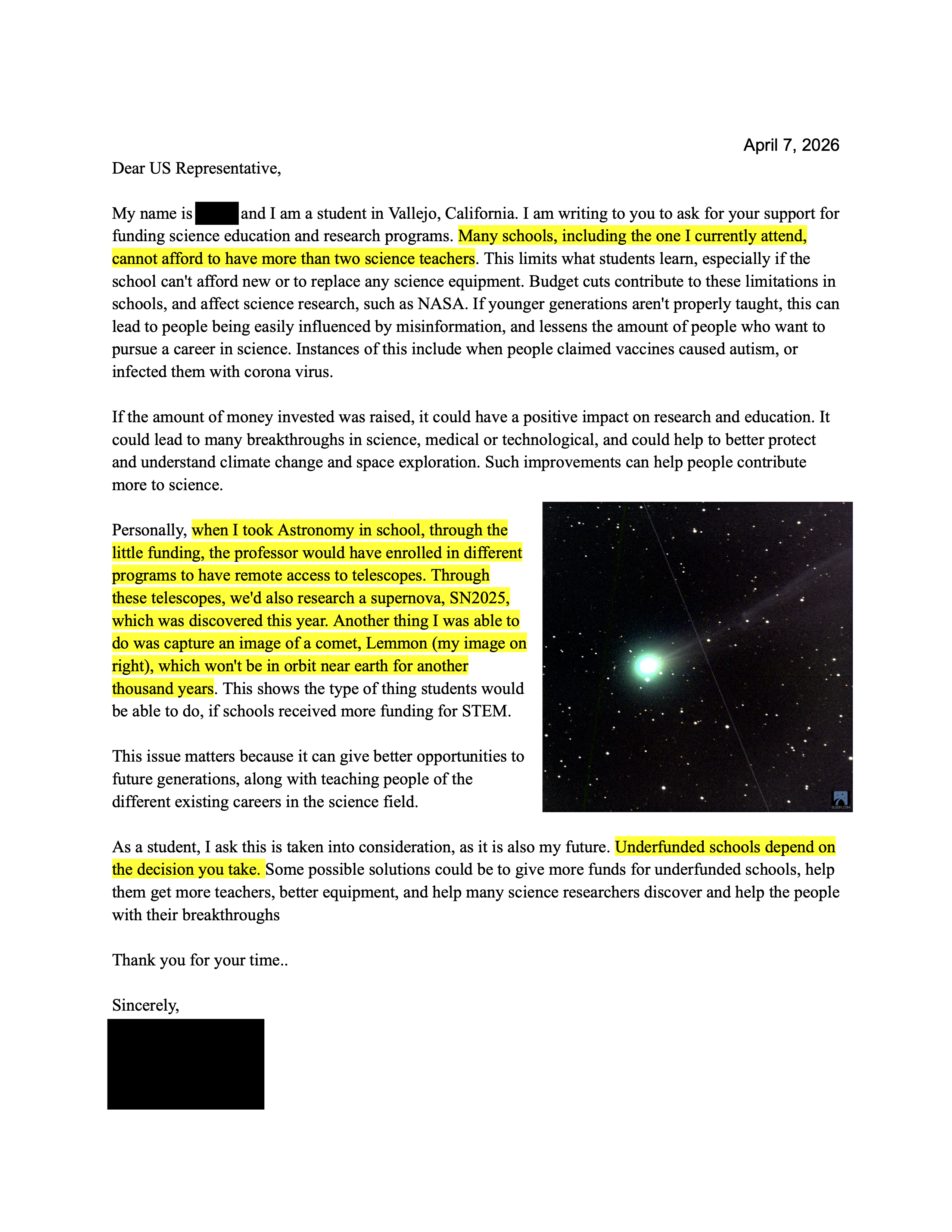
Beyond the surveys, several students went further. Inspired by the stakes, students in my high school astronomy class and in colleague Ms. Stephany Vallejo's high school government class wrote personal letters to California Senators Schiff and Padilla and Vallejo's District 8 Representative, Congressman Garamendi. Two are shared below, with key passages highlighted and names and signatures redacted for privacy.
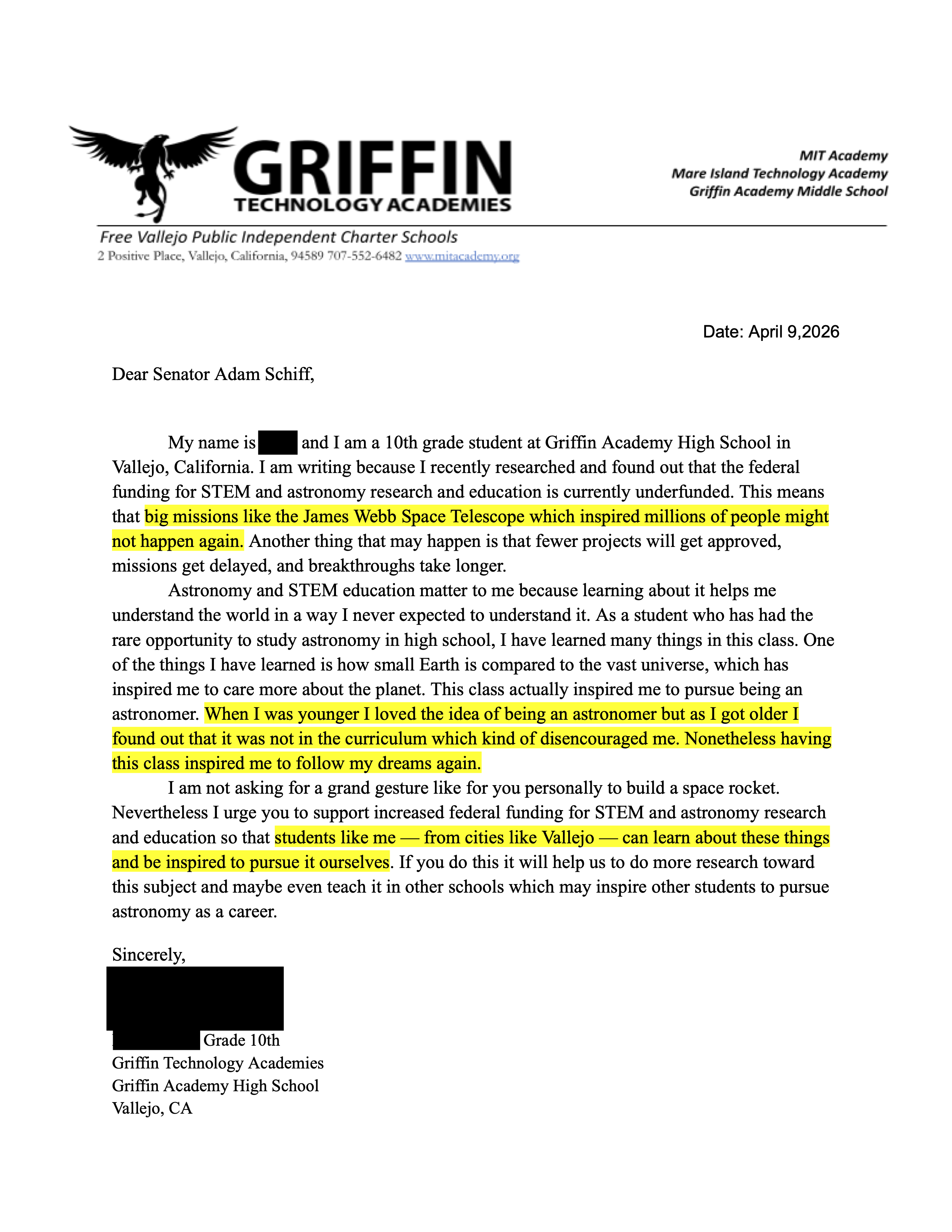
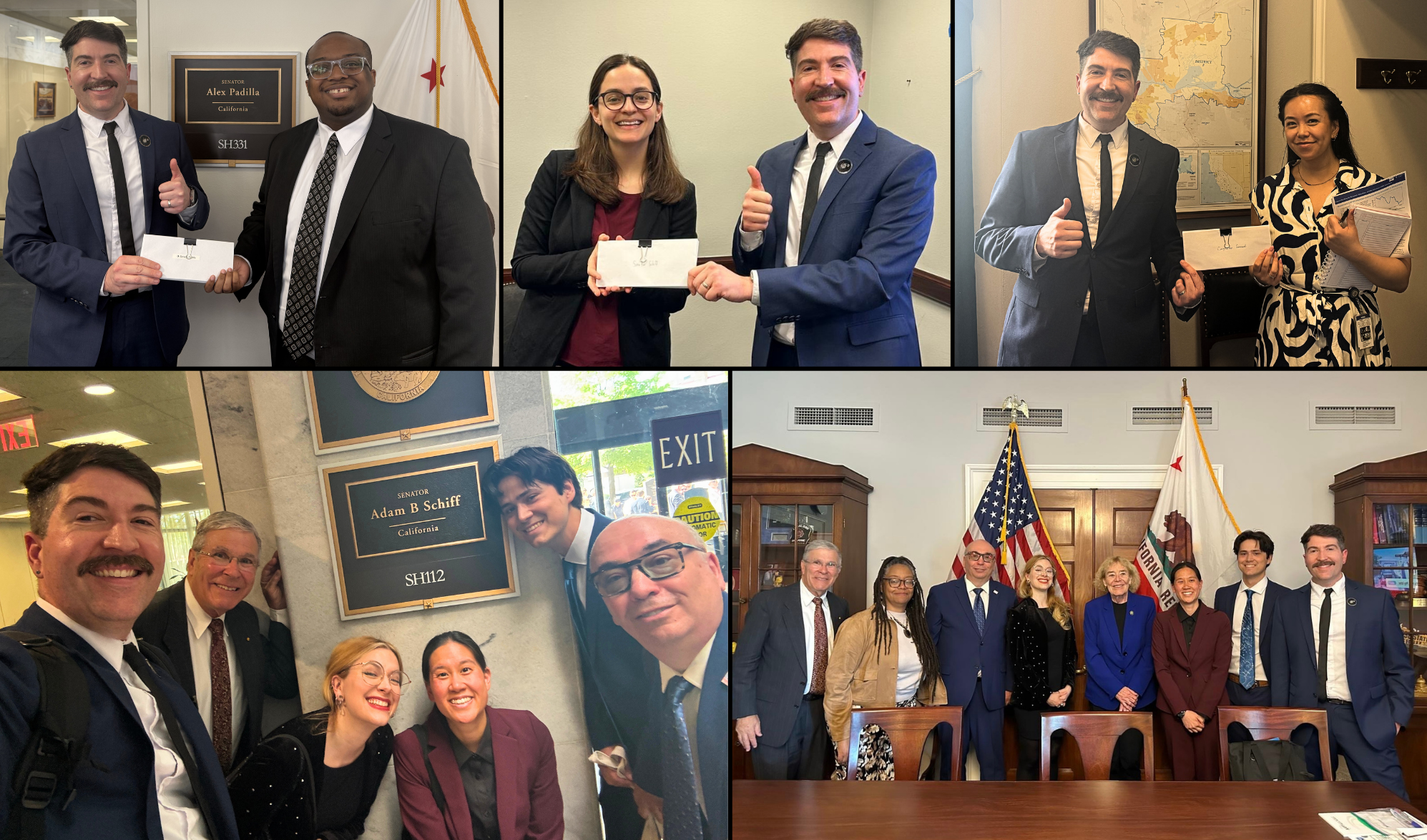
I personally carried these and all 51 student letters to DC and hand-delivered them to the offices of Senator Schiff, Senator Padilla, and Representative Garamendi. Direct meetings with them were not possible since staffers handle most constituent visits, but constituent letters are among the most powerful leave-behinds an advocate can bring, especially when they come from America’s youth.
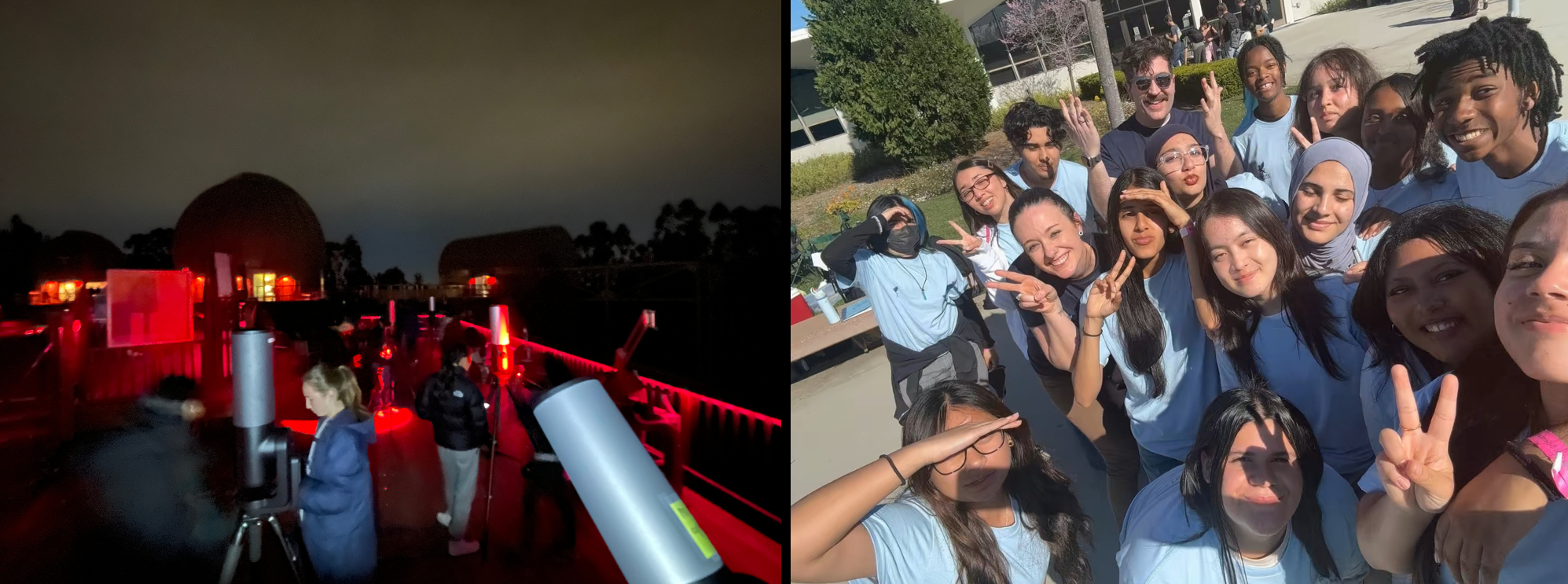
This is not just a story of what we stand to lose. It is a story of what becomes possible when we invest. In 2023, I worked with Bay Area high school students in Chabot Space and Science Center's Galaxy Explorers program (Oakland, CA) who contributed to the peer-reviewed confirmation of a new exoplanet, TIC 139270665b, becoming co-authors in The Astronomical Journal alongside 27 citizen scientists from around the world (Peluso et al., 2024). The experience inspired students and adult citizen scientists alike, and for some, sparked a path toward a science career. This was made possible by a philanthropic grant from the Gordon and Betty Moore Foundation. It is exactly the kind of program that federal investment should be scaling up, not leaving to philanthropy alone. Griffin Academy's Science Olympiad team had a similarly inspiring moment at this year's California regional competition, but it also encountered the resource gaps that follow under-resourced schools: no transportation funding, limited equipment, and teachers already stretched too thin. Federal investment in programs, equipment, and teacher support would give more American students opportunities like these and help build the next generation of STEM leaders our country depends on.
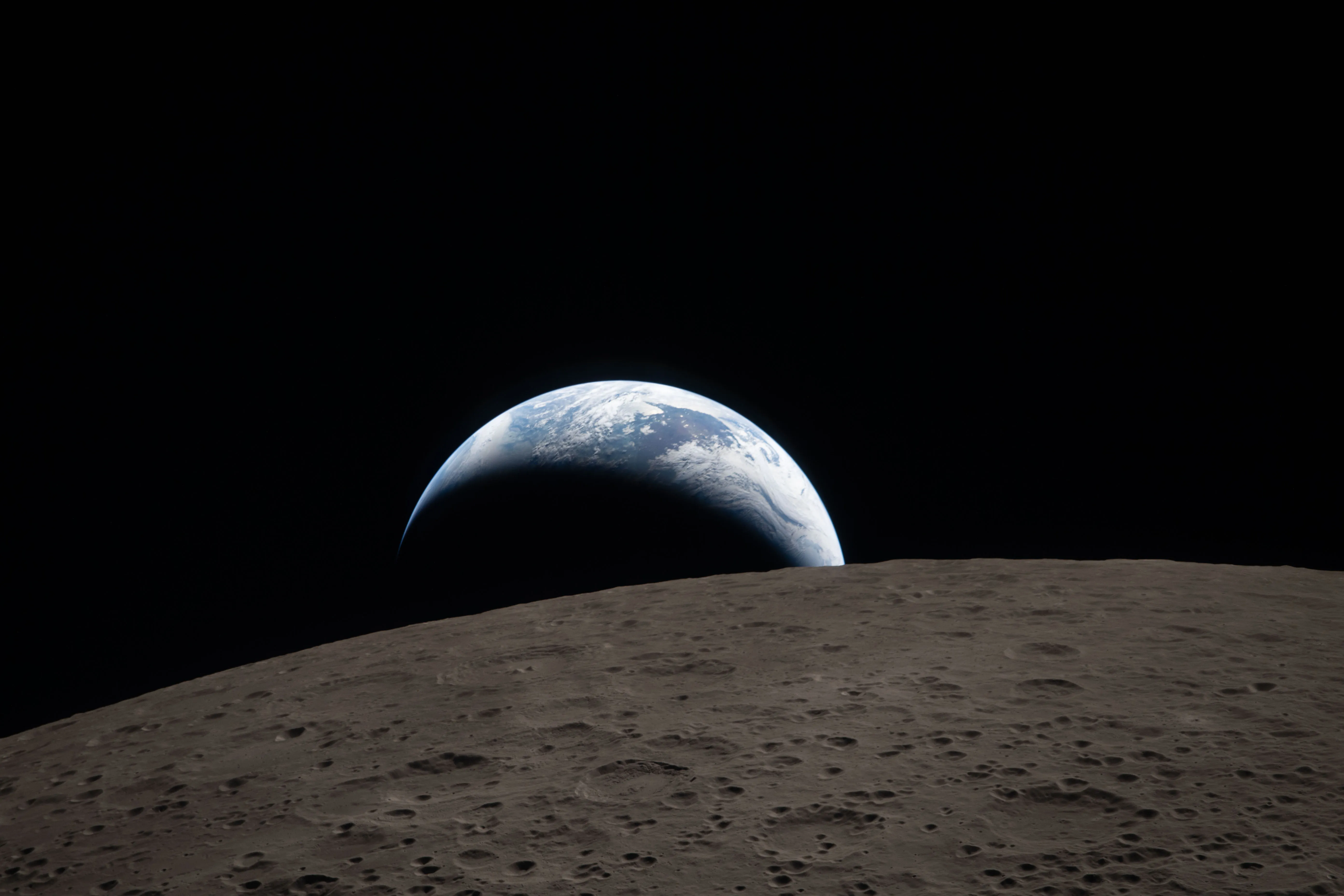
Consider the image of our home planet Earth setting below the lunar horizon, coined “Earthset” by NASA's Artemis II astronauts who photographed it on 6 April 2026, just days after the White House proposed gutting the agency that made it possible. NASA just took us back to the Moon and inspired a generation for less than half a penny of every US citizen’s paid tax dollar. The FY27 request would cut that to roughly a quarter of a penny — the smallest share of the federal budget since 1961, the year we were just beginning to reach for the stars.
Consider my students at Griffin Academy: inspired by astronomy, hungry to pursue science, but struggling to navigate a K–12 system that underinvests in them. Consider that California needs 227 physics teachers and is only producing 11. Nationally, of the approximately 1,400 new physics teachers hired each year, only 35% have a degree in physics or physics education (American Institute of Physics, as cited in Physics Teacher Education Coalition, 2025). Our STEM pipeline is not struggling. It is collapsing.
The federal agencies (e.g., NASA, NSF, DOE) that inspire us, drive innovation, employ STEM professionals, and support our nation's teachers and students are already underfunded. As a high school teacher, I see and feel this firsthand — in the burnout, the turnover, and culture that too often treats teaching as a fallback and then blames teachers when the system it starved stops working. American culture has a saying: those who can't do, teach. The ancient Greeks, particularly Aristotle, flipped that logic entirely: those who understand, teach. What if we took that seriously? What if we invested in our K–12 teachers the way we invest in the things we actually value? Rejecting the FY27 PBR is only the beginning. The deeper question is what kind of future we want, and whether we're willing to invest in the people who will build it.
How much is America's future worth? If you believe it's worth more than a quarter of a penny, please consider contacting your Congressional representatives and telling them today.
To learn more about the FY27 PBR and its impact on US science, read "The FY27 President’s Budget Request: NASA, NSF, and DOE Details." To take action, visit "2026 Week of Action in Support of Federal Funding for the Sciences" — the advocacy suggestions there are useful any week, not just the one highlighted.
References
Butow, S. J., Cooley, T., Felt, E., & Mozer, J. B. (2020). State of the Space Industrial Base 2020: A Time for Action to Sustain US Economic and Military Leadership in Space. https://apps.dtic.mil/sti/citations/AD1106608
Dreier, C. (2026, March 25). 3 charts that show how Artemis compares to Apollo. The Planetary Society. https://www.planetary.org/articles/three-charts-that-show-how-nasas-art…
Jolly, J. L. (2009). The National Defense Education Act, current STEM initiative, and the gifted. Gifted Child Today, 32(2), 50–53. https://files.eric.ed.gov/fulltext/EJ835843.pdf
Krumenaker, L. (2009). The modern US high school astronomy course, its status and makeup, and the effects of No Child Left Behind. Astronomy Education Review, 8(1), 1-8. https://doi.org/10.3847/AER2009042
Peluso, D. O. C., Dalba, P. A., Wright, D., Esposito, T. M., Sgro, L. A., Weaver, I. C., ... & Yue, W. C. (2024). Confirming the warm and dense sub-Saturn TIC 139270665 b with the automated planet finder and unistellar citizen science network. The Astronomical Journal, 167(4), 170.
Physics Teacher Education Coalition. (2025). TCNJ remains a national leader for producing high school physics teachers. The College of New Jersey. https://science.tcnj.edu/2025/08/27/tcnj-physics-5-award/
PhysTEC. (2020). PhysTEC report card. American Physical Society. https://phystec.org/report-card/
Planetary Society, The. (2026). FY 2027: Another historic cut to NASA [Chart]. The Planetary Society. https://www.planetary.org/press-releases/the-planetary-society-urges-co…
World Economic Forum & McKinsey & Company. (2024, April 8). Space: The $1.8 trillion opportunity for global economic growth. World Economic Forum. https://www.weforum.org/publications/space-the-1-8-trillion-opportunity…
Related Posts
Inside the Web of Policy: A High Schooler’s Experience in Advocacy
9 Jul 2025
Thamarie Pinnaduwage, a high school senior from Northern Virginia, shares her experiences shadowing the AAS public policy team for two weeks.
Rocket Science Needs Rocket Fuel: An Early Scientist’s Experience on the Hill
28 May 2025
Eshan Raul from the University of Wisconsin-Madison shares his experiences from AAS's Congressional Visits Day.
Space at Stake: Texas Astronomers Take Stand Against Government Cuts
21 May 2025
Avery Abramson from the University of Texas at Austin shares her experiences from AAS's Congressional Visits Day.
Empowered by Advocacy: My Experience at the 2025 AAAS CASE Workshop
16 Apr 2025
Faith Simmons shares her experiences at the AAAS Catalyzing Advocacy in Science and Engineering (CASE) workshop.
Science Takes a Village
8 May 2024
Each year, the AAS brings volunteers to Washington, DC, to learn how to advocate for science as part of our Congressional Visits Day (CVD). In this guest post, Lindsey Wiser describes her experience at this year's CVD.