Impacted Members/Scientists: Request a membership waiver, seek meeting support, and other resources. Learn more. For the latest public policy updates, please visit this page.




21 May 2025
Space at Stake: Texas Astronomers Take Stand Against Government Cuts
Avery Abramson The University of Texas at Austin
Astronomers across Texas are raising alarm over proposed government budget cuts that could cripple the state’s leadership in space science.
Texas is a powerhouse for science, technology, engineering, and math (STEM) in the United States. According to the National Center for Science and Engineering Statistics, Texas’ total research and development performance reached $37.26 billion in 2021, ranking fifth nationally.
Texas is also known for its impact on the space sciences, which is spearheaded by the University of Texas System. In JWST’s first year of operations, University of Texas at Austin astronomers earned 10% of its coveted data collection time. The University of Texas at Rio Grande Valley (UT-RGV) also played a pivotal role in detecting gravitational waves, earning three physicists the Nobel Prize in 2017.

Much of this was made possible by funding from the National Science Foundation (NSF) and the NASA Science Mission Directorate (SMD). However, budget cuts for these government agencies threaten to impede Texas’ strong presence in aerospace and astrophysics.
The skinny President’s Budget Request (PBR) proposes 47% and 55% cuts to SMD and NSF budgets, respectively. If Congress adopts the PBR proposals, the US’s national competitiveness in space exploration may falter, allowing countries like China to dominate in its place. China has already surpassed the US in the number of scientific articles published each year, and the PBR may cause the US to lose a majority of its global STEM influence.
But, not all hope is lost. Although the PBR has caused concern, the president does not have the final say in how the government funds science — Congress does.
Space scientists have been fighting back by advocating to their congressional representatives and the House Appropriations Committee. Calls to action have included writing letters, sending emails, and making phone calls to explain why funding STEM is important. An especially significant call to action was participating in Congressional Visits Day (CVD), hosted by the American Astronomical Society. The event allows STEM professionals to advocate for funding for the space sciences by visiting their congressional representatives in Washington, DC.
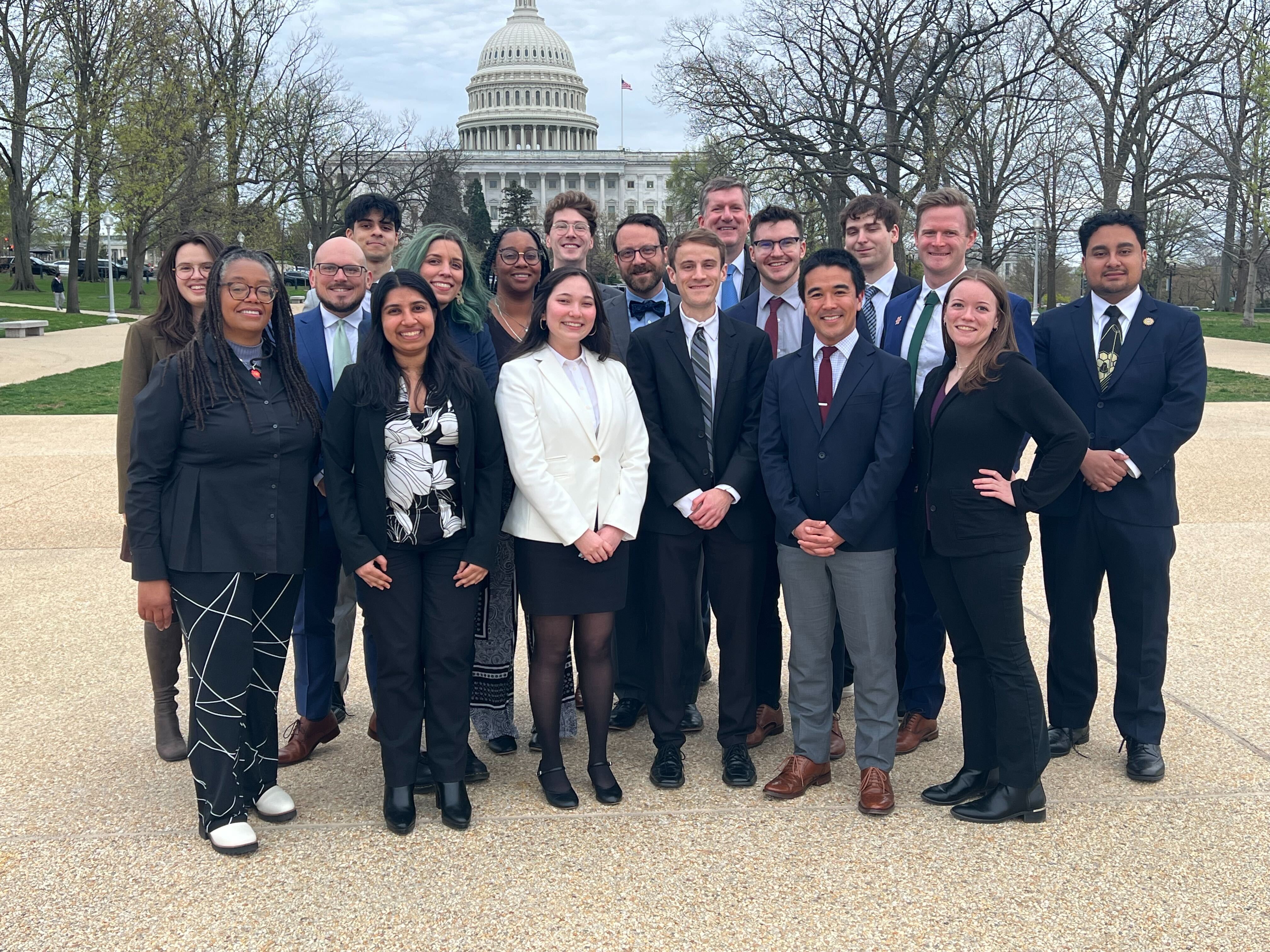
Three constituents represented CVD’s Team Texas, including Ryan Oelkers, a professor from UT-RGV, and Emma Louden, a graduate student from Yale.
For two days before the event, participants learned about AAS policy priorities. An important lesson was ensuring “no harm is done,” as said by AAS John N. Bahcall Public Policy Fellow Colin Hamill.
“While we want to make sure there’s funding for what we do, we also want to make sure that we don’t defund other sciences in the process,” Hamill said. “If one of our fields goes down, then we’ll eventually go down with them.”
During CVD, Team Texas met with six congressional offices representing areas surrounding UT-Austin and UT-RGV. Team Texas’ final meeting was at the office of Sen. Ted Cruz (R-Texas), where they met with two science committee members. During this meeting, Team Texas discussed their concerns about the NASA Transition Authorization Act of 2025, which guarantees government support for certain NASA missions. However, the bill did not include support for the Habitable Worlds Observatory.
Following the meetings, participants continued their advocacy by writing blog posts and hosting their own policy events at their institutions, similar to CVD. Representatives Don Bacon and Judy Chu are also leading a bipartisan “Dear Colleague” letter in support of $9 billion for NASA SMD. So far, 83 House representatives have signed the letter, which will be submitted to the leadership of the House Appropriations Subcommittee on Commerce, Justice, and Science.
"It’s a real honor to work in Congress alongside so many people who are committed to space programs,” said US Rep. Mike Haridopolos (R-Florida), during a live Zoom address to the participants. “We want to make sure the United States has the ultimate high ground. And, of course, that ultimate high ground is in space."
Related Posts
Empowered by Advocacy: My Experience at the 2025 AAAS CASE Workshop
16 Apr 2025
Faith Simmons shares her experiences at the AAAS Catalyzing Advocacy in Science and Engineering (CASE) workshop.
Science Takes a Village
8 May 2024
Each year, the AAS brings volunteers to Washington, DC, to learn how to advocate for science as part of our Congressional Visits Day (CVD). In this guest post, Lindsey Wiser describes her experience at this year's CVD.