Impacted Members/Scientists: Request a membership waiver, seek meeting support, and other resources. Learn more. For the latest public policy updates, please visit this page.




9 July 2025
Inside the Web of Policy: A High Schooler’s Experience in Advocacy
Thamarie Pinnaduwage
McLean High School
I never expected to find myself in the world of science policy, especially not as a high school senior. I always gravitated towards the precision of chemistry or the logic of mathematics, while government and politics felt abstract and inaccessible. My AP Government class frequently consisted of watching the clock, in hopes of returning to the comforting complexities of labs and equations. Wrestling amendments into my head before exams felt like excessive short-term memorization lacking long-term relevance. Even though I regularly followed the news, politics seemed distant — something I observed but could never influence.
That sense of separation was shattered when I received startling news: the National Institutes of Health summer research internship I applied for was cancelled due to federal funding cuts. Looking into the change, headlines regarding slashed science funding flooded my screen. For the first time, politics didn’t feel abstract. It felt personal, shaping my opportunities, field, and future.
In the wake of the disappointment, I reached out to Roohi Dalal, Deputy Director of Public Policy at the American Astronomical Society (AAS). The outreach culminated in the opportunity to shadow both Roohi Dalal and Colin Hamill (John N. Bahcall Public Policy Fellow) for two weeks — a truly transformational experience.
Week 1:
My first day began with a crash course on all things government, policy, and how the AAS operates. Colin Hamill kindly explained everything, from the federal budget process and the role of appropriations committees to the various advocacy strategies employed by the AAS. He patiently answered my numerous questions as I attempted to decode the seemingly endless acronyms and policy jargon. To my surprise, some of my AP Government knowledge was relevant! However, I realized just how much there was to learn. The policy world appeared to be a web — intricate, interconnected, and nearly impossible to untangle. Every issue required a nuanced approach, and meaningful change often relied on the collaboration of many.
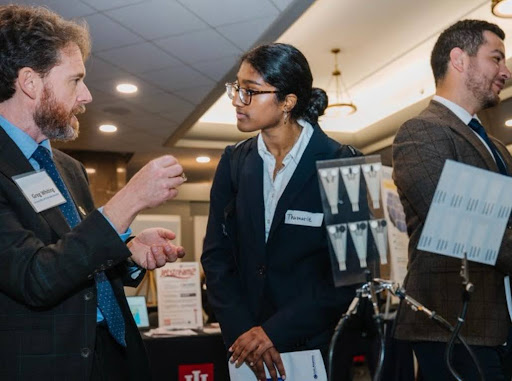
In the first week, I started navigating the interwoven threads. I developed a one-pager on Science Funding in Virginia to prepare for meetings with my congressional offices, learning that 26% of jobs in the state are related to Science, Technology, Engineering, or Math (STEM), and over 2,000 researchers rely on federal funding. These numbers highlight the significant role science plays in Virginia’s economy and the potential impact of funding cuts to NASA and the National Science Foundation (NSF) on students, teachers, and researchers at all levels. I also helped review messages from AAS members to their members of Congress, urging their representatives to sign the NSF and NASA Science Dear Colleague letters. The responses were deeply personal, reflecting on missions that would cease to launch, students who would lose access to mentorship, and the many careers now at risk. I was struck by their vulnerability and moved by the clarity of their calls to action. These themes were echoed at the Coalition for National Science Funding (CNSF) showcase, where I met researchers from across the country who presented their NSF-funded work, extending from novel sustainable agriculture techniques to cutting-edge gravitational wave research. I ended the week attending the House Committee on Science, Space, and Technology’s Subcommittee on Space and Aeronautics hearing titled “From Detection to Deflection: Evaluating NASA’s Planetary Defense Strategy.” It was fascinating to watch how the NASA official and scientists navigated questions regarding strategy, science, and budget. As I watched the policy unfold live, the web of concepts suddenly didn’t seem quite as foreign.
Week 2:
The second week was slightly different, as I spent most of my time listening in on conference calls, trying to keep up with the flurry of new terms that never ceased to appear. I scribbled down the concepts, watching my “Things to Google” list grow longer with every minute as I began puzzling out how advocacy happens behind the scenes. I attended a few meetings with the Committee for the Protection of Astronomy and the Space Environment (COMPASSE), where members were drafting letters to Congress, blending their scientific expertise with strategic policy perspectives. One letter focused on protecting radio bandwidths from commercial interference caused by government spectrum auctions, which threatened to compromise crucial astronomical data. Observing how the members effortlessly combined science with advocacy was inspiring. Their efficient collaboration helped me realize just how many individuals were involved, all ready to take action. Furthermore, with each conference call, I watched the complexities of policy become clearer and clearer.
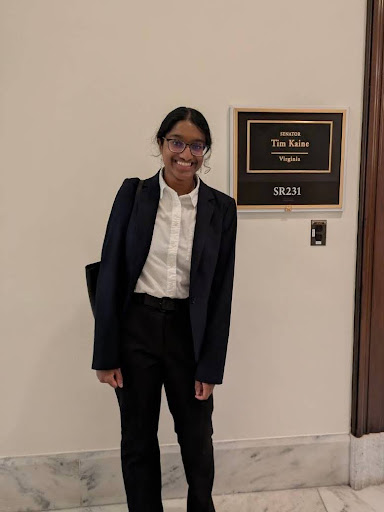
These conversations helped prepare me for the final tasks, including meetings with the offices of Senators Warner and Kaine, as well as Representative Beyer. Nervously treading into the offices with Roohi Dalal’s extensive coaching in mind and my one-pagers in hand, I was surprised by the friendly and optimistic faces that greeted me. The staffers seemed to genuinely listen, asked thoughtful questions, and even made space for mine. I even found myself fluently using a few of the acronyms I had previously scribbled down with confusion. I had expected the experience to feel intimidating, but instead, it felt human.
Before this experience, I believed that policy was solely a world for experts, something I would read on the news, but never shape. However, my time at the AAS changed this. I realized that taking action isn’t as impossible as it appears to be. The policy web that once seemed overwhelming now feels more like a map. It remains intricate, full of twists and tangles, but now I see how those threads hold everything and everyone together. They connect researchers to lawmakers, students to scientists, and citizens to crucial decisions. I may have started out unsure of how anything worked, but I left knowing that my voice matters. Advocacy is for everyone, and this is just the beginning.
Related Posts
Rocket Science Needs Rocket Fuel: An Early Scientist’s Experience on the Hill
28 May 2025
Eshan Raul from the University of Wisconsin-Madison shares his experiences from AAS's Congressional Visits Day.
Space at Stake: Texas Astronomers Take Stand Against Government Cuts
21 May 2025
Avery Abramson from the University of Texas at Austin shares her experiences from AAS's Congressional Visits Day.
Empowered by Advocacy: My Experience at the 2025 AAAS CASE Workshop
16 Apr 2025
Faith Simmons shares her experiences at the AAAS Catalyzing Advocacy in Science and Engineering (CASE) workshop.
Science Takes a Village
8 May 2024
Each year, the AAS brings volunteers to Washington, DC, to learn how to advocate for science as part of our Congressional Visits Day (CVD). In this guest post, Lindsey Wiser describes her experience at this year's CVD.