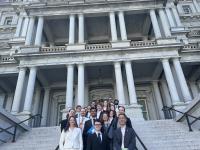
Impacted Members/Scientists: Request a membership waiver, seek meeting support, and other resources. Learn more. For the latest public policy updates, please visit this page.




28 May 2025
Rocket Science Needs Rocket Fuel: An Early Scientist’s Experience on the Hill
Eshan Raul University of Wisconsin–Madison
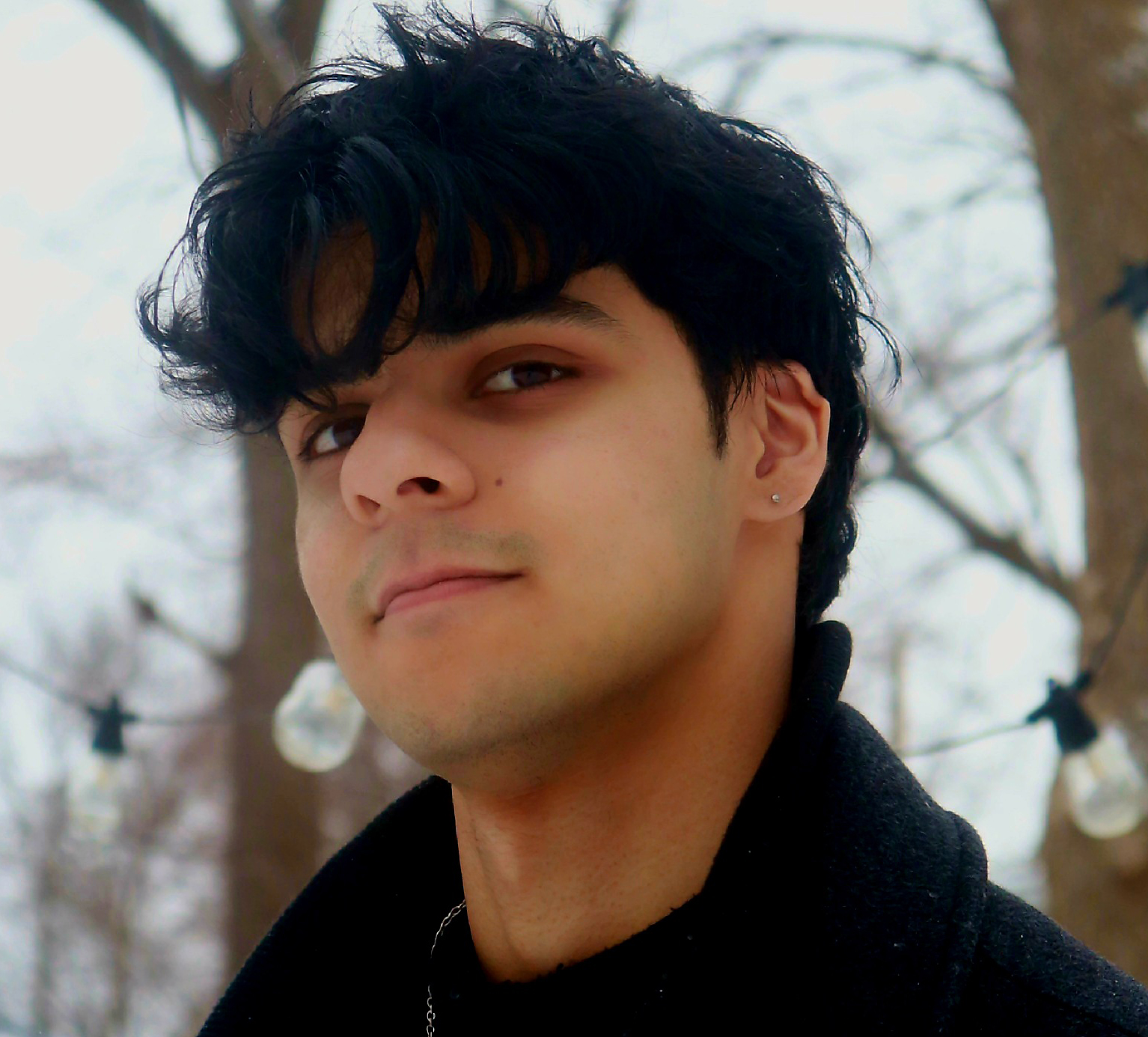
The heart of the machine that powers America has always felt like a distant place to me. Yet even growing up in a Midwest town like Livonia, Michigan, I could understand that, in some upstream sense, my life was being impacted by the decisions being made there. However, local politics was not something I directly engaged with: the faces I saw on television political ads seemed relevant for the duration of the election season, after which I seldom heard much about them. The taboo of "talking politics" only added to the mystique. However, as I began dedicating my life to science, it was only a matter of time until I discovered just how far-reaching the government’s grasp is over what research gets done and, more importantly, whether it gets done at all.
I began my astrophysics journey later than most. Unlike a love for space that began in childhood or a penchant for Star Wars or Star Trek, I started as an engineering student at the University of Michigan, but eventually fell in love with the subject thanks to outreach efforts both within and outside the university. However, being able to dive into astronomy research as an undergraduate at one of the country's largest research institutions, I didn’t realize how fortunate I had been. Research projects were abundant, and I was privileged enough that the sources of funding for them were not even a distant concern.
Now, stepping into a PhD program at the University of Wisconsin–Madison, in which funding directly shapes the progress I can make each semester, the process has become forcefully demystified. While securing funding is already challenging in academia, even for tenured faculty members, the currently fractured and unstable political landscape has added another layer of uncertainty to an already delicate system. I’ve personally known people who have had their program admissions rescinded or current funding canceled. Places like Michigan State University have already canceled their summer physics Research Experiences for Undergraduates for this year due to a lack of federal funding, which disproportionally affects students at smaller institutions who use these programs to explore their scientific interests at R1 universities. Even further, I’ve watched friends and colleagues both look for and actively move to Canada and Europe for opportunities and positions with stronger job security. As I found these feelings began to grow within me as well, I realized that such decisions aren’t necessarily rooted in any anti-American sentiment, but rather reflect a rational response to an unsustainable environment; nobody wants to uproot their own life because of someone else’s decisions. Yet, personally, or even selfishly, the number of opportunities I will be able to apply for my own funding will be extremely limited if the currently suggested budget cuts were to come to fruition. Thus, armed with a rudimentary understanding of the federal funding process and a wary curiosity of DC, I made a commitment to myself to take a more active role in science advocacy.
The AAS’s Congressional Visit Day (CVD) was the perfect opportunity for me to bring the science I care about into the political arena. Before even setting foot in the nation’s capital, we were tasked with reaching out and scheduling meetings with the offices of each of our state senators and district representatives. In doing so, I expected a maze of bureaucracy, but what I found instead was a surprisingly human process. Some offices responded quickly, while others required a few follow-ups; however, I quickly found that it was no different from emailing anyone else to set up a meeting: just two people trying to find a time that worked for both of us. Suddenly, these once-distant representatives weren’t the abstract, intangible forces I had initially thought; rather, they were groups of real people just a few states over, representing the values they believed in, regardless of what those happened to be. As these dialogues became real appointments on the calendar, I realized that as a constituent, I was genuinely looking forward to meeting my representatives.
During the first two days of CVD, we were immersed in a crash course led by experts on the inner workings of the government, the various roles people play, and the most pressing science policy issues today. We started with the basics, such as the difference between appropriations and authorizations committees, but one fact stuck with me in particular: Congress has not passed its appropriations bills on time since 1997, meaning that it hasn’t even happened once in my lifetime. This simple fact helped dispel any remaining illusion that the government was a well-oiled machine; in many ways, the scientific organizations I’m used to interacting with operate much more efficiently than the government does. We then explored several traditional policy issues affecting astronomy as a whole, including light pollution, unregulated satellites contaminating observations, and the threat of Kessler Syndrome. While these immediate and urgent problems would be the primary topics of advocacy during a typical year, the threat of defunding science overshadowed them almost completely; none of these issues matter if there aren’t scientists left to work on them. Based on the energy in the air during our presentations, it seemed that everyone else in the room understood this too.
However, what stuck with me the most was the idea of how to communicate the importance of science to those who do not actively participate in it. It’s a fine balance to respectfully communicate scientific ideas to non-scientific audiences while simultaneously not presenting our funding as an entitlement. For example, instead of criticizing private space technology companies, one could explain why the gap in funding for NASA and NSF cannot be simply funded by universities or the private sector by pointing to simple, memorable facts. In 2023, NASA stimulated the economy with a 3:1 economic return for every federal dollar invested, something that cannot be achieved by private companies, who won’t invest in basic research due to its long-term ROI. Furthermore, outside of my own personal stake in the funding of space science, personal stories help. Astronomy is a “gateway” science for many people: it’s exciting, and inspires kids to dip their toes into science, even if it isn’t directly related to space. I realized that science is not even a bipartisan issue; it’s truthfully a non-partisan non-issue that most people support, and framing it as such is the kind of approach that works better when talking to the bureaucratic minds of congressional staffers on Capitol Hill. We were told that if we were to do all these things well, we’d experience the ever elusive but immensely rewarding feeling of actually being heard as a scientist.
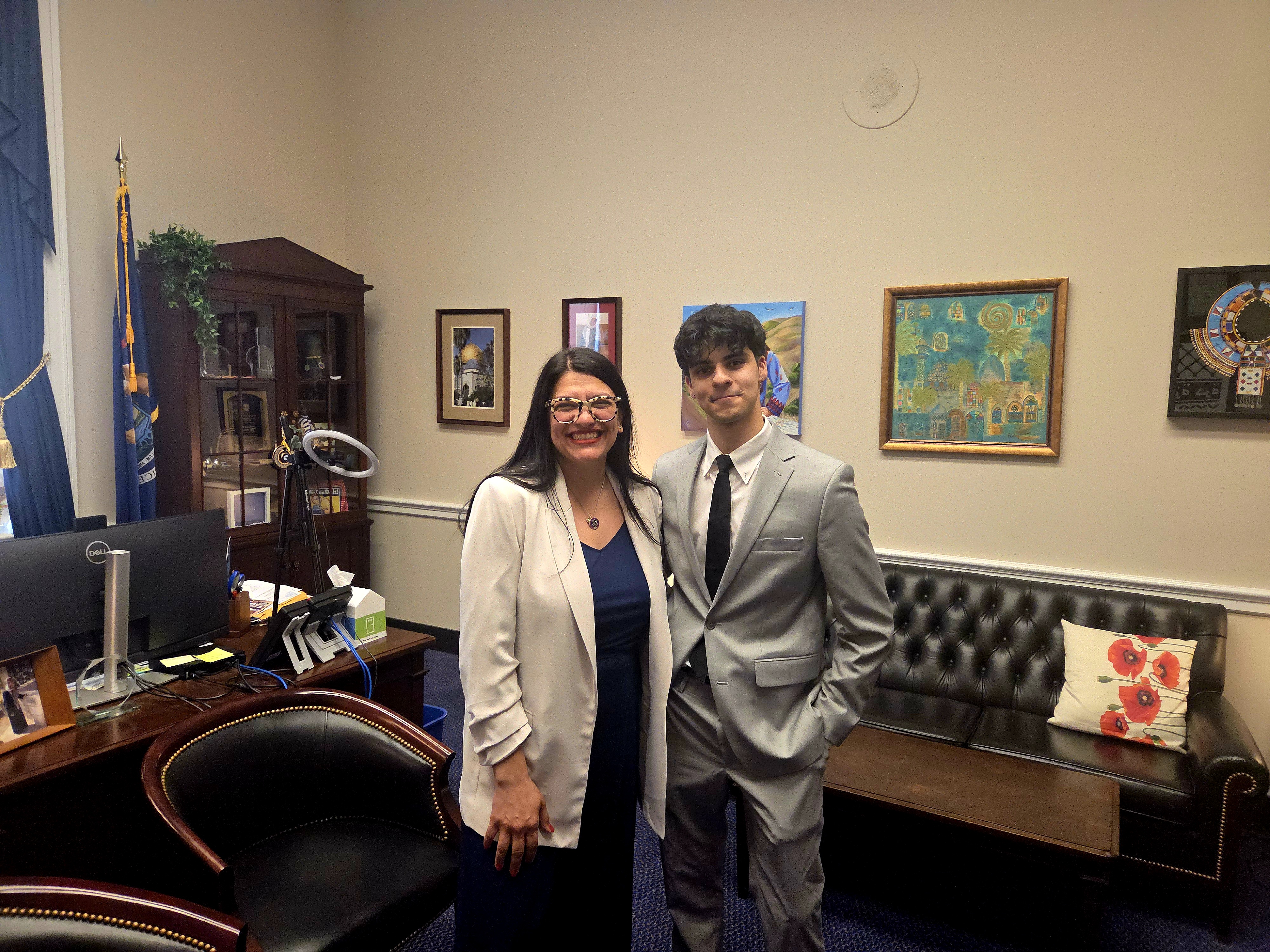
On the third and final day came our long-awaited visits to the Hill. I was teamed with a group of other AAS CVD volunteers from the Midwest, and together we would accompany each other to meetings to provide support and amplify our message. What stood out immediately was the age of many of the staffers we were meeting, often my age or even younger, with varying levels of familiarity with science. Some offices had no dedicated science staffer and virtually no involvement in science legislation at all, while others showed genuine interest and even personal passion for the sciences. Over the course of the day, we got the full range of experiences, from eager staffers taking lots of notes, a brief greeting from an Indiana senator during a constituent coffee, a knowledgeable staffer who was a former scientist, an impromptu meeting with a non-science aide in a cluttered hallway, and a staffer who was unfortunately 11 minutes late to our allotted 15-minute meeting. A cramped schedule, long lines, and the entire campus to navigate left us exhausted by the time we arrived at our final meeting. This was with the office of my own home district’s representative, and the only meeting our entire group was able to schedule with the House of Representatives. However, to everyone’s surprise, we found out at the last minute that we were meeting with Congresswoman Rashida Tlaib herself for a lengthy chat.
Instead of handing us off to one of her staffers, Congresswoman Tlaib sat down with us at a table and listened to our requests, even as she needed to prepare for another commitment. I had been told that the congresswoman would not be available for another three weeks, yet she still took the time to sit down with us and hear us out. Despite not specializing in any type of science policy, she demonstrated a sincere understanding of the power she had as a member of Congress. It was by taking the time not just to meet with us, but to be one of the few people we met with who also asked us questions, that it struck me we were really being listened to. As the meeting wrapped, one-pagers given, pictures taken, and hands shaken, I walked out of the room with that rare feeling of warmth I’d been promised, the kind that follows when you feel like you’ve truly been seen and heard.
If you’ve ever wanted to experience this same feeling firsthand, I implore you to get involved in science advocacy yourself. Whether through CVD, other advocacy organizations, or just personally reaching out to your legislators, get involved. Funding uncertainties were the primary driver in my decision to go, but there are countless other issues that need to be championed across this and other fields of science. What surprised me most from this experience wasn’t the disconnect between the decision-makers and the issues, but my own ignorance of the system I’m ultimately a part of. The ability to advocate for science to policy makers and influence science policy ensures that research remains funded, accessible, and ongoing for everyone. It's not just astronomy at stake, but all of science, and if there's anything I learned from our training, it's that science supports science. This is why I’m certain scientific advocacy will remain a part of my future. Will it be part of yours?
Related Posts
Space at Stake: Texas Astronomers Take Stand Against Government Cuts
21 May 2025
Avery Abramson from the University of Texas at Austin shares her experiences from AAS's Congressional Visits Day.
Empowered by Advocacy: My Experience at the 2025 AAAS CASE Workshop
16 Apr 2025
Faith Simmons shares her experiences at the AAAS Catalyzing Advocacy in Science and Engineering (CASE) workshop.
Science Takes a Village
8 May 2024
Each year, the AAS brings volunteers to Washington, DC, to learn how to advocate for science as part of our Congressional Visits Day (CVD). In this guest post, Lindsey Wiser describes her experience at this year's CVD.