Impacted Members/Scientists: Request a membership waiver, seek meeting support, and other resources. Learn more. For the latest public policy updates, please visit this page.





56th DPS Meeting
Meeting Program
DPS 56
56th Annual Meeting of the Division for Planetary Sciences
Boise, Idaho & Virtual
6
–
10 October 2024
Plenary & Prize Speakers

Katherine de Kleer is an Assistant Professor of Planetary Science and Astronomy and the Hufstedler Family Scholar at Caltech. Her research aims to unravel the connections between the atmospheres, surfaces, and thermochemical histories of Solar System bodies to understand their diversity and the processes that shaped them. Her work utilizes innovative telescope techniques at optical through radio wavelengths, and has covered a broad range of topics with an emphasis on the galilean satellites of Jupiter and on using main-belt asteroids to investigate early planetesimal processes. Dr. de Kleer received her Bachelors degrees in mathematics and physics from MIT in 2009 and her PhD in Astrophysics from UC Berkeley in 2017. She started at Caltech in 2017 as a 51 Pegasi b postdoctoral fellow before joining the faculty there in 2019. She was named a Kavli Fellow and a Cottrell Scholar in 2024, and is the recipient of an NSF CAREER award. She is the 2024 recipient of the DPS Urey Prize for outstanding achievements in planetary science by an early-career scientist.

Cédric Gillmann is a senior researcher and lecturer in the Geophysical Fluids Dynamics group of the Department of Earth and Planetary Sciences at ETH Zurich. He is a leading expert on Venus’ past and evolution, editor of ISSI’s “Venus: Evolution Through Time” book, and a collaborator to the science team for EnVision, ESA’s mission to Venus. Cedric’s main research interest is the long-term evolution of terrestrial planets, from their deep interior to their atmosphere. He investigates volatile exchanges and the resulting consequences regarding planetary habitability. His work includes the study of mantle dynamics, interior evolution mechanisms, atmospheric escape, atmosphere/surface/interior interaction, climate, and impact processes.
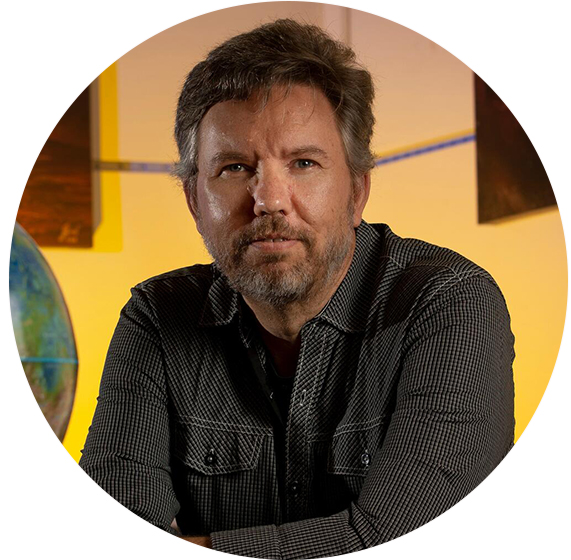
Stephen Kane is a Professor of Planetary Astrophysics at the University of California, Riverside who specializes in exoplanetary science and planetary habitability. He received his Bachelor of Science (Honours) from Macquarie University in Sydney and his Doctorate from the University of Tasmania. His work covers a broad range of topics related to planetary astrophysics and he has discovered and co-discovered hundreds of planets orbiting other stars. He is a science team member for the NASA DAVINCI mission, and is a leading expert on the topic of planetary habitability, the habitable zone of planetary systems, and the study of why Venus and Earth underwent divergent evolutions. He has published hundreds of peer-reviewed scientific papers as well as several books on the topic of planetary science and habitability. He is a prolific advocate of interdisciplinary science through the combination of biology, climate science, geophysics, planetary science, and stellar astrophysics.
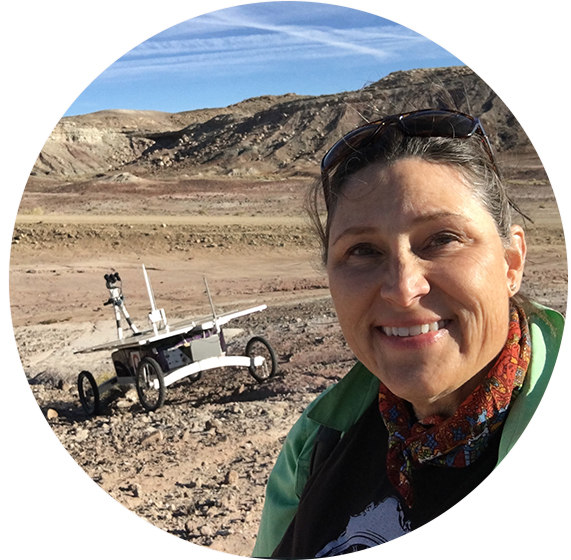
Melissa Lane is a Senior Scientist and Program Manager at Fibernetics LLC in Lititz, PA. She specializes in vibrational spectroscopy of minerals, particularly "secondary" minerals such as sulfates, phosphates, carbonates, and oxides, directed toward understanding how crystal structure, axis orientation, and particle size affect spectral shape. Dr. Lane is a Fellow of the Mineralogical Society of America and has been a Participating Scientist/team affiliate on several NASA missions including Mars Odyssey, Mars Global Surveyor, and Mars Observer. She was Spectroscopy Lead on the TREX SSERVI team, measuring fine-particulate mineral samples at the German Aerospace Center (DLR) and synthesizing all of the participating laboratories' spectral data of mineral "dust" from the far-ultraviolet through mid-infrared range. She acted as FTIR Spectrometer Lead during TREX field seasons in Arizona and Utah. Other research interests include spectroscopy of meteorites, planetary analog materials, sulfides, and synthetic pyroxenes and olivines.

Kathy Mandt is a planetary scientist working in the NASA Goddard Space Flight Center (GSFC) Planetary Systems Laboratory. She previously served as the Chief Scientist for Exoplanets and as the Astrobiology Section Manager at the Johns Hopkins Applied Research Laboratory (APL). Kathy's research covers a broad range of topics including the formation and evolution of the solar system, the role of atmospheric processes in understanding this, and the implications for understanding exoplanet atmosphere observations. Previously, she was an adjoint professor in the Department of Physics and Astronomy at the University of Texas at San Antonio and a senior research scientist at Southwest Research Institute. She has served in several community and NASA mission leadership roles, including as the project scientist for the Io Volcano Observer phase A study, the deputy project scientist for the Heliophysics Division-funded Interstellar Probe pre-decadal mission study, and is a science team member on the Europa Clipper team. She earned her PhD in environmental science and engineering from the University of Texas, San Antonio.

David Sing is a Bloomberg Distinguished Professor in the Departments of Physics & Astronomy and Earth & Planetary Science at Johns Hopkins University. His research focuses on characterizing exoplanet atmospheres, and he pioneered the observational study of clouds, hazes, and aerosols in the atmospheres of exoplanets. He continues to advance the field of planetary atmospheres with new, high-impact observations. Dr. Sing is the 2024 recipient of the DPS Alexander Prize for a mid-career scientist who has made and continues to make outstanding contributions that have significantly advanced our knowledge of planetary systems, including our solar system.

David Trang is a planetary scientist with Space Science Institute and a pre-licensed mental health counselor working as an academic coach in the Hoʻokō Rising Scholars Program at Hawai’i Pacific University. On the planetary science side, Dr. Trang focuses on surfaces processes on airless bodies, such as impact cratering, volcanism, and space weathering, as well as characterizing the composition of planetary surfaces through modeling of the visible to near-infrared. On the counseling side, Dr. Trang aids under-resourced undergraduate students with their transition to college in the first two years. His primary focus is on helping them grow academically, assisting them with developing healthy study habits, and motivating them to do their best in school. Dr. Trang has married his two interests by working on improving mental health in planetary science and helping the community create a positive and healthy work environment that promotes well-being.

Tuan H. Vu is a Research Scientist in the Planetary Science Section at the NASA Jet Propulsion Laboratory in Pasadena, California. He obtained his PhD in physical chemistry from Tufts University in 2013 and his B.S. from CUNY Brooklyn College with a double major in chemistry and mathematics. He specializes in laboratory investigations of icy planetary materials, including organic solids, clathrate hydrates, and brines under cryogenic conditions. He is a recipient of the JPL Lew Allen Award for Excellence in 2022 for pioneering experimental work on the chemical composition and geological processes of icy worlds.
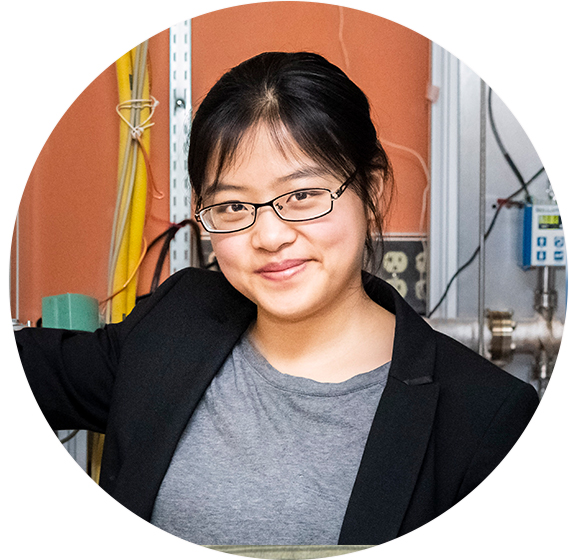
Xinting Yu is an assistant professor in the Department of Physics and Astronomy at the University of Texas at San Antonio. Dr. Yu’s research focuses on characterizing the physical properties of planetary materials and understanding atmospheric and surface processes on Titan and exoplanets. Dr. Yu completed their undergraduate studies at the University of Science and Technology of China and earned a PhD in Planetary Science from Johns Hopkins University. As a 51 Pegasi b postdoctoral fellow at the University of California, Santa Cruz, Dr. Yu led a student team to work on experimental and theoretical studies to explore planetary atmospheres and surfaces. Dr. Yu is currently developing a standardized Planetary Material CHaractErization Facility (PMCHEF) and a comprehensive material property database to support planetary exploration in and outside the solar system.