Impacted Members/Scientists: Request a membership waiver, seek meeting support, and other resources. Learn more. For the latest public policy updates, please visit this page.




27 April 2026
AAS Prizes for Textbook Authors & Amateur Astronomers

Richard Fienberg Running Hare Observatory
Longtime AAS member Carlson R. Chambliss, now retired from a lengthy career at Kutztown University in Pennsylvania, endowed several new AAS prizes in 2006. Among them are the Chambliss Astronomical Writing Award and the Chambliss Amateur Achievement Award. Dr. Chambliss is also a longtime member of the American Numismatic Association with a keen interest in coins and medals, so these prizes come with gleaming medals that he designed himself: a gold one for the writing award and a silver one for the amateur award.
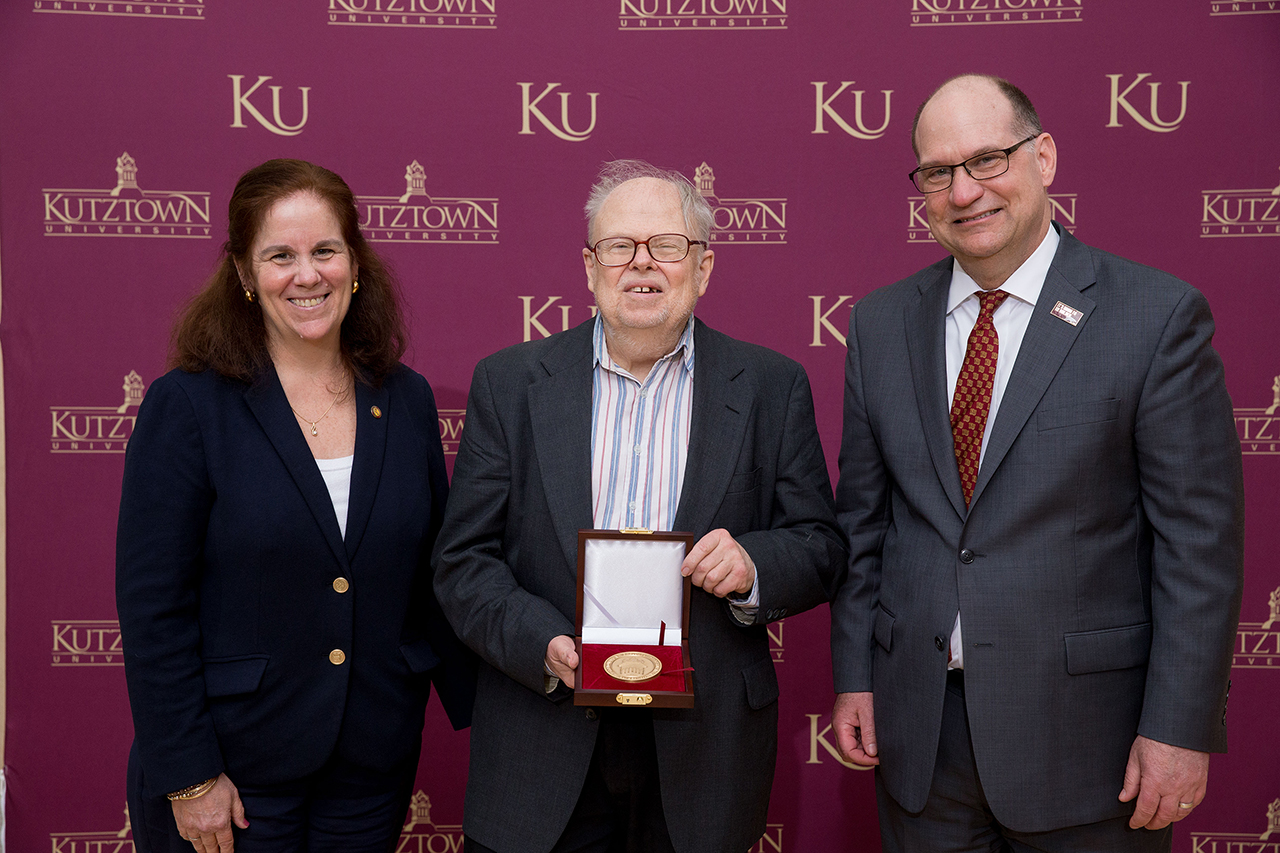
Although these medals are meant to be awarded annually, the Society has sometimes received no nominations for them, so there have been years where no prize was awarded. Here we provide details of both prizes and strongly encourage you to nominate worthy candidates, perhaps even yourself! As with most AAS prizes, self-nominations are allowed.
Chambliss Astronomical Writing Award
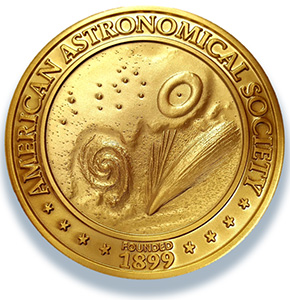 The Chambliss Astronomical Writing Award is presented for books written for an academic audience — specifically, astronomy textbooks at either the upper-division undergraduate level or the graduate level. Why advanced textbooks? Because introductory texts and popular astronomy books have large markets, and their authors are already eligible for a variety of prizes from other organizations. Textbooks serving astronomy majors and graduate students, by contrast, have relatively small markets, and excellence in this area is rarely recognized. Nonetheless, such textbooks (which for the purposes of this award do not include books assigned or recommended as supplemental reading) serve a vital role in professional development, and since that’s part of the AAS’s mission, that’s what the Chambliss writing prize rewards.
If you teach upper-division undergraduate courses or graduate courses and are impressed with one of the textbooks you use, please consider nominating it for the Chambliss Astronomical Writing Award. The rules don’t say that a nominated book needs to have been published recently, but its authors must still be alive to be eligible for the award.
The winning book — which must be currently available in North America — will be recognized with a single gold medal, and if the book has multiple authors, the accompanying honorarium (currently $1,000) will be divided equally among them, and each will receive a separate award certificate. The recipient (or both recipients, if there are two) will also receive complimentary registration for an upcoming AAS meeting.
Chambliss Amateur Achievement Award
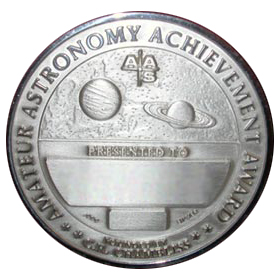 The Chambliss Amateur Achievement Award is presented for an achievement in astronomical research made by an amateur astronomer — that is, a person not employed in the field of astronomy in a professional capacity — and who is resident in North America. The key factor in deciding the recipient will be that the work contributes to the advancement of the astronomical sciences. There is no honorarium or certificate, “just” a beautiful silver medal engraved with the awardee’s name and free registration for an upcoming AAS meeting.
This is the only AAS prize that allows nominations by non-members. Why the exception? Because while the AAS does have Amateur Affiliate members, they are few in number, whereas as a group amateur astronomers far outnumber their professional counterparts.
The Chambliss Amateur Achievement Award typically celebrates one of three kinds of work: high-quality observations and/or analysis done by an amateur astronomer, often in collaboration with a professional; the development of an algorithm, computer program, or analytical technique that advances scientific research by other amateurs and/or professionals; or an outstanding contribution to a citizen-science project.
If you’re a professional astronomer who collaborates with amateurs or runs a citizen-science program, consider nominating a worthy candidate for the Chambliss Amateur Achievement Award. If you’re an amateur astronomer and know of someone (perhaps a member of your local astronomy club, perhaps even yourself) who is involved in scientific research — alone, with other amateurs or with professionals, or online via a citizen-science effort — consider nominating them for a Chambliss silver medal.
AAS prize nominations are now open, with a deadline of 30 June. Visit the AAS website for more information about the Chambliss writing award, the Chambliss amateur award, and the prize-nomination process. The nomination process does take some time to complete, so don’t leave it until the last minute!