Impacted Members/Scientists: Request a membership waiver, seek meeting support, and other resources. Learn more. For the latest public policy updates, please visit this page.




19 December 2024
2024 — A Stellar Year for the AAS!

Kevin Marvel Society for Neuroscience
As the end of 2024 approaches, I started to take just a few moments to look back at all the activities that the AAS has carried out through the efforts of engaged volunteers, our dedicated staff, and the community we strive to serve. Those scheduled few moments quickly expanded to an hour or so. We have accomplished a lot — too much to summarize here fully, but I will mention just a few highlights.
Our journals have remained a central component of our operations and a vital tool for the broader research community, with improvements both in their impact and the number of submissions we are receiving each week. On average, in 2024, we received 30% more submissions per week than in any prior year, and in two weeks (one week in late summer and another week in late fall), we received more than 200 submissions… a first.

Acceptances are following historic ratios, so the manuscripts we are receiving in such larger numbers are not of poor quality. Ethan Vishniac, our Editor in Chief, and our dedicated Lead and Scientific Editors are managing the peer review process effectively, and we are increasing the number of editors we have to help handle the increased volume of submissions (if you are interested in serving as a science editor, don’t hesitate to reach out to Ethan). We also said goodbye to our Chief Publishing Officer Julie Steffen, who retired mid-year, and welcomed on board our Director of Scholarly Publishing, Kerry Kroffe. Kerry brings long experience working for our journals at the University of Chicago Press and IOP Publishing, as well as significant publishing experience working with PLOS-One, including as the Director of Editorial Services. Kerry has established a great working relationship with our publishing partner, IOP Publishing, while taking on the leadership of our publishing team during this dynamic period of growth for our journals.
Our scientific conferences continue to be highly impactful and highly regarded by attendees. This year, we met with the Historical Astronomy Division in New Orleans for AAS 243, a new meeting location for the Society, and we were pleased to host more than 3,400 attendees, with about 2/3 of them being first-time attendees. A highlight was hosting the actor and astronomy enthusiast John Rhys-Davies, who just happened to be in New Orleans at the same time as our meeting. He was overly gracious with his time and took hundreds of selfies with his fans in our exhibit hall.
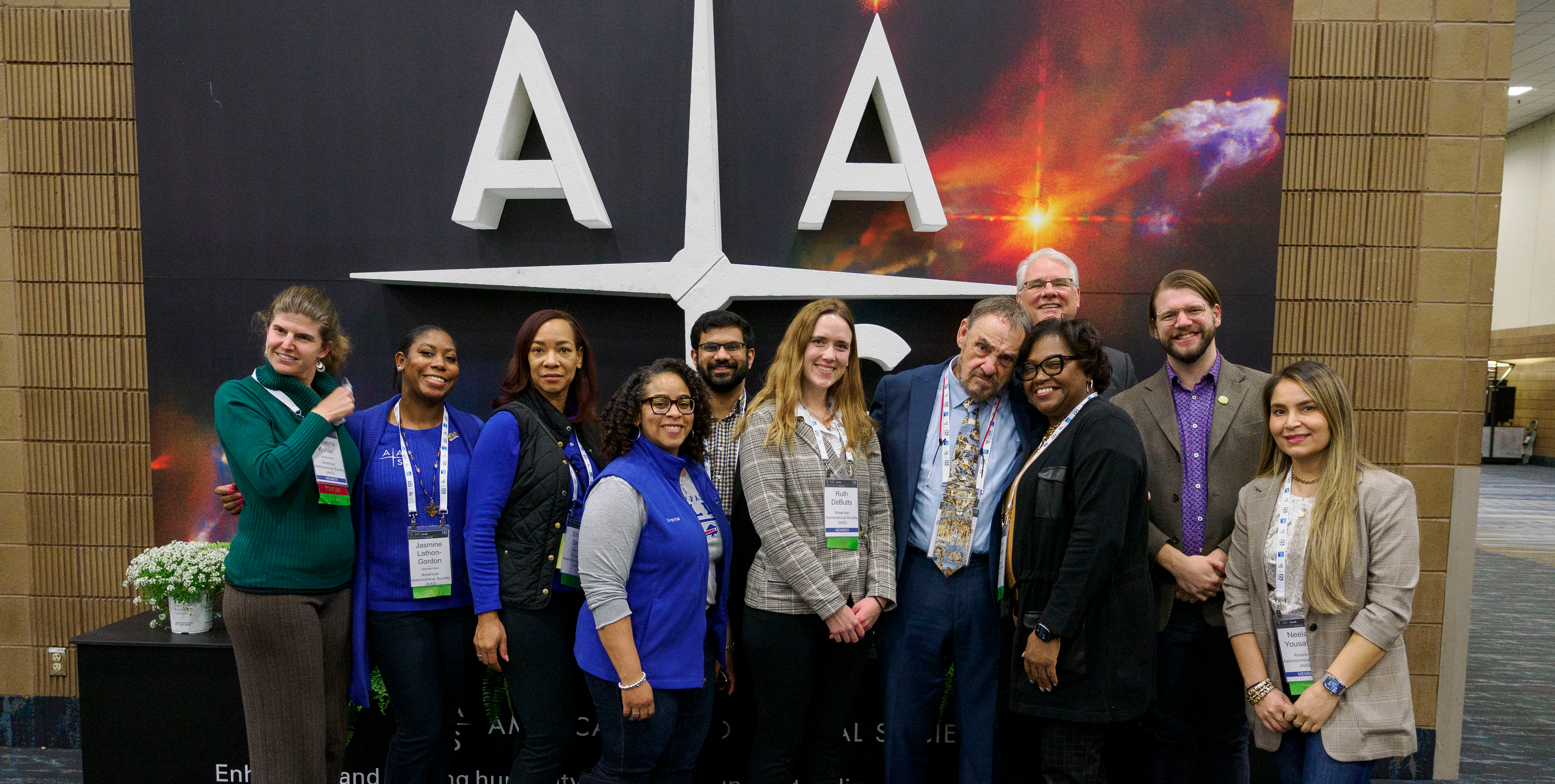
Our High Energy Astrophysics Division met in Texas in April to experience the total solar eclipse and share their latest research results. Despite a thin and variable layer of clouds, the eclipse and the meeting were spectacular. Our 10th AAS Topical Conference Series meeting was held in New Zealand in March. Hundreds of exoplanet researchers gathered at Extreme Solar Systems V, a meeting series that continues to play a central role in moving exoplanet research forward. The Division on Dynamical Astronomy met in Toronto in May, and AAS 244 was held in Madison, Wisconsin, the sixth time the Society has met in Madison during its 125-year history. We were thrilled to once again have the Laboratory Astrophysics Division with us in Madison. Nearly 500 planetary scientists gathered for our Division for Planetary Sciences meeting in Boise in October, and significant portions of the meeting were available online for remote participants. The Society’s meeting services group, capably led by Michele Stevenson, is planning or carrying out eight to ten conferences at any one time, ensuring they are high quality and enjoyable for all of our attendees. They do an impressive job.
The AAS took on Sky & Telescope magazine in 2019, buying it at the bankruptcy auction of its corporate owner, along with its online store, books, and tour businesses. The magazine continues to be highly regarded by subscribers and has healthy newsstand sales. The editorial team headquartered in Cambridge continues to put out a high-quality, engaging monthly issue and is one of only a handful of monthly magazines to be continuously published for more than 1,000 issues; the 1,000th issue was just mailed to subscribers this past month. Peter Tyson, Editor in Chief, retired in October, and we hired Diana Hannikainen to replace him. Peter led the magazine through a period of significant transition, and Diana is excited to lead the magazine into the future. We are thrilled to have her on board! 2025 will be the first year where we manage to hit a positive bottom line, having overcome the legacy financial challenges left behind by the previous owner.
In addition to the big three (from a revenue perspective) activities detailed above, we maintained an impactful public policy effort and welcomed back Joel Parriott as Deputy CEO and Director of External Affairs and Public Policy from his short stint working at the White House on science policy. We also welcomed a new Deputy Director for Public Policy, Roohi Dalal. A new John N. Bahcall public policy fellow rounds out this team and will begin in early 2025. Working together, this team carries out our advocacy efforts and assists our Divisions with their advocacy efforts as well, ensuring we speak with a consistent voice.
Our Education Program Manager, Tom Rice, has truly helped us have more impact in education, from helping restructure and focus how our Education Committee approaches their work to securing an exciting grant from the American Institute of Physics to train astronomy educators in Africa; he is having a significant and growing impact.
Much of the reason we are successful in the areas spotlighted above is the important staff members who don’t always get a lot of visibility, including our Human Resources, Membership Services, Communications and Marketing, and Finance and Administration teams. Sylvia Martinez, Diane Frendak, Hua Liu, and Kelly Clark lead these areas as Directors, and their dedicated team members show up every day to help the entire organization function, ensuring we can meet the goals set by the Board of Trustees. These duties include paying our bills, ensuring payroll is working, processing payments, handling administrative duties, ensuring good interaction with the press, handling member renewals, helping grow and maintain a supportive work environment, and all the rest of the nearly infinite small tasks necessary for any organization to operate. I am truly grateful for all that they and their teams do because, without them, we could do nothing.
I am truly honored and grateful to serve the AAS and humbled to lead such an engaged and capable group of people. Everyone keeps our central mission to enhance and share humanity’s scientific understanding of the universe as a diverse and inclusive astronomical community front and center as they approach their work. I know helping the Society achieve that mission is truly rewarding for each of us. We have accomplished a great deal in 2024 and are looking forward to doing even more in 2025 while ensuring the service we deliver to our community each and every day remains impactful and valued by the community we are proud to serve.