Impacted Members/Scientists: Request a membership waiver, seek meeting support, and other resources. Learn more. For the latest public policy updates, please visit this page.




12 May 2026
How the AAS Education Committee Is Making Meetings Better for Students
Kevin Flaherty Williams College
Briley Lewis University of California, Santa Barbara
Emily Rice CUNY Macaulay Honors College
Jessica Harris Jessica A. Harris, LLC
Welcome to the AAS Education Committee Blog! Our blog features posts from astronomers and educators in the extended AAS community, curated by the AAS Education Committee. Subscribe here to receive future posts and other astronomy education news directly into your inbox every two weeks; also follow us on Bluesky and Instagram. We welcome guest article submissions! — AAS Education Committee.
Attending your first conference can be challenging, especially so when it’s one as large as a typical AAS meeting. The size of the venue feels overwhelming, as does the schedule. You look around and see people whose papers (or textbooks) you have read, and it feels like everyone already knows everyone else. Someone walks up to you and asks you where you are from and what you study, and you feel like you would forget your name if it weren’t printed on your badge. You may feel alone, but at any given AAS meeting, roughly 30% of attendees are attending for the first time, and a new subcommittee of the AAS Education Committee is focusing on improving the student experience at AAS meetings, starting with a student's first meeting.
The AAS Education Committee’s Project Team on Student Conference Experiences recently created a series of documents and activities designed to make AAS meetings more accessible to first-timers. We hope to introduce first-timers to the elements of an AAS meeting and offer advice on how to get the most out of the experience and the many professional and social interactions involved.
We started with a Guide for AAS meetings, updated and adapted from the post "Your First AAS Meeting" on the AstroWright blog as posted on the AstroBetter wiki, which itself was originally compiled from advice by Jason Wright, Jason Curtis, Ming Zhao, Marshall Perrin, Sharon Wang, and others. This document provides guidance on common processes like registering for the AAS meeting, planning travel, and checking in at the conference venue. It discusses meeting elements like the grad school fair, the opening reception, plenary sessions, town halls, oral sessions, and poster sessions. It also offers advice on how to talk to people and how to prioritize your well-being, which is especially important at an event as complex and intense as the AAS meeting.
The guide is currently 12 pages long and designed to be comprehensive, beginning from months before the meeting, and it will continue to evolve as we incorporate feedback and make updates. To make things easier at the meeting itself, we created a one-page document for easier reading and reference. At AAS 247 this past January in Phoenix, printed copies were available at the registration desk for all new attendees. Within the guide is also a Suggested First-Timers’ Schedule that narrows the block schedule down to its core elements (plenary sessions, poster sessions, town halls, oral sessions), while highlighting events that might be of particular interest to students attending their first meeting, like Society of Physics Students events, career-related events, social events, and more.
At AAS 247, we also debuted the First-Timers’ Orientation event. This one-hour session was held on Sunday evening before the grad school and REU fair in space and time. To a standing-room-only crowd, Education Committee member Emily Rice, with help from other AAS volunteers and staff, facilitated an introduction to the guide, how to use the Slack/app for the meeting, and the logistics of the graduate school fair. Attendees were welcomed by representatives from the AAS Agents, Astrobites, Black in Astro, the AAS Committee on the Status of Women in Astronomy, the AAS Committee on the Status of Minorities in Astronomy, the AAS Working Group on Accessibility and Disability (now the Committee for Accessibility Rights and Equity), the AAS Committee for Sexual-Orientation & Gender Minorities in Astronomy, the Society of Physics Students, the AAS Education Committee, and AAS President Dara Norman.
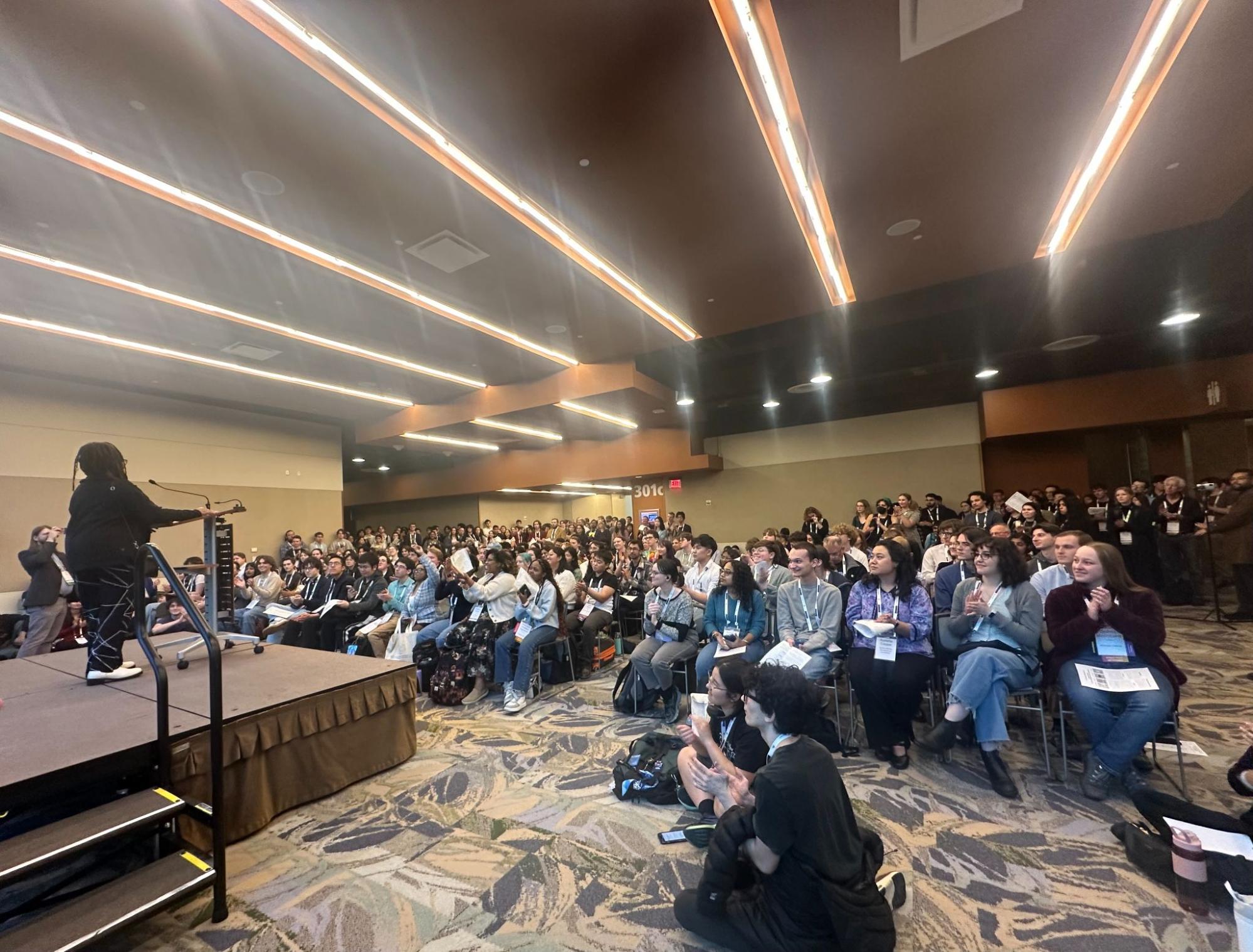
Overall, these elements were a huge success and a valuable addition to the AAS experience. The popularity of the First-Timers’ Orientation, with 300–400 students in a space meant for 120, highlights the importance of providing guidance for navigating an AAS meeting. We plan for many of these elements, especially the guide and the First-Timers’ Orientation, to become regular parts of AAS meetings.
This subcommittee is committed to making AAS meetings a more welcoming and valuable experience for all attendees. If you have any questions, comments, or suggestions for how to improve the student conference experience at AAS, please submit them via this form.