Impacted Members/Scientists: Request a membership waiver, seek meeting support, and other resources. Learn more. For the latest public policy updates, please visit this page.




28 January 2026
AAS Member Jonas Zmuidzinas Receives James Craig Watson Medal

Susanna Kohler American Astronomical Society (AAS)
This post is adapted from a press release from the National Academy of Sciences.
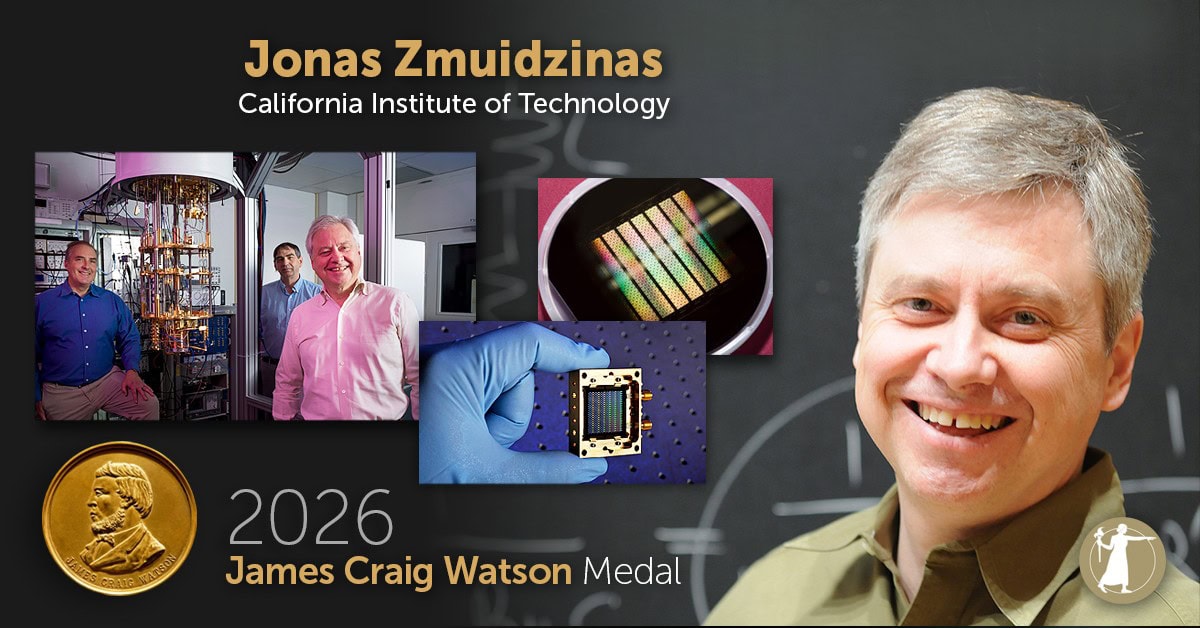
The National Academy of Sciences (NAS) has announced that it will honor 19 individuals in recognition of their extraordinary scientific achievements in the physical, biological, and medical sciences. Among the 19 awardees is AAS member Jonas Zmuidzinas of the California Institute of Technology. Zmuidzinas is cited "for his seminal work designing and developing technologies and instruments to advance astrophysics."
Working at the intersection of astronomy, engineering, and physics, Zmuidzinas has developed ultra-sensitive detectors and innovative astronomical devices that are enabling the next generation of space- and ground-based astronomical surveys. His inventions include super‐conducting microwave kinetic inductance detectors (MKIDs or KIDs), a transformational technology enabling observations from millimeter to X-ray wavelengths, with applications ranging from the cosmology and exoplanet science to neutrino detection and synchrotron X-ray spectroscopy. He also developed and implemented terahertz heterodyne spectrometers that have been critical to studies of star formation, significantly expanding the scientific capabilities of the Kuiper Airborne Observatory and the Herschel Space Observatory.
As noted on the NAS website, the James Craig Watson Medal is presented every two years for outstanding contributions to the science of astronomy and carries with it a gold-plated bronze medal, a $25,000 prize, and $50,000 to support the recipient's research. The Watson Medal was established by NAS Member and prolific Canadian-American astronomer James Craig Watson, who is credited with discovering 22 asteroids. He published many articles and wrote A Popular Treatise on Comets (1861) and Theoretical Astronomy (1868).