Impacted Members/Scientists: Request a membership waiver, seek meeting support, and other resources. Learn more. For the latest public policy updates, please visit this page.




3 September 2025
Celebrating the 2024–2025 AAS Shapley Lecturers
Tom Rice
American Astronomical Society
Donna Richardson
SETI Institute
Welcome to the AAS Education Committee Blog, which features posts from the extended AAS community curated by the AAS Education Committee. Subscribe here to receive future posts! — AAS Education Committee.
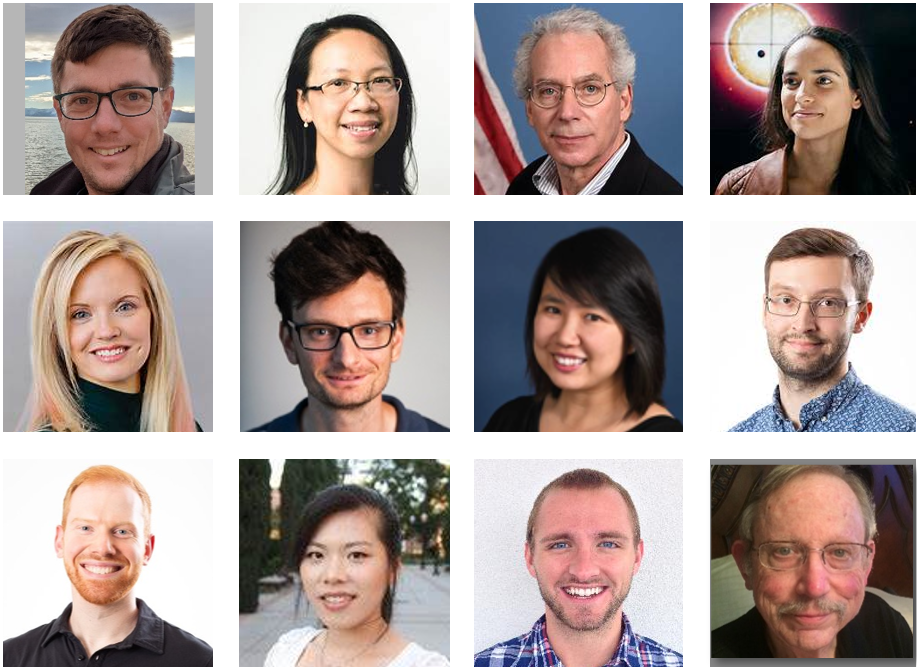
The American Astronomical Society (AAS) is pleased to share and celebrate the work of 12 astronomers who formed the 2024–2025 cohort of AAS Harlow Shapley Visiting Lecturers! These Shapley Lecturers visited a number of community colleges and schools across the US to share their science and inspire wonder about the universe. The Society gives its deep thanks to these individuals for giving their time to advance its mission to “enhance and share humanity’s scientific understanding of the universe as a diverse and inclusive astronomical community.”
The AAS Harlow Shapley Visiting Lecture Program partners with schools and communities to expand access to astronomy, bringing distinguished astronomers to share the wonder of the universe and inspire people to bring science into their lives. The program, which grew out of AAS’s Visiting Professors Program dating back to 1958, is named in honor of eminent astronomer and former AAS President Harlow Shapley (1885–1972) and has been a long-running tradition for the Society. For many years, the AAS has financially supported the travel of its visiting lecturers through an endowed fund built through private charitable donations. The program entered a hiatus around the COVID-19 pandemic but relaunched in 2024 in partnership with the NASA Community College Network (NCCN), run by the SETI Institute in California. See this press release for more about the AAS–NCCN partnership!
If you are excited to share astronomical science with the world, we’d love to include you in the Shapley Lectures Program!
Apply to the Shapley Visiting Lectures Program!
We are now accepting applications to either serve as a Shapley Visiting Lecturer or to organize and host a Shapley visit in 2026. Applications are due 31 October 2025.
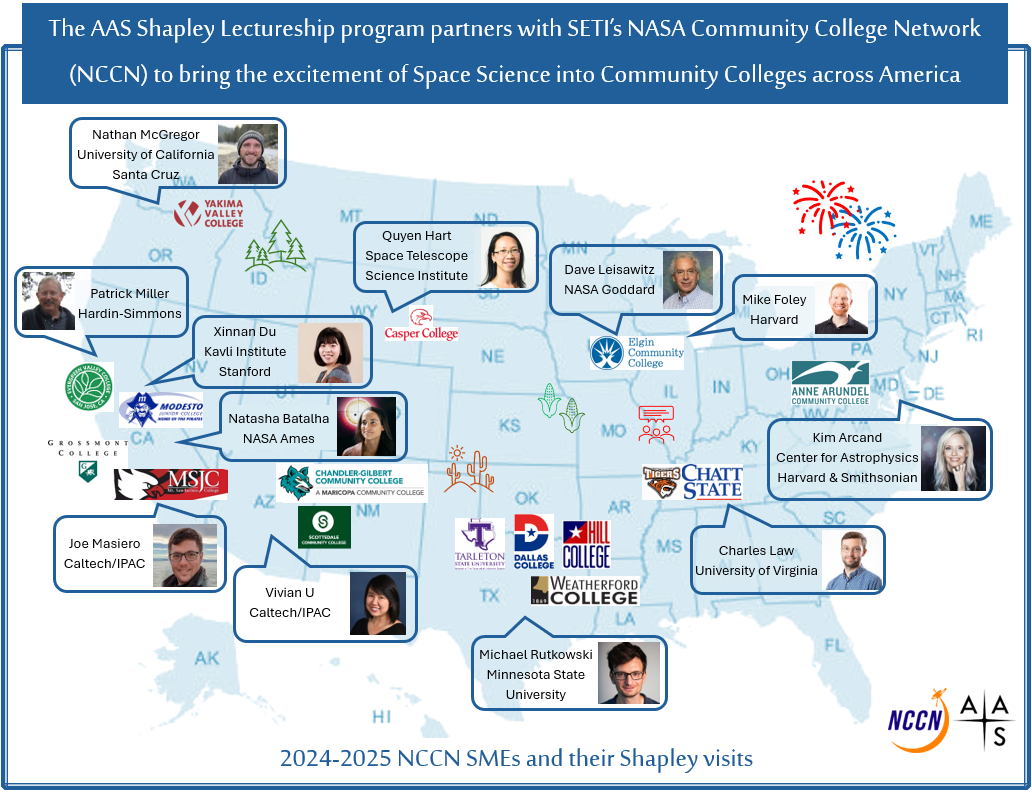
The AAS Shapley Visiting Lectures Program brought 12 astronomers to the following institutions in 2024–2025 to share their science.
2024
Charles Law, 9 April, Chattanooga State Community College (Tennessee)
Xinnan Du, 18 October, Modesto Junior College (California)
2025
Joe Masiero, 6 April, Grossmont Community College (California)
Vivian U, 7 April, Scottsdale Community College, Chandler Gilbert Community College (Arizona)
Dave Leisawitz & Michael Foley, 21 April, Elgin Community College (Illinois)
Michael Rutkowski, 23 April, Dallas Area Colleges (five colleges) (Texas)
Joe Masiero, 29 April, Mt. San Jacinto College, Menifee Campus (California)
Quyen Hart, 6 May, Casper College (Wyoming)
Nathan McGregor, 28 May, Yakima Valley College (Washington)
Patrick Miller, Sept 18, Evergreen Valley College (California)
Kim Arcand, 1 October, Anne Arundel Community College (Maryland)
Natasha Batalha, 3 October, Modesto Junior College (California)
Each visit of an AAS Shapley Lecturer was unique. At the center of each event was the public Shapley Lecture, broadly advertised to the local community. Beyond the Shapley Lecture itself, the host institutions organized a variety of local engagement activities — ranging from star parties and classroom visits to meetings with college deans and faculty — to make the most of their time with the Shapley Lecturer. A few examples of specific Shapley visits are provided below:
- Michael Rutkowski's visit to Dallas
- Joe Masiero’s visits to Southern California
- Xinnan Du’s visit to Modesto Junior College in the San Francisco Bay Area
- Quyen Hart’s visit to Casper College in Wyoming
Michael Rutkowski: Five Community Colleges in Dallas
In April 2025, Dr. Michael Rutkowski, Associate Professor of Astronomy at Minnesota State University, Mankato, traveled across the Dallas–Fort Worth area to visit five community colleges and meet with hundreds of students, faculty, and community members. His Shapley Lecture, “The First 100 Years of Astrophysics: Where We’ve Come From and Where We’re Going,” was at the center of the program, but his three-day visit also included classroom discussions, faculty workshops, and outreach events.
On the first day, Dr. Rutkowski visited Weatherford College, where he met with students in two physics classes taught by Professor James Espinosa. He then continued to Hill College and its Burleson Higher Education Center, where Assistant Professor Sagar Paudel and his students engaged with Dr. Rutkowski on both his research and possible career paths in science. Following his lecture, he spoke individually with students and faculty, offering advice on undergraduate research opportunities and professional development.
“His visit made a permanent change in how my classes will be taught in the sense that ‘honors’ projects will be available for ambitious students. I intend to keep in touch with him for several years to come, which is a big impact for our present and future students.”
— Astronomy instructor James Espinosa, Weatherford College
On the second day, Dr. Rutkowski visited Harmony Science Academy in Dallas County, where instructor Fernando Cepeda’s robotics and technology students asked about both his career in research and strategies for pursuing STEM pathways. He then presented to astronomy students at Dallas College’s Cedar Valley Campus with Professors Zachary Taylor and Heather Appleby, followed by an evening program at the Richland Campus that included a lecture, planetarium show, and star party. The event was also live-streamed, allowing additional students and community members to participate.
On his final day, Dr. Rutkowski returned to Cedar Valley to participate in the School of Engineering, Technology, Mathematics, and Science Faculty Collaboration Day. There, he presented “Teaching Students to Use Python to Analyze Spectra” and exchanged ideas for integrating data-driven astronomy into coursework.
Over the course of the visit, Dr. Rutkowski traveled more than 260 miles across three counties and met with students, educators, administrators, and community members at five community colleges, high schools, and clubs. The success of the Dallas–Fort Worth Shapley Visit was due to the collaborative planning of Professors Espinosa, Paudel, Jayant Bhalerao, Tara Urbanski, and Daniel Marble, coordinated by Professor Heather Appleby at Dallas College. Their combined efforts ensured that Dr. Rutkowski’s visit reached the widest possible audience and left a lasting impression.
“Many students stayed for both his talks and received business cards from Michael for possible future undergraduate research. I am looking forward to more collaboration with Dr. Rutkowski and among us.”
— Sagar Paudel, Professor at Hill College, Dallas
Joe Masiero: Grossmont Community College and Mt. San Jacinto College, California
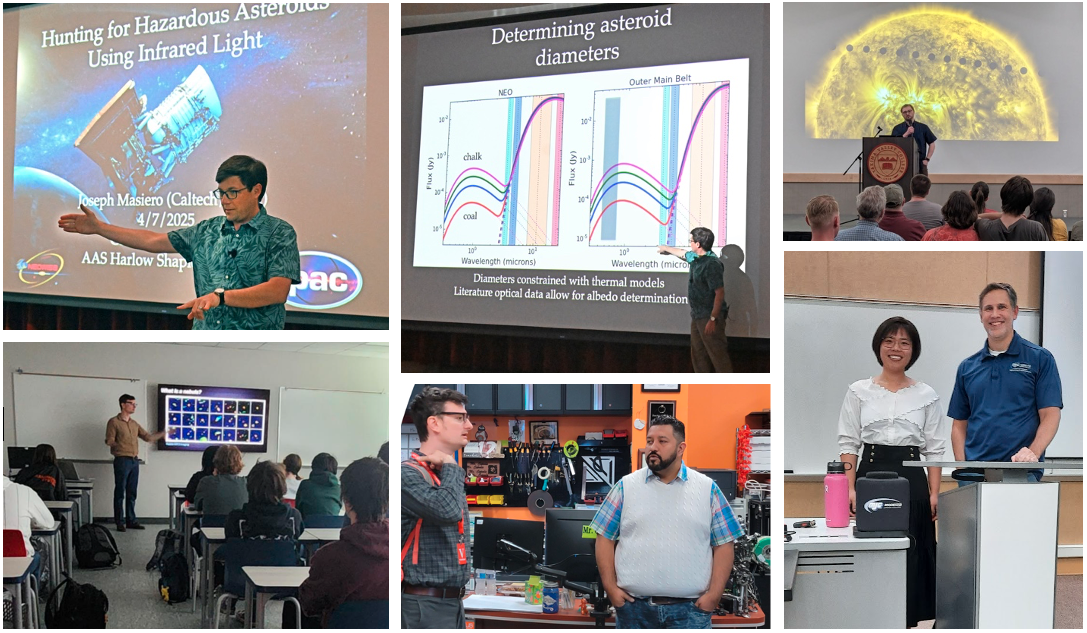
Dr. Joe Masiero, a Solar System scientist at Caltech/IPAC, demonstrated how a Shapley Lecture can be integrated into an already full schedule of research, mentoring, and outreach. In early April 2025, he visited Grossmont Community College, where Professor Brodney Fitzgerald hosted his presentation, “Hunting for Hazardous Asteroids Using Infrared Light.” Students were highly engaged, with some requesting a copy of his presentation slides for further study.
In addition to the lecture, Dr. Masiero met with the community and separately with more instructors to discuss ideas for engaging with students and suggestions for student projects. Later in April, he traveled to Mt. San Jacinto College’s Menifee Campus to meet with Professor Mark Maier and his physics and astronomy students. These visits highlighted the flexibility of the Shapley Lectures program, allowing astronomers to bring their science to local communities even on a tight schedule.
Xinnan Du: Modesto Junior College, California
In October 2024, Dr. Xinnan Du, an astronomer and outreach manager at Stanford’s Kavli Institute for Particle Astrophysics and Cosmology, traveled to Modesto Junior College to meet with Professor Daniel Chase and his students. Her schedule included visits to several classrooms, a discussion with the astronomy club, and a public lecture titled “Do Galaxies Breathe, Too?”
The evening event was hosted by Modesto Junior College and recorded for future use by both students and the general public. Through her visit, Dr. Du connected directly with current students while also creating a resource that will continue to serve the community for years to come.
Quyen Hart: Casper College, Wyoming
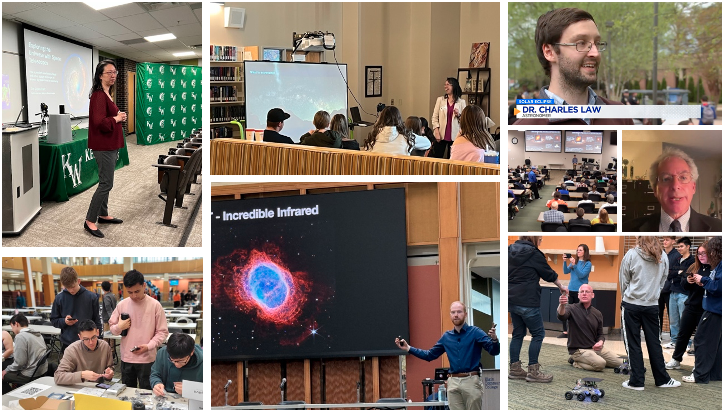
Dr. Quyen Hart, project scientist and science communicator at the Space Telescope Science Institute, undertook one of the most extensive Shapley Lecture visits of the year in May 2025, spending four days in Casper, Wyoming. Working closely with Dr. Hart, Physics Professor Drew Young developed a schedule that reached audiences across multiple grade levels and institutions.
Dr. Hart's itinerary included visits to elementary and junior high school classrooms, two high schools, and all the physics, astronomy, and calculus classrooms at Casper College. For each audience, she prepared tailored presentations, adjusting both content and level of detail to match the needs of students.
Dr. Hart’s public Shapley Lecture, “Uncovering the Universe with the James Webb Space Telescope,” was presented at the Goodstein Foundation Library in conjunction with the Casper College ASTR 1050 astronomy class, and she delivered an additional public talk at the Casper Planetarium the following day. Professor Young also arranged opportunities for Dr. Hart to meet with the college president, the board of trustees, faculty, and more students at the College’s School of Science End-of-Year Banquet.
Through this carefully planned program, Dr. Hart inspired students across all stages of education and strengthened connections across the Casper community. Her visit is an outstanding example of the Shapley Lectures’ mission to bring astronomy to institutions that may not otherwise have access to visiting scientists.
Concluding Commentary
In addition to the visits by Drs. Rutkowski, Masiero, Du, and Hart featured above, we wish to extend our thanks to all the Shapley Lecturers and their hosts at community colleges and other institutions across the country. The AAS could not have organized these events without the partnership of the NASA Community College Network, and so we graciously thank Donna Richardson, Simon Steel, and Pamela Harman of the SETI Institute, who led this program. We are looking forward to scheduling the 2026 series of AAS Shapley Lectures — please stay tuned for that announcement by subscribing to the AAS Education biweekly email newsletter!