Impacted Members/Scientists: Request a membership waiver, seek meeting support, and other resources. Learn more. For the latest public policy updates, please visit this page.




15 April 2025
Policy Update (15 April 2025)

Colin Hamill American Astronomical Society (AAS)
Reports of the passback from the Office of Management & Budget (OMB), essentially a draft version of the FY 2026 President's Budget Request for NASA, indicate the White House has suggested a two-thirds cut to the Astrophysics Division, a 40% cut to the Heliophysics Division, and a 30% cut to the Planetary Science Division. Cuts of this magnitude would lead to the cancelation of the Nancy Grace Roman Space Telescope, Mars Sample Return, and DAVINCI. Large cuts were also proposed for NOAA, including a ~75% cut to the Office of Oceanic and Atmospheric Research. We are awaiting information about NSF and the DOE Office of Science.
On 9 April 2025, Jared Isaacman, the NASA Administrator nominee, attended a nomination hearing in front of the Senate Committee on Commerce, Science, and Transportation. Mr. Isaacman made promises to return American astronauts to the Moon and Mars, and voiced support for Earth and space science. For more details, see:
- Trump White House budget proposal eviscerates science funding at NASA (ArsTechnica)
- Major budget cuts proposed for the National Oceanic and Atmospheric Administration (NPR)
- Isaacman says NASA should pursue human moon and Mars programs simultaneously (SpaceNews)
On 10 April 2025, the House narrowly approved the Senate's budget resolution with a vote of 216 - 214. Now that the House and Senate have agreed on the same budget resolution, congressional leadership must start writing the final reconciliation package, including tax cuts, increased spending on defense, energy, and border security, and at least $1.5 trillion in spending cuts. At this time, the General Science, Space, and Technology (Function 250) budget category, which includes funding for NASA, NSF, and DOE Office of Science, is not targeted for cuts. For more information, read "House approves budget framework, kick-starting work on Trump's domestic agenda" (NPR).
Last week, the AAS policy team made a new Action Alert to voice support for the NASA Science Mission Directorate and urge your House representatives to sign a letter in support of NASA science. In less than four days, over 600 AAS members have taken action. If you haven't already, please consider taking a moment to send your representative an email or phone call using our prompt.
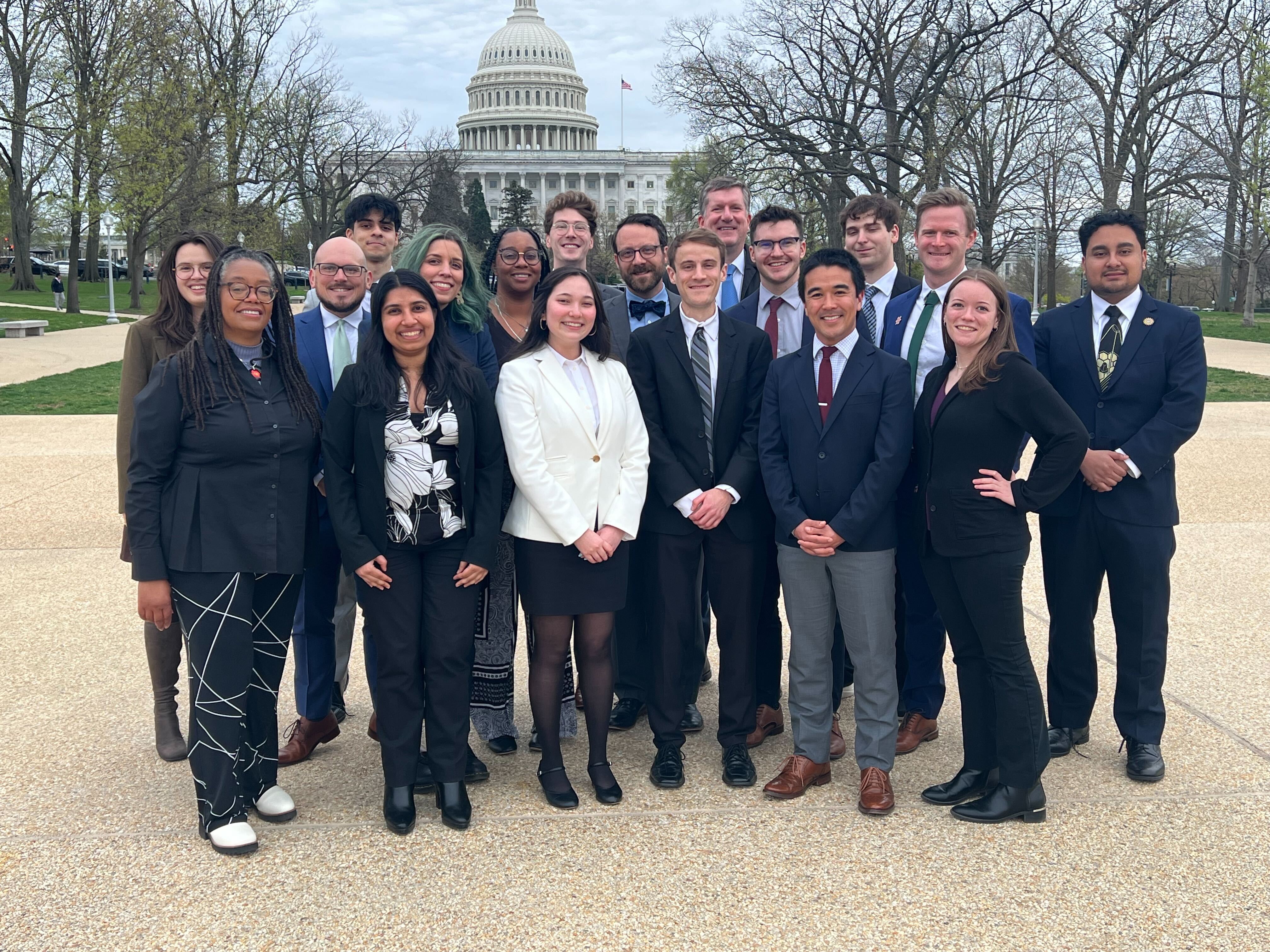
AAS held our annual Congressional Visits Day (CVD) from 31 March to 2 April, where we supported 17 AAS members to spend three days in Washington, DC, to learn about the federal budget process and science policy. On the final day, we went to nearly 40 congressional offices to share the critical role of astronomy in driving US innovation and research. From undergraduates to faculty, our participants represent the next generation of scientific leaders who will drive discovery across the country. A huge thank you to our participants for your time, hard work, and passion. You all made this event an amazing success. Watch for future blog posts from CVD participants to read about their experiences. We also hosted two undergraduate students to attend the Catalyzing Advocacy in Science and Engineering (CASE) workshop.
As always, if you have questions or comments, please email [email protected] or stop by the AAS Policy and Education Office Hours.