Impacted Members/Scientists: Request a membership waiver, seek meeting support, and other resources. Learn more. For the latest public policy updates, please visit this page.




2 December 2024
Remembering Helmut Abt (1925 – 2024)

Kevin Marvel Society for Neuroscience
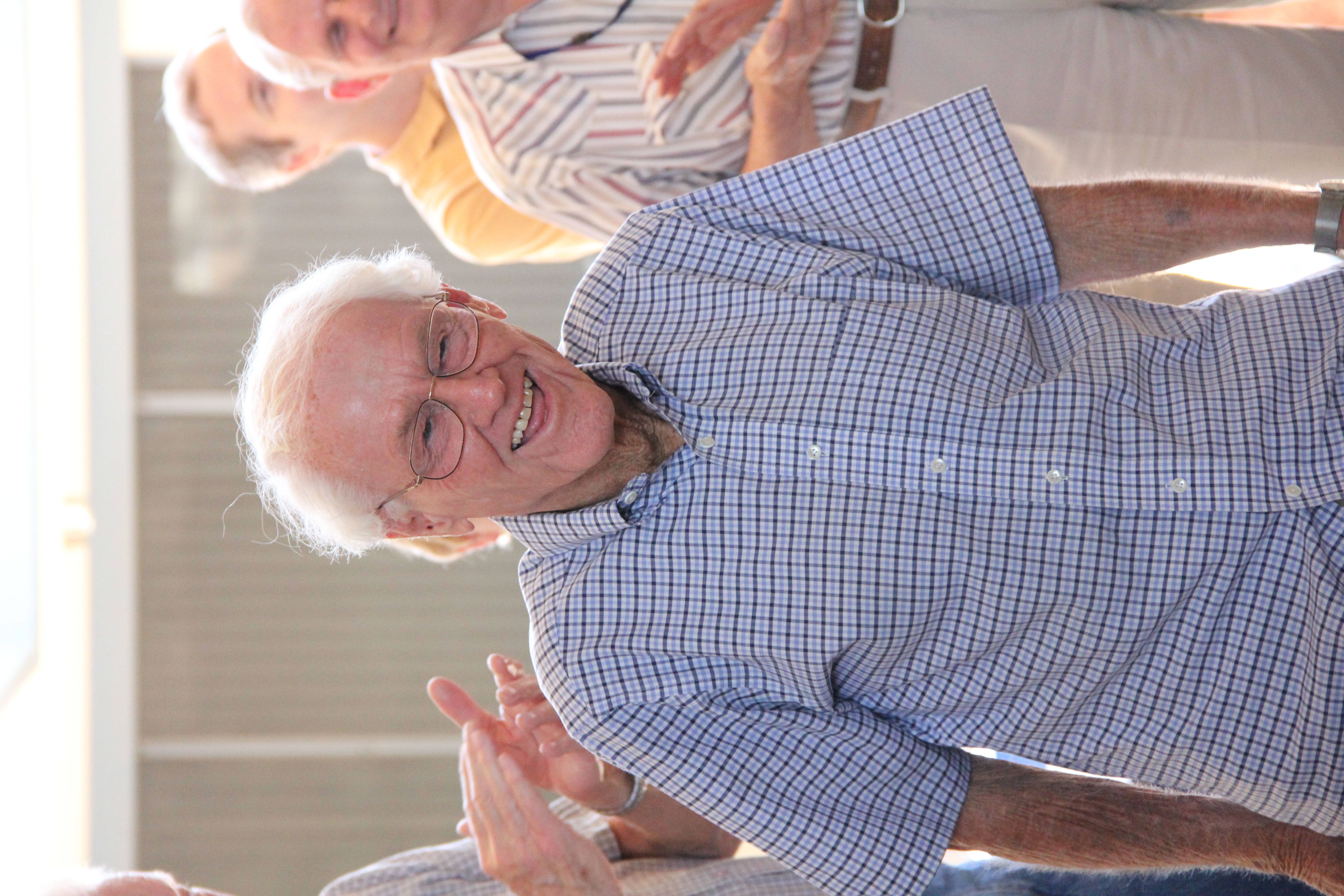
Helmut Abt, who served as Managing Editor for the Astrophysical Journal (ApJ) for 29 years from 1971 to 1999, died 22 November 2024 at the age of 99. The Society will publish a more formal and complete obituary recognizing his professional achievements in the weeks ahead.
Born in Germany, Helmut’s family emigrated to the United States when he was a child. In 1952, he became the first person awarded a PhD in astrophysics at Caltech. In 1971, he took over as Managing Editor for the ApJ family of journals from Subrahmanyan Chandrasekhar, who was Managing Editor from 1952 to 1971. In 1973, the Astrophysical Journal Letters (ApJL) received its own editor, Alex Dalgarno, who, similar to Helmut, served in his role for many decades. This allowed Helmut the time and space to focus on the ApJ and The Astrophysical Journal Supplement (ApJS), leaving the rapid publication journal in Alex’s competent care.
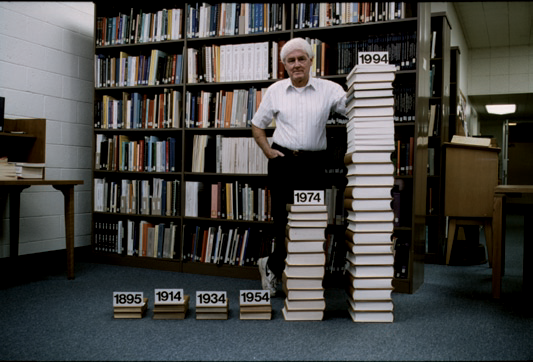
During his tenure, the journals grew from 726 published articles in 1971 (506 ApJ, 200 ApJL, and 20 ApJS) to 2,394 in 1999 (1,643 ApJ, 627 ApJL, and 124 ApJS), representing more than a threefold growth in volume. For comparison, in 2023, we published 3,924 articles (2,859 ApJ, 727 ApJL, and 338 ApJS). Helmut, delighted in this continual growth of the journals, took a photo standing next to stacks of journals over time to demonstrate the significant increase in printed content.
Helmut also navigated the journals through the significant transition to electronic publishing with the help of the AAS Publications Committee, journals staff, and the University of Chicago Press staff. With the advent of the Internet, email communications, and SGML as the default publishing standard language, how journals were published changed dramatically.
It is hard to remember today that before the electronic revolution in publishing, manuscripts were submitted in typed form, then rekeyed by a typesetter, and referee reports were sent in via regular post (or perhaps telex!). The journal arrived in printed form, small enough and light enough to be easily carried around… even a few issues at once.
Helmut saw these changes as advantageous, primarily for the faster publication times they enabled, but also lamented the lost ability to browse all the content to discover new and interesting results serendipitously.
The Society awarded him the 1997 George Van Biesbroeck Prize to recognize his significant and long-term service to the astronomical community in this role. And in 2020, he was named an AAS Legacy Fellow for his outstanding research and service.
While I was an undergraduate at the University of Arizona, I regularly bumped into Helmut in the evenings in the NOAO (now NOIRLab) building on campus. I was using the plate scanner in the basement, and he was doing editorial work. We shared a love of stamps, and Helmut regularly posted his latest acquisitions proudly on his door, which I greatly admired.
It was an honor to work with him briefly when I started with the AAS in 1998 and 1999. I enjoyed discussing the future of the AAS’s journals with Helmut in depth at a meeting in Brussels entitled "Future Professional Communication in Astronomy" in 2007. Some of what we discussed there has come to pass (open access), but much has not (like the predicted demise of peer review).
Helmut was deeply dedicated to the AAS, the ApJ, and scholarly publishing. During his decades of significant service, he helped the Society grow and enhance our flagship journal.
Ad astra per aspera Helmut Abt, truly.