Impacted Members/Scientists: Request a membership waiver, seek meeting support, and other resources. Learn more. For the latest public policy updates, please visit this page.




15 November 2024
This Month in Astronomical History: November 2024
Michael Marotta American Astronomical Society (Amateur Affiliate)
 Each month, as part of this series from the AAS Historical Astronomy Division (HAD), an important discovery or memorable event in the history of astronomy will be highlighted. This month, Mike Marotta celebrates the work of Carl Sagan. Interested in writing a short (500-word) column? Instructions and previous history columns are available on the HAD web page.
Carl Sagan
Carl Sagan (born 9 November 1934) was an active planetary science researcher widely known for being a popular communicator about space exploration and the search for extraterrestrial intelligence. In addition, he advocated government science policy at the highest levels.1 Carl Sagan’s public outreach continued the tradition practiced by John Herschel, George Biddle Airy, Arthur Eddington, and Henry Norris Russell, astronomers who wrote for the broadest readerships.2 Like those predecessors, in the words of one colleague at Cornell, Sagan was always interesting and often right.3,4
Biographers easily fill paragraphs with anecdotes about Sagan’s personality. His university mentors included Harold C. Urey and Gerard P. Kuiper, who shared similar stories about Sagan.5 As an undergraduate, Sagan learned genetics working in the laboratory of Hermann J. Muller, whose communist ideology was his exit visa from the University of Texas and who later had to flee the USSR because he disagreed with the state-approved work of Trofim D. Lysenko.6 Sagan’s political writings included warnings of the “nuclear winter” effect of even a limited exchange of atomic weapons by the USSR and USA. In that, he was opposed by Edward Teller, among others, and the ensuing discussions (and arguments) ultimately resulted in predictions for a less dire though nonetheless undesirable consequence.7
Sagan began his undergraduate studies at the University of Chicago in 1951. By that time, intellectual specialization had separated the fine arts and natural sciences into two cultures. That disconnect became the subject of several works in 1959 and 1961 by C. P. Snow, a novelist and a physical chemist. However, Chancellor Robert Maynard Hutchins insisted that all candidates study science and literature at the University of Chicago. In Sagan’s words: "It was considered unthinkable for an aspiring physicist not to know Aristotle, Bach, Shakespeare, Gibbon, Malinowski, and Freud."8 Ever since he declared his intention to become an astronomer, Sagan began his scientific career working in Hermann Muller’s genetics laboratory at Indiana University in 1954. Sagan’s first peer-reviewed paper was “Radiation and the Origin of the Gene,” published in Evolution (1 March 1957). With his hallmark erudition, Sagan’s summary paragraph said: “For, as Muller has repeatedly emphasized, life implies evolution, and evolution implies both reproduction and reproduction of mutations, accomplishments which cytoplasm alone is unable to make. The cytoplasm may select the instruments, but it is the gene which plays the tune of life.”
Benefiting from intellectual cross-fertilization, Sagan was drawn to theories over practices. Sagan never wavered from his commitment to facts. Yet, sometimes, the same facts can be explained by competing theories, and Sagan excelled at considering those alternatives. Always a philosophical empiricist, he was also known for not being enthusiastic about the detailed and exacting practices of hands-on science. Kuiper said that while at the McDonald Observatory, waiting for dust storms to clear on Mars and in Texas, he enjoyed discussing the possibilities for life elsewhere in the cosmos with Sagan.9 Conversely, Kuiper later disparaged Sagan’s lack of enthusiasm for working at the telescope.10 Therefore, it is ironic that for its 20 October 1980 cover story about Sagan, the Time essay included an obviously posed snapshot of him in a corduroy sport coat and turtleneck at the Yerkes telescope. It is also true that Sagan credited Kuiper with teaching him the value in order-of-magnitude, “back of the envelope” estimations to see where a theory can lead.11
Frank Drake and Carl Sagan worked together at Cornell University, collaborated in the search for extraterrestrial intelligence, and got along quite well. The famous “Drake equation” originated in Drake’s preparation for a conference on extraterrestrial intelligence — one of the attendees was Sagan. Frank Drake often referred to the equation in his work, but not as frequently as Carl Sagan, who was its greatest publicist.
In Sagan’s obituary for the AAS, Yervant Terzian and Virginia Trimble called him astronomy’s “clearest and most colorful public voice.” He died on 20 December 1996.
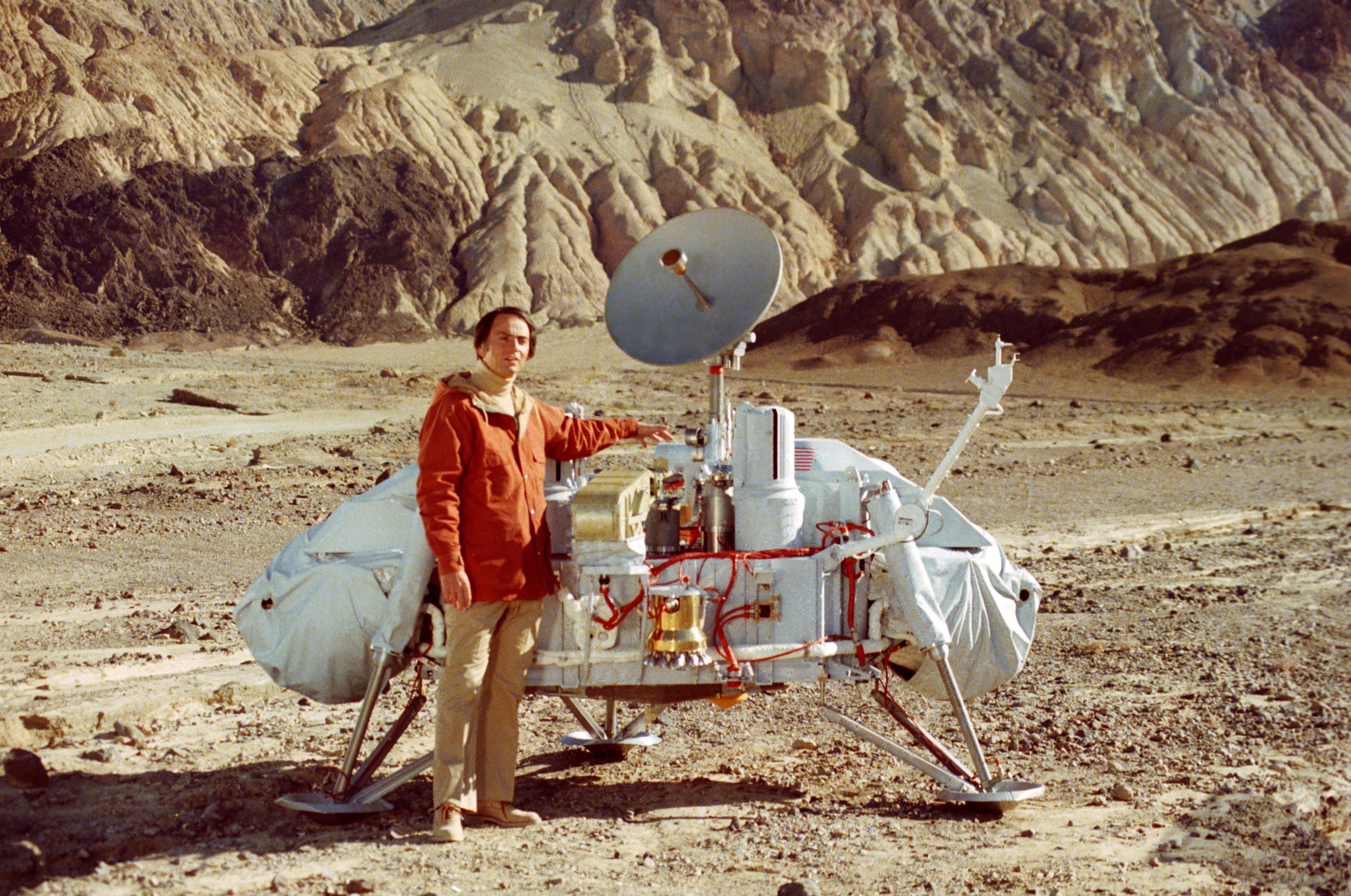
Fig. 1: Carl Sagan with a Viking lander. "Cornell astronomer Carl Sagan stands in front of a Viking lander mockup in Death Valley, California. Sagan helped select the landing sites and plan the Viking missions and was a tireless promoter of the Viking program and related explorations of Mars and other planets." NASA/JPL - https://airandspace.si.edu/multimedia-gallery/saganvikingjpg
References
- Terzian, Yervant and Virginia Trimble. [1997]. “Carl Sagan (1934-1996),” Bulletin of the AAS, vol 29, issue 4.
- Whiting, Alan B. [2011]. Hindsight and Popular Astronomy by Alan B. Whiting (World Scientific Publishing Pte., Singapore; Hackensack.
- Golden, Frederic, and Peter Stoler. [1980] “The Cosmic Explainer He-e-e-re's Carl, bringing you nothing less than the universe,” Time, 20 October 1980. See also “Science: A Gift for Vividness,” Time, https://time.com/archive/6697228/science-a-gift-for-vividness/
- Watkin, Edward. [1981]. “God and Carl Sagan: Is the Universe Big Enough for Both of Them?” U. S. Catholic, May 1981, p. 19-24, in Head, Tom. [2006]. Conversations with Carl Sagan, University of Mississippi Press, p. 68
- Marotta, Michael E. [2024]. “Book Review: Gerard P. Kuiper and the Rise of Modern Planetary Science, by Derek W. G. Sears,” HAD News, Number 103 May 2024, page 36
- Elmer, Nicole. [2016]. “A Look at the Life of Geneticist Herman Muller – Part II.” https://integrativebio.utexas.edu/about/history/hermann-j-muller-part-ii
- Davidson, Keay. [1999]. Carl Sagan: A Life. John Wiley & Sons, Inc.
- [N.A.] [N.D.] “Liberal Arts Astronomer” in Collection: Finding Our Place in the Cosmos: From Galileo to Sagan and Beyond; Carl Sagan and the Tradition of Science. Library of Congress, Washington, DC. https://www.loc.gov/collections/finding-our-place-in-the-cosmos-with-ca…
- Spangenburg, Ray and Kit Moser [2009]. Carl Sagan: A Biography. Prometheus Books; Amherst, NY. (Also Davidson, pp. 69-71.)
- Davidson, pp. 200-201.
- Sagan, Carl. [1995]. The Demon-Haunted World: Science as a Candle in the Dark. Random House; New York.
- Drake, Frank D. [1965]. “The Radio Search for Intelligent Extraterrestrial Life,” in Mamikunian, Gregg and Briggs, Michael H, eds. [1965]. Current Aspects of Exobiology. Oxford University Press; pg. 323-345.
Further Reading
- Soter, Steven. [2000]. “Carl Sagan and the Search for Life,” American Museum of Natural History https://www.amnh.org/learn-teach/curriculum-collections/cosmic-horizons… from Cosmic Horizons: Astronomy at the Cutting Edge, edited by Steven Soter and Neil deGrasse Tyson, [2000]. New Press, American Museum of Natural History.
- The Library of Congress; Collections website; pages: “Finding Our Place in the Cosmos with Carl Sagan”
- Carl Sagan and the Tradition of Science, https://www.loc.gov/collections/finding-our-place-in-the-cosmos-with-ca…
- Sagan’s Science Mentors, https://www.loc.gov/collections/finding-our-place-in-the-cosmos-with-ca…