Impacted Members/Scientists: Request a membership waiver, seek meeting support, and other resources. Learn more. For the latest public policy updates, please visit this page.




3 September 2024
This Month in Astronomical History: September 2024
Michael Marotta American Astronomical Society (Amateur Affiliate)
 Each month as part of this series from the AAS Historical Astronomy Division (HAD), an important discovery or memorable event in the history of astronomy will be highlighted. This month, Mike Marotta writes about the solar storm events of 1859. Interested in writing a short (500-word) column? Instructions along with previous history columns are available on the HAD web page.
The Carrington-Hodgson Event
In 1859, from Saturday, 28 August, through Saturday, 3 September, a solar superstorm ignited the aurora borealis as far south as Havana, Cuba. In Europe and the northern United States telegraph operations were affected as the magnetic disturbances induced currents in the lines. Similar occurrences were reported in Australia and India, along with changes in the visible aurora australis. Although other extraordinary space weather conditions were known previously and many afterward, the Carrington-Hodgson Event of 1-2 September 1859 was the strongest solar weather event experienced on Earth and recorded in history.1 The entire display and the associated effects remain “the most significant solar proton event of the last 450 years…”2 What that portends for electronic communication in our information-based society is a topic of interest.3,4
Remarkable auroras were reported on 28 August across New England and New York, as well as being observed in Cleveland and Cincinnati. In Australia, similar phenomena were also seen in Adelaide, Sydney, and Brisbane, the date there being the 29th at the same time. Four days later, another wave of nighttime polar lights elicited reports in both the northern and southern hemispheres, attracting people out of their homes in New York City to gaze at the sky.5
English astronomers Richard Christopher Carrington and Richard Hodgson observed and recorded the novel phenomenon.6,7 Richard Carrington’s father was a successful brewer and supported his scientific career. After graduating from the University of Cambridge, Richard Carrington found work at the Durham University Observatory; and with his father’s approval, he built his own observatory in 1853 at Redhill, Surrey, about 30 km south of central London. He was awarded a gold medal by the Royal Astronomical Society in 1859 for accurately locating the circumpolar stars. Richard Carrington was working on the morning of 1 September. He also plotted sunspots.8
“I had secured diagrams of all the groups and detached spots, and was engaged at the time in counting from a chronometer and recording the contacts of the spots with the cross-wires used in the observation, when within the area of the great north group (the size of which had previously excited general remark), two patches of intensely bright and white light broke out, in the positions indicated in the appended diagram by the letters A and B, and of the forms of the spaces left white. My first impression was that by some chance a ray of light had penetrated a hole in the screen attached to the object-glass, by which the general image is thrown into shade, for the brilliancy was fully equal to that of direct sun-light; but, by at once interrupting the current observation, and causing the image to move by turning the H.A. handle, I saw I was an unprepared witness of a very different affair. I thereupon noted down the time by the chronometer, and seeing the outburst to be very rapidly on the increase, and being somewhat flurried by the surprise, I hastily ran to call someone to witness the exhibition with me, and on returning within 60 seconds, was mortified find that it was already much changed and enfeebled. Very shortly afterwards the last trace was gone, and although I maintained a strict watch for nearly an hour, no recurrence took place.”6
Fortunately, Richard Hodgson was also working. After retiring from publishing, he turned to astronomy and became well-known within the amateur community. His observatory was at Claybury, Essex, about 15 km north of central London.9
“While observing a group of solar spots on the 1st September, I was suddenly surprised at the appearance of a very brilliant star of light, much brighter than the sun’s surface, most dazzling to the protected eye, illuminating the upper edges of the adjacent spots and streaks, not unlike in effect the edging of the clouds at sunset; the rays extended in all directions; and the centre might be compared to the dazzling brilliancy of the bright star a Lyrae when seen in a large telescope with low power. It lasted for some five minutes, and disappeared instantaneously about 11.25 a.m.”7
In the same time frame of 28 August to 3 September, telegraph operations were disrupted in Europe, North America, and Australia. Telegraphs were powered by direct current created by batteries of chemical cells. Depending on the type (Siemens, Bunsen, etc.), each cell generated about 1.0 to 1.9 volts for lines requiring 300 volts of potential along 20 to 100 miles of iron (not copper) wire. The circuit was grounded (“earthed” in British English) for the return path and the loop was normally closed, i.e., it was always “on” and messages were transmitted as the sending key opened the circuit, preventing flow. This allowed more rapid sending of signals.10,11 The solar event’s waves of charged particles, which excited the auroras, induced currents in the telegraph wires that were so powerful that the system batteries were insufficient to change the potential in the lines.
Being the information system “hackers” of their day, the telegraph operators were quick to respond and they continued sending using “celestial power” and “auroral currents.” Over the following week, the same stories were republished in newspapers from Boston to Charleston to San Francisco.12,13,14
During one of these intervals, the Boston operator said to the one at Portland [Maine]: ‘‘Please cut off your battery, and let us see if we cannot work with the auroral current alone’’.
The Portland operator replied: ‘‘I will do so. Will you do the same?’’
‘‘I have already done so,’’ was the answer. ‘‘We are working with the aid of the aurora alone. How do you receive my writing?’’
‘‘Very well indeed,’’ responds the operator at Portland; ‘‘much better than when the batteries were on; the current is steadier and more reliable. Suppose we continue to work so until the aurora subsides?’’
‘‘Agreed,’’ replied the Boston operator. ‘‘Are you ready for business?’’
‘‘Yes; go ahead,’’ was the answer.
The Boston operator, Mr. Miliken, then commenced sending private despatches, which he was able to do much more satisfactorily than when the batteries were on, although, of course, not so well as he could have done with his own batteries without celestial assistance.
Although the Carrington-Hodgson event stands out for its intensity, environmental interference with telegraphy was well-known at the time. The Government of Canada provides a set of web pages about the impacts of space weather on technology going back to 1847. It is inherent in the nature of a single-strand earth-loop circuit that any change in the environmental magnetic field will induce a current and that a change in potential can be detected given the sufficient surface area of the wire and sensitivity of the recorder. In the 1840s and 1850s, they were called “telluric” events because they were associated with geophysical phenomena. In the early 20th century, shortwave radio waves bounced off the ionosphere were sometimes disrupted by solar flares.
In our time, the solar storms of 10-13 May 2024 disrupted many GPS signals, most prominently those of the automated planting machines made by John Deere.15 This event brought to the fore an article written by David Wallace, Assistant Clinical Professor of Electrical Engineering, Mississippi State University, for The Conversation website.16 In the wake of the May 2024 storm, Prof. Wallace updated that work for Astronomy magazine, CBS News, and others.3,16 He wrote: “Today, a geomagnetic storm of the same intensity as the Carrington Event would affect far more than telegraph wires and could be catastrophic. With the ever-growing dependency on electricity and emerging technology, any disruption could lead to trillions of dollars of monetary loss and risk to life dependent on the systems. The storm would affect a majority of the electrical systems that people use every day. A solar storm the size of the Carrington Event could knock out the backbone of the Internet. Every few centuries the Sun blasts Earth with a huge amount of high-energy particles. If it were to happen today, it would wreak havoc on technology.”
Ahead of the 2024 solar storms, writing in Northrup Grumman’s online magazine NOW for 28 March 2024, science writer Doug Bonderud, was more confident of the systemic resilience of our cybernetic infrastructure. He wrote:
“Is the internet apocalypse upon us? Probably not. Despite recent, sensational stories claiming that increased solar activity will take out the internet, bring down our power grids and damage all electronic devices, the reality doesn't match the hype.
“According to Space.com, it's true that the sun is rapidly approaching its "solar maximum" — a period of increased activity that occurs on an 11-year cycle — but it's unlikely that coronal mass ejections (CMEs) will destroy life as we know it. This isn't to say there's no risk, since solar flares can cause electronic disruptions. Instead, it's better to take apocalyptic reports with a grain of salt and look for the truth behind the talk.
“Solar storms are real, and CMEs are common. Dire warnings about a looming super-storm event, however, are mere speculation. While the sun is predicted to reach maximum solar activity in 2024 or 2025, more activity doesn't mean an internet apocalypse. “Instead, the term was lifted from a 2021 study published in SIGCOMM '21: Proceedings of the 2021 ACM SIGCOMM 2021 Conference titled, "Solar Superstorms: Planning for an Internet Apocalypse." In the study, author Sangeetha Abdu Jyothi suggests that if a major solar storm leading to a significant solar flare occurred and the resulting CME reached Earth, it could cause widespread internet disruption. Jyothi didn't say this was going to happen — she simply stated the possibility.”4
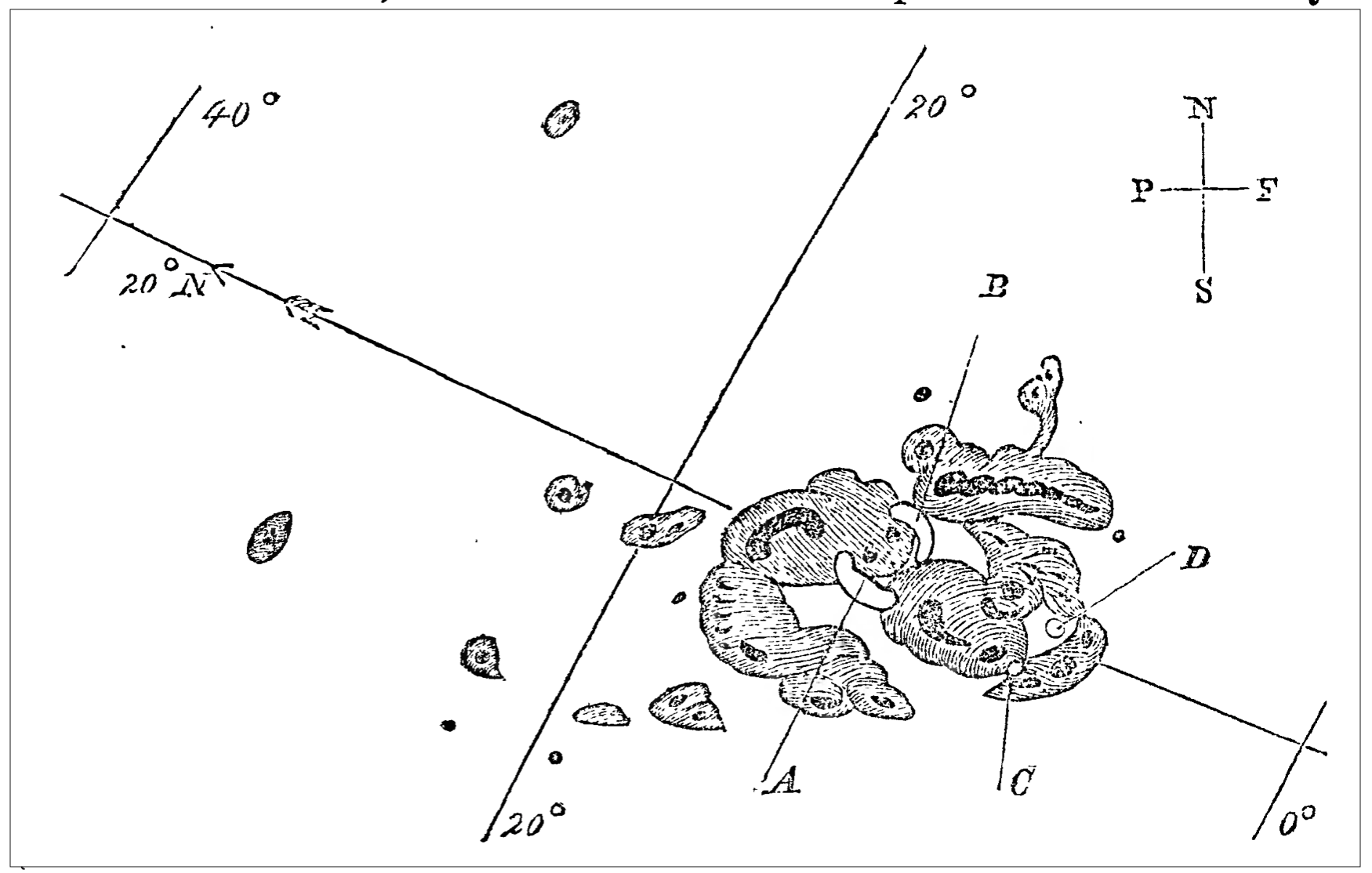
Fig. 1: Carrington’s drawing of the solar white flare from “Description of a Singular Appearance seen in the Sun on 1 September 1859.” Monthly Notices of the Royal Astronomical Society, Vol. 20, p.13-15.
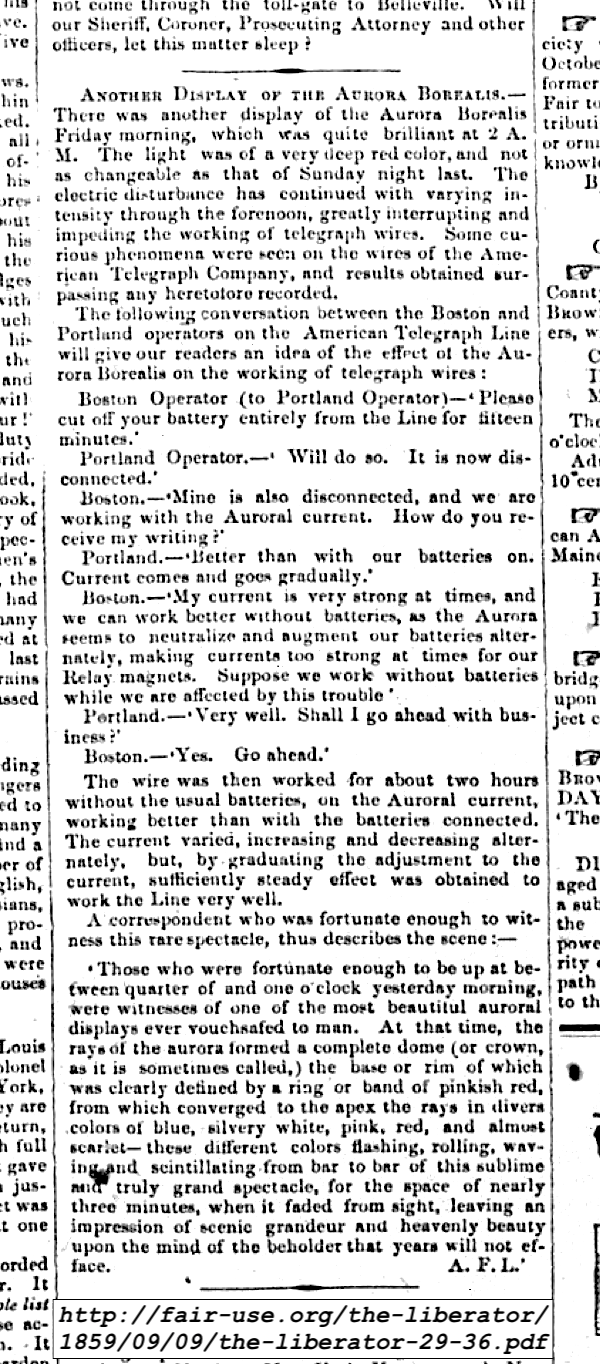
Fig. 2: Newspapers of the day repeated reports about the event. The Liberator. 9 September 1859. (Page 3 of the issue, page 143 of the volume.) The Liberator has been scanned by the Boston Public Library and is provided by them to The Smithsonian collections.
Notes & References
- Clauer, C. R.; Siscoe, G. (eds). (2006). The Great Historical Geomagnetic Storm of 1859. Advances in Space Research, Volume 38, Issue 2, Pages 115-388 (2006). Elsevier ScienceDirect. https://www-sciencedirect-com.ezproxy.lib.utexas.edu/journal/advances-i… (21 articles summarizing and analyzing the events of 28 August to 2 September 1859.)
- Rodger, Craig J.; Verronen, Pekka T.; Cliverd, Mark A.; Seppälä, Annika; Turunen, Esa. (2008). “Atmospheric impact of the Carrington event solar protons,” Journal of Geophysical Research: Atmospheres. Volume 113, Issue D23. 16 December 2008. Wiley Online Library. https://agupubs.onlinelibrary.wiley.com/doi/10.1029/2008JD010702
- Wallace, David. (2024). “A Large Solar Storm Could Knock Out the Internet and Power Grid.” Astronomy. May 10, 2024. https://www.astronomy.com/science/a-large-solar-storm-could-knock-out-t…
- Bonderud, Doug. (2024). “Solar Storms: Is an Internet Apocalypse Imminent?” https://now.northropgrumman.com/solar-storms-is-an-internet-apocalypse-…
- Green, James L.; Boardsen, Scott; Odenwald, Sten; Humble, John; Pazamickas, Katherine A. (2006). “Eyewitness reports of the great auroral storm of 1859,” in 1 above.
- Carrington, R. C. (1860). “Description of a singular appearance seen in the Sun on September 1, 1859.” Monthly Notices of the Royal Astronomical Society. 20, 13–15.
- Hodgson, R. Esq. (1860). “On a curious Appearance seen in the Sun. Monthly Notices of the Royal Astronomical Society, Vol. 20, p.15-16.
- Sheehan, W. (2014). “Carrington, Richard Christopher” In: Hockey, T., et al. Biographical Encyclopedia of Astronomers. Springer, New York, NY. https://doi.org/10.1007/978-1-4419-9917-7_9034
- Hockey, T. (2014). “Hodgson, Richard” In: Hockey, T., et al. Biographical Encyclopedia of Astronomers. Springer, New York, NY. https://doi.org/10.1007/978-1-4419-9917-7_9075
- Prescott, George B. (1885). Electricity and the Electric Telegraph, Sixth edition, revised and enlarged, 2 volumes. New York: D. Appleton and Company.
- Kerr, Les, editor. (2024),”Ask the Wirechief” Morse Telegraph Club. https://morsetelegraphclub.org/wirechief/
- Boteler, D. H. (2006). “The super storms of August/September 1859 and their effects on the telegraph system.” In 1 above.
- Shea, M. A.; Smart, D. F. (2006). “Compendium of the eight articles on the ‘Carrington Event’ attributed to or written by Elias Loomis in the American Journal of Science, 1859 1861.” In 1 above.
- N.a. (1859). “Auroral Phenomenon: Remarkable Effect Upon the Telegraph,” New York Times, 5 September 1859, page 2. ProQuest Historical Newspapers: The New York Times
N.a. (1859). “The Aurora Borealis and the Telegraph,” The Charleston Mercury, 8 September 1859
N.a. (1859) “Auroral Phenomena—Remarkable Effect of the Aurora Upon the Telegraph Wires,” Daily Alta California, volume 11, number 285, 14 October 1859. (https://www.cdnc.ucr.edu/?a=d&d=DAC18591014.2.32)
[Signed] A.F.L. (1859) “Another Display of the Aurora Borealis.” The Liberator. 9 September 1859. - Wichers, Geralyn. (2024). “Solar sends fields navigation haywire.” The Western Producer, 21 May 2024. https://www.producer.com/news/solar-storm-sends-field-navigation-haywir…
- https://theconversation.com/solar-storm-knocks-out-farmers-high-tech-tr…
https://www.cbsnews.com/news/how-do-solar-storms-affect-electronics-gps…