Impacted Members/Scientists: Request a membership waiver, seek meeting support, and other resources. Learn more. For the latest public policy updates, please visit this page.




16 September 2024
Astronomical Society of the Pacific Honors Former AAS Press Officer Rick Fienberg
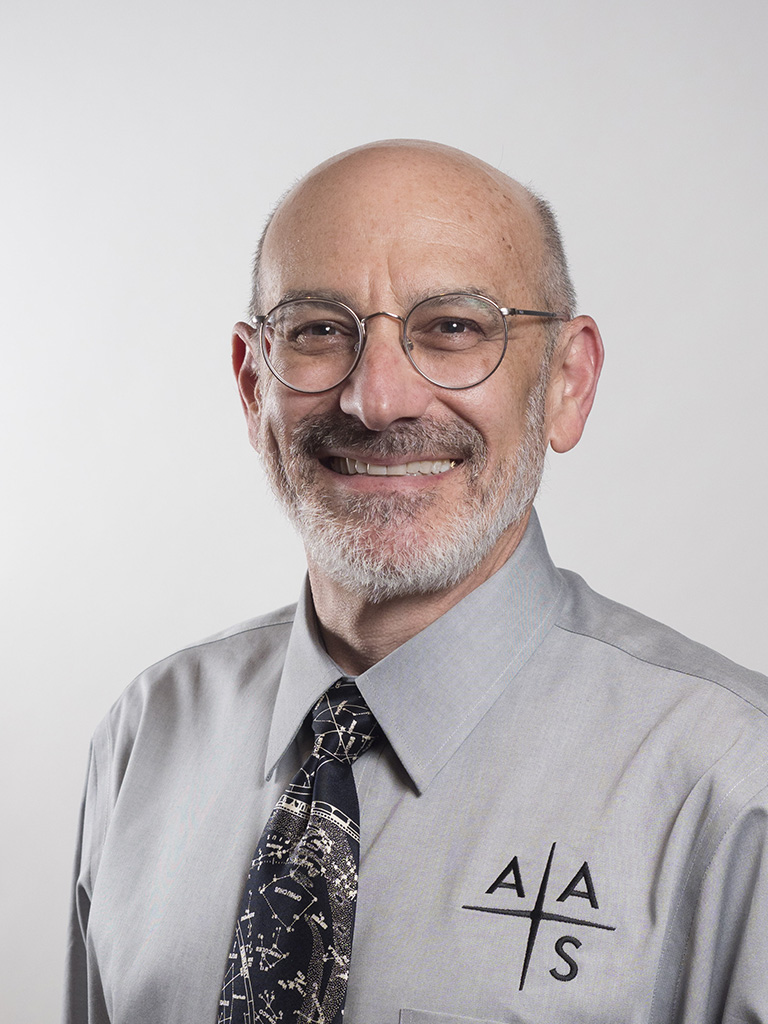
The Astronomical Society of the Pacific (ASP) is honoring Richard Tresch Fienberg with the ASP’s 2024 Klumpke-Roberts Award for his outstanding contributions to the public understanding and appreciation of astronomy. Fienberg is a distinguished astronomer, science communicator, and former Press Officer of the American Astronomical Society (AAS). He is being recognized “for over 40 years as an advocate for astronomy sharing his passion and enthusiasm through his work and outreach, and for over a decade of dedication educating the public on all things solar eclipse.”
Fienberg’s lengthy career includes a PhD in astrophysics, 22 years on the staff of Sky & Telescope magazine (including 8 as Editor in Chief), and 12 years as AAS Press Officer. In addition, he served as President of the International Astronomical Union’s Commission C2, Communicating Astronomy with the Public; he co-created the Galileoscope educational telescope kit designed for the 2009 International Year of Astronomy; he co-wrote “Build a Sun Funnel” on how to make a solar-observing outreach aid; and he co-authored the 5th edition of the book Astronomy for Dummies (Wiley, 2023) with Stephen P. Maran, his predecessor as AAS Press Officer and the 1999 recipient of the Klumpke-Roberts Award.
Perhaps most notable is his work preparing for the North American solar eclipses of 2017, 2023, and 2024. An eclipse chaser himself, Fienberg spent over a decade helping to lead the AAS Solar Eclipse Task Force to educate the public on how to safely and enjoyably view and understand these extraordinary events. Beginning in 2014, Fienberg and an interdisciplinary team of experts developed and disseminated clear and concise eye-safety information. To combat the proliferation of counterfeit and potentially dangerous “eclipse glasses,” Fienberg single-handedly created and maintained an online list of reputable vendors that quickly became the leading reference for where to buy genuinely safe solar viewers. Fienberg received NASA’s Exceptional Public Achievement Medal in 2018 for his work on solar eclipse safety, which the space agency credited with minimizing eye injuries during the 2017 eclipse across the United States. Even following his retirement in the fall of 2021, he volunteered full time to help prepare the public for the 2023 and 2024 solar eclipses.
"Rick is one of those lucky people whose passion overlaps with his work," says AAS Chief Executive Officer Kevin Marvel. "For decades, he has brought astronomy to the people in every role he has had. His energy, drive, and excitement thrill those around him and enhance his ability to communicate and lead in the area of public understanding and appreciation of astronomy. I could not be more happy with the recognition he is receiving from the ASP for his dedicated service to our profession."
The ASP established the Klumpke-Roberts Award in 1974 for outstanding contributions to the public understanding and appreciation of astronomy. Past awardees include Carl Sagan, Isaac Asimov, and the Hubble Heritage Project. Fienberg will be presented with his award at the in-person ASP Awards Gala on Saturday, 9 November, in Burlingame, CA.
Contacts

Other Press Releases
Image
https://aas.org/sites/default/files/inline-images/rickfienberg_1328_768x1024.jpg
Dr. Rick Fienberg, former Press Officer of the American Astronomical Society. AAS photo by Phil McCarten/CorporateEventImages
About the AAS
The American Astronomical Society (AAS), established in 1899, is a major international organization of professional astronomers, astronomy educators, and amateur astronomers. Its membership of approximately 8,000 also includes physicists, geologists, engineers, and others whose interests lie within the broad spectrum of subjects now comprising the astronomical sciences. The mission of the AAS is to enhance and share humanity’s scientific understanding of the universe as a diverse and inclusive astronomical community, which it achieves through publishing, meetings, science advocacy, education and outreach, and training and professional development.