Impacted Members/Scientists: Request a membership waiver, seek meeting support, and other resources. Learn more. For the latest public policy updates, please visit this page.




17 September 2025
AAS Names Daniella Mendoza DellaGiustina as Fred Kavli Plenary Lecturer for 247th Meeting
With support from the Kavli Foundation, the Vice Presidents of the American Astronomical Society (AAS) name a special invited lecturer to kick off each semiannual AAS meeting with a presentation on recent research of great importance. At the 247th AAS meeting in Phoenix, Arizona, on 5 January 2026, the Fred Kavli Plenary Lecture will be given by Dr. Daniella DellaGiustina, a planetary scientist at the University of Arizona's Lunar and Planetary Laboratory.
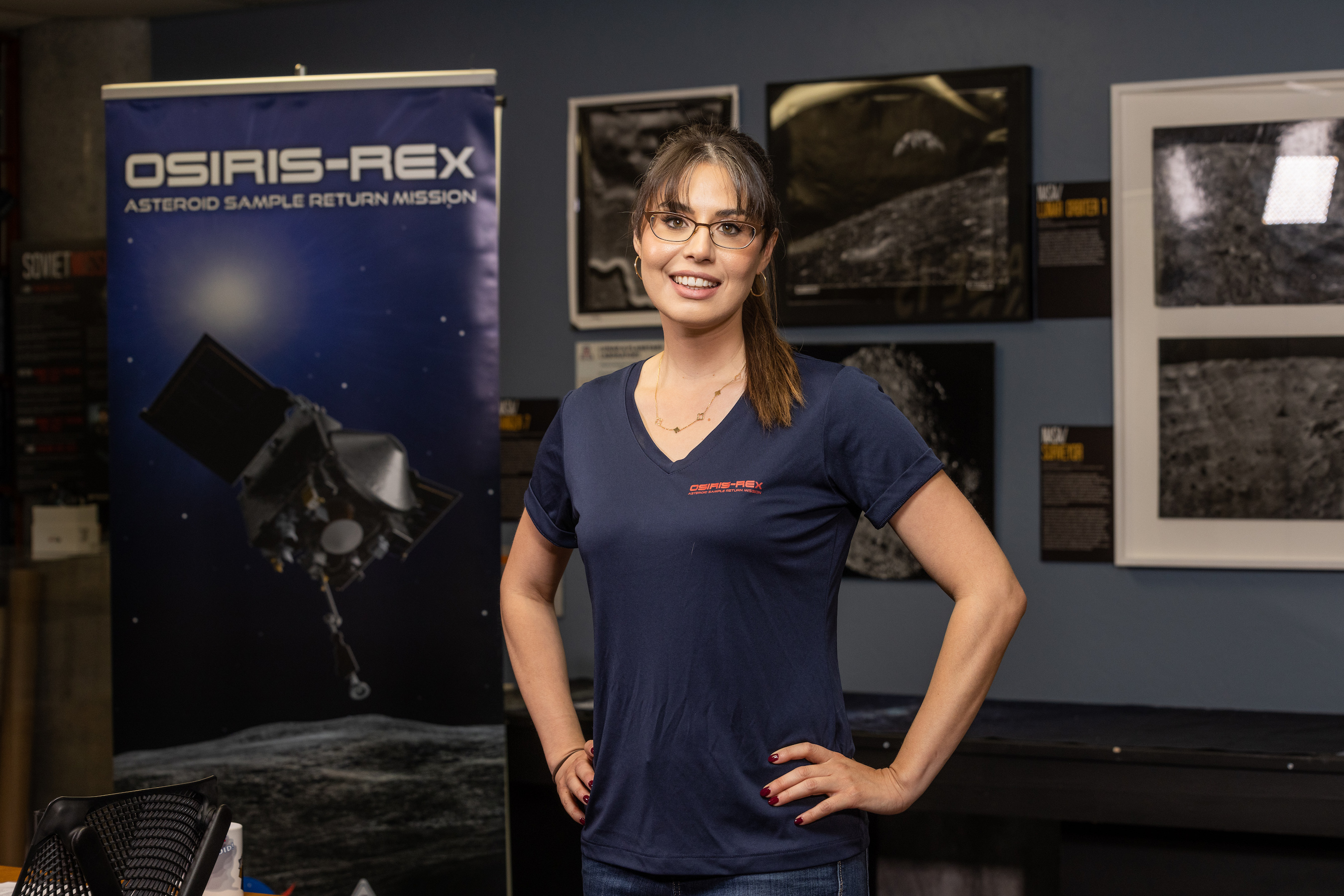 DellaGiustina is the Deputy Principal Investigator for NASA's OSIRIS-REx sample-return mission, a spacecraft that visited and collected samples from the near-Earth asteroid 101955 Bennu. The goals of the mission — and DellaGiustina's research — include learning more about the formation and evolution of our solar system.
Asteroids can act as time capsules, preserving the earliest history of our solar system and possibly even chemical signatures of the oldest building blocks of life. By analyzing the pristine carbonaceous material of Bennu, scientists hope to answer questions like whether the conditions necessary for the emergence of life were present in the early universe, what processes shaped the early solar system, and whether asteroids like Bennu helped shape Earth's own biochemistry.
The OSIRIS-REx mission launched in September 2016 and landed on Bennu in October 2020, ultimately collecting a 121.6-gram sample of Bennu's carbonaceous material and returning it to Earth in September 2023. This material is now being analyzed by scientists in laboratories around the world, and the team has already begun to announce preliminary discoveries — and new questions — uncovered as a result of this analysis.
The AAS Vice Presidents honor the entire OSIRIS-REx sample-return mission team and are delighted to have DellaGiustina deliver the AAS 247 Kavli Lecture in her capacity as Deputy Principal Investigator of the mission. The mission team is lauded "for providing groundbreaking insights into the origins of the Earth and other solar system bodies via the significant achievement of successful sample return from the near-Earth asteroid 101955 Bennu."
Daniella Mendoza DellaGiustina earned her PhD from the University of Arizona before starting as faculty at the University of Arizona's Lunar and Planetary Laboratory in 2022. In addition to serving as the Deputy Principal Investigator of the OSIRIS-REx sample-return mission, DellaGiustina is the Principal Investigator of OSIRIS-APEX, an extension of the OSIRIS-REx mission that will study the asteroid Apophis after its close approach to Earth in 2029. She is also leading the team building seismometers for NASA’s Artemis III mission, which will be deployed by astronauts at the Moon’s south pole in 2027 — marking the first seismic investigation of that region. DellaGiustina is the recipient of numerous awards both individually and as part of the OSIRIS-REx team.
The AAS is delighted to honor Dr. DellaGiustina with the January 2026 Fred Kavli Plenary Lectureship.
Contacts

Image:
https://aas.org/sites/default/files/inline-images/Daniella_Mendoza_DellaGiustina.jpg
Planetary scientist Daniella Mendoza DellaGiustina of the University of Arizona's Lunar and Planetary Laboratory will give the Fred Kavli Plenary Lecture opening the 247th meeting of the American Astronomical Society in Phoenix, Arizona, on 5 January 2026. Photo provided by Daniella Mendoza DellaGiustina.

The Kavli Foundation, established in December 2000 by Fred Kavli, a California business leader and philanthropist, is dedicated to advancing science for the benefit of humanity, promoting public understanding of scientific research, and supporting scientists and their work. The foundation’s mission is implemented through an international program of research institutes, professorships, symposia, and other initiatives in the fields of astrophysics, nanoscience, neuroscience, and theoretical physics.
The American Astronomical Society (AAS), established in 1899, is a major international organization of professional astronomers, astronomy educators, and amateur astronomers. Its membership of approximately 8,000 also includes physicists, geologists, engineers, and others whose interests lie within the broad spectrum of subjects now comprising the astronomical sciences. The mission of the AAS is to enhance and share humanity’s scientific understanding of the universe as a diverse and inclusive astronomical community, which it achieves through publishing, meetings, science advocacy, education and outreach, and training and professional development.