Impacted Members/Scientists: Request a membership waiver, seek meeting support, and other resources. Learn more. For the latest public policy updates, please visit this page.




25 June 2026
AAS 248 Updates for NASA and NSF

Colin Hamill American Astronomical Society (AAS)
During the 248th AAS summer meeting in Pasadena, CA, astrophysics leadership at the National Science Foundation (NSF) and NASA presented updates to AAS attendees. We are writing this blog post to share these updates amidst the agencies’ ongoing programmatic changes, and to offer an overview of how potential incoming policy changes may impact the astronomical community.
One week after the AAS conference, Science’s Jeffrey Mervis reported that the NSF is cutting the budget for many of its science programs by roughly 20–30%, even though Congress appropriated only a ~3% cut to the agency in Fiscal Year 2026 (FY26). These cuts are rumored to be taking place to free up money for X-Labs, a new “outcomes-driven initiative” to fund teams of interdisciplinary researchers with “institutionally independent organizational structures.” It was also reported that program officers within a Section of the Mathematical and Physical Sciences (MPS) Directorate have been directed to stop seeking funding for proposals and to pull back any award recommendations from their queue until more details are provided to the Section.
Given the breadth of the recent and upcoming potential grant solicitation and other policy changes from our science agencies, we ask the astronomical community to submit any comments, questions, and concerns on these policy changes. As we continue to engage in advocacy in support of our members, your feedback will be crucial to our engagement with lawmakers and agency officials. Any and all information gathered here will be used completely anonymously in any communications with Congress and federal agencies, unless you indicate that you are comfortable with your name being shared. Please encourage others to provide their input as well. We also strongly encourage you to continue to stay in contact with your program officers at the relevant agencies.
Feel free to reach out to us at [email protected] if you have questions or would prefer to discuss any of this with the AAS public policy team directly.
A summary of the NSF and NASA updates from the AAS 248 summer meeting is presented below:
NSF
Jim O’Neill, the Administration’s nominee to be the next director of NSF, has not yet been confirmed by the Senate, and the National Science Board has yet to be reappointed following the dismissal of every member in April 2026. With the Department of Housing and Urban Development having taken over the NSF headquarters, NSF staff have been teleworking since January as the agency’s new building is prepared for move-in.
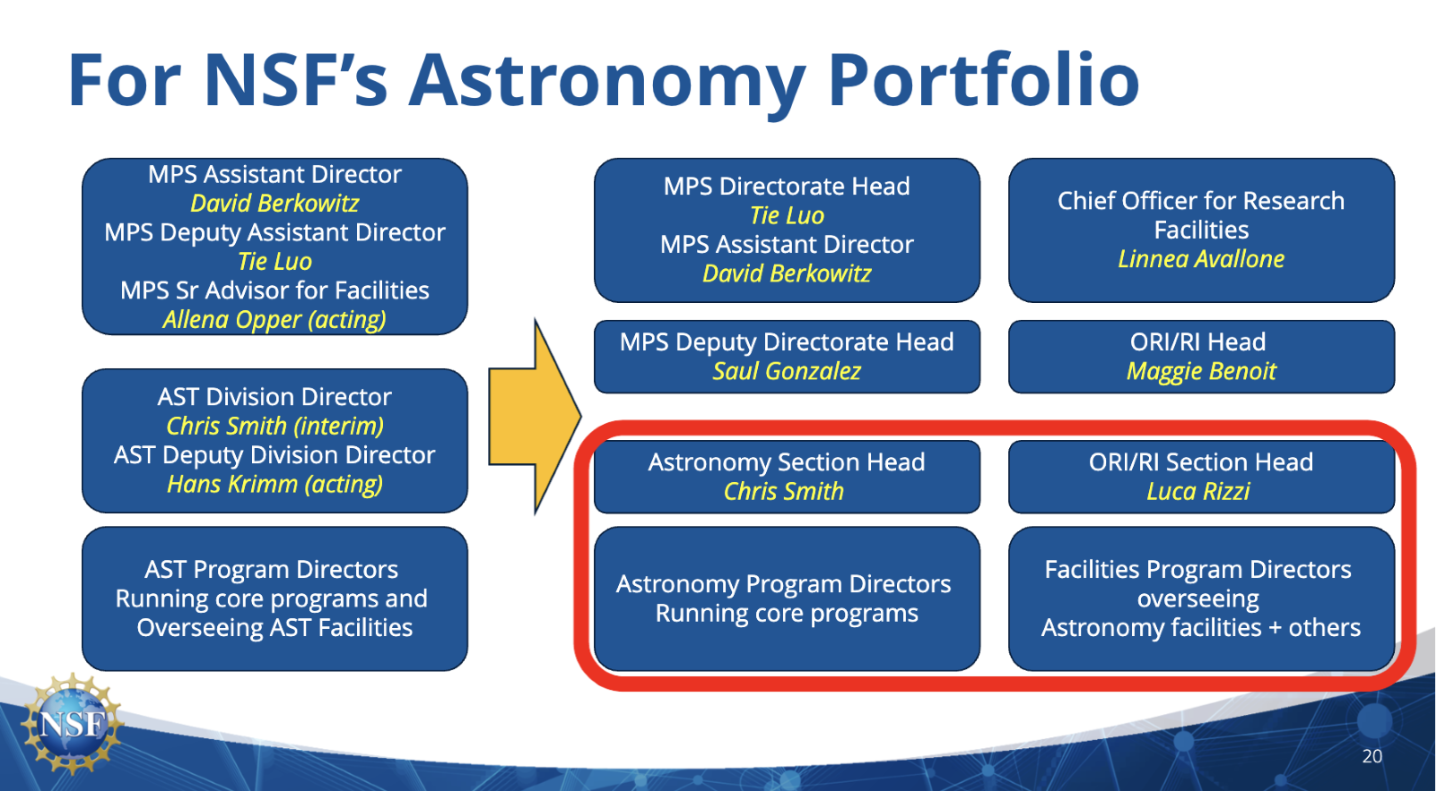
As a reminder, the NSF underwent a major reorganization (below) late last year. All major facilities, including telescopes formerly managed by the Astronomical Sciences Division, are now managed by the Office of Research Infrastructure (ORI). In practice, NSF’s astronomy portfolio is now split across two sections, with grants largely being managed through the Astronomy Section within the MPS Directorate, though the community has been assured that the Astronomy Section within MPS and the ORI Astronomy Section maintain a close working relationship.
Astronomy Grants
The current Administration and NSF have outlined a set of agency-wide priorities, including the following:
- artificial intelligence
- quantum information science
- advanced manufacturing of semiconductors / microelectronics
- biotechnology
- increased investment in EPSCoR (Established Program to Stimulate Competitive Research) jurisdictions
Funding targets have been established for these priority areas across the NSF sections, and these targets and priorities will impact funding available for astronomical science grants. The community was advised that it may be easier to find funding for proposals that emphasize/maximize overlap with Administration priorities, and that emphasizing interdisciplinary overlap with these priorities can help make a stronger case for future funding.
The community was informed there will be new and fewer grant solicitations offered from the Astronomy Section in FY27, as part of an agency-wide effort to significantly reduce the number of solicitations. While the exact changes to NSF astronomy grants are still under development, we expect to see solicitations grouped together into broader solicitations.
Another major change on the horizon is that the Astronomy and Astrophysics Postdoctoral Fellowship might be incorporated into an NSF-wide postdoctoral program. This change may imperil the number of postdoctoral astronomers that are supported by NSF if the agency decides to deprioritize basic research in fields like astronomy in favor of their listed priority areas. At this time, we have been told not to expect any major changes to the solicitations for Research Experiences for Undergraduates (REU) or the Faculty Early Career Development Program (CAREER) programs.
The Astronomy Section at NSF is also considering how to respond to decreasing proposal selection rates. While NSF has not made selection rates at the Division/Section level public for a few years now, funding rates across the agency and within the MPS Directorate dropped in 2025. Given flat or reduced budgets in addition to increased sizes of grants and increased spending on facility operations, it is not inconceivable that this year’s funding rates might be in the single digits. Given the possibility of such low success rates, the Astronomy Section is considering how to maximize the return on investment in terms of the time spent by the community in writing and reviewing proposals, as well as agency staff time and workload. One possibility being considered is a phased grant cycle for the Astronomy and Astrophysics Grants program, such that approximately half of the topical areas covered by the program are considered for funding in a given year, with the other half being considered the following year. Such a phased cycle might also be applied to instrumentation solicitations, but will likely not result in changes to REUs, the Graduate Research Fellowships Program, and CAREER solicitations. We are interested in hearing the community’s feedback on this proposal, as well as the broader issue of decreased selection rates and return on investment. If you have any concerns or ideas regarding these grant solicitation changes, please let us know in our feedback form.
Facilities
The Vera C. Rubin Observatory’s budget and operations continue to ramp up towards its 10-year Legacy Survey of Space and Time. Rubin alerts went live in February, and Data Preview 2 is expected to release sometime between July and September. You can create your free account on the Rubin Science Platform here.
On the US Extremely Large Telescope Program, the Giant Magellan Telescope is in Final Design Phase, with Final Design Review in late 2027 for a possible construction start in 2028. The Thirty Meter Telescope remains in Preliminary Design Phase, despite the FY26 Commerce-Justice-Science Joint Explanatory Statement from January 2026 directing NSF to immediately advance both telescopes into final design review.
The Next Generation Very Large Array (ngVLA) Conceptual Design Review took place in December 2025, and the NSF is currently working on the process to get ngVLA to the Preliminary Design Phase. A prototype ngVLA antenna recently achieved first light .
Operations for the Daniel K. Inouye Solar Telescope continue to ramp up into steady state heading into a new award. The Gemini Observatory continues to be a priority for both Congress and the Administration, and five countries (Argentina, Brazil, Canada, Chile, and Korea) have verbally agreed to a continued Gemini partnership, with an International Agreement for CY 2028–2033 being prepared.
The Astronomy Section and ORI are supporting Cosmic Microwave Background science with planned upgrades for the BICEP Array, the South Pole Telescope with 3G+ camera, Advanced Simons Observatory, and Cosmology Large Angular Scale Surveyor, in coordination with the NSF Physics Section, the NSF Office of Polar Programs, the Department of Energy Office of Science, and the Simons Foundation.
The Next Generation Global Oscillations Network Group (ngGONG), currently in its design stage, is expected to boast 7–17 times greater sensitivity than GONG, and potentially be supported with partnerships with the National Oceanic and Atmospheric Administration, NASA, and/or the Department of Defense.
NASA
NASA Astrophysics and SMD-Wide Announcements of Opportunity
The release of Research Opportunities in Space and Earth Sciences 2026 (ROSES-26) is expected no earlier than July 2026. Most program elements in ROSES-26 will be open to proposals “that advance opportunities aligned with NASA’s Artemis/Moon/Mars exploration program.” NASA has also updated the language used in it post-review notifications in compliance with recent executive orders, but the community has been told that these changes do not reflect a significant change in the underlying processes by which NASA handles proposals after peer review.
A new element called Artificial Intelligence for Astrophysics Networks (AIAN) has been added to ROSES “to advance the maturation and trustworthiness of AI capabilities for use in NASA astrophysics research and future mission development.” Proposals for AIAN must address problem-driven challenges in two main areas — AI for data-driven astrophysics or AI for mission design and technology development — and should be designed to support multi-institutional, interdisciplinary networks across astrophysics, AI/machine learning, and relevant domains. The core requirements for AIAN proposals emphasize establishing systematic and reproducible approaches to AI in astrophysics research by defining performance metrics, characterizing uncertainty and potential failure modes, and evaluating AI capabilities with real-world mission data.
There is another new program element in ROSES called Collaborative Opportunities for Mentorship, Partnership and Academic Success in Science (COMPASS). COMPASS was incorporated into ROSES-25, receiving several Astrophysics proposals, and will also be in the ROSES-26 solicitation. As written on NASA’s website:
“COMPASS prioritizes collaborations with academic institutions that have not traditionally been funded by NASA as part of an effort to provide funding to a broad range of recipients rather than to a select group of repeat players. COMPASS prioritizes research that reflect NASA and the Administration’s priorities and advance the Science Mission Directorate and NASA’s research goals.”
ROSES will have a new solicitation called Astrophysics Research in Technologies (ART), which is a combination of the Astrophysics Research and Analysis Program (APRA), which solicits broad research proposals in astrophysics and astronomy, and the Strategic Astrophysics Technology (SAT), which supports technology maturation for future spaceflight missions. Laboratory Astrophysics, however, will now be a standalone element and no longer part of APRA. The Pioneers element now incorporates the option to propose for smaller-sized CubeSats, which were previously part of APRA. Suborbital investigations will remain a part of ART.
ROSES-27 will include Astrophysics Data Analysis Program (ADAP) and have a proposal due date in mid-2027, returning to the prior schedule of ADAP.
The final Announcement of Opportunity for the 2026 Astrophysics Small Explorer (SMEX) was released on 9 June. Mission selection, following a single-step selection process, is planned for early 2027 with launch readiness around 2031.
Mission Updates
By the end of June 2026, Katalyst’s LINK spacecraft will be launching to boost the altitude of the Neil Gehrels Swift Observatory (Swift), a critical multiwavelength observatory known for its rapid follow-up of transient astrophysical events. Katalyst was awarded the contract to boost Swift in September 2025 and has had ~10 months to design, build, and test their spacecraft. The Swift Boost Mission is being used to demonstrate NASA’s ability to move quickly and affordably, and to demonstrate the US space industry’s on-orbit servicing and life-extension capabilities.
The Nancy Grace Roman Space Telescope (Roman) has successfully completed its final comprehensive performance tests, and it recently arrived at the Kennedy Space Center. Roman’s Operational Readiness Review is expected to occur on 7-8 July, and remains on schedule to launch as early as 30 August. After launch, the telescope will be in a commissioning phase for the first three months, following preliminary operations from months four through nine, before full science operations begin 10 months after launch.
NASA recently passed Key Decision Point B recently for the Laser Interferometer Space Antenna (LISA), a mission led by the European Space Agency (ESA) with NASA as a major partner. The Telescope Structural Models also completed fabrication and testing at NASA and were delivered to ESA.
NASA Goddard Space Flight Center will be the prime manager for Habitable Worlds Observatory (HWO) mission, with 75% of HWO funds going external to NASA to help with early technology maturation. HWO funds are also being used to fund five industry-led studies on the “architecture trade space,” investigating how in-space servicing could be used on HWO and/or upgrade instruments over its lifetime. NASA is also exploring how AI tools can help accelerate both the design process and the evaluation of HWO architectures/concepts. NASA Marshall Space Flight Center is leading a study on adding gamma-ray burst detectors to HWO.
The Compton Spectrometer and Imager, a SMEX mission to study energetic phenomena with its wide-field gamma-ray telescope, is planned to launch no earlier than 2027. The Ultraviolet Explorer, a Medium-Class Explorer mission to study the ultraviolet sky, is expected to launch in 2030.
NASA’s Astrophysics Division is launching the Astrophysics Strategic Technology & Research Accelerator Initiative "to reduce the total cost, time-to-science, and schedule risk of future strategic missions, aligning with the guidance from Astro2020...” per NASA’s website.