Impacted Members/Scientists: Request a membership waiver, seek meeting support, and other resources. Learn more. For the latest public policy updates, please visit this page.




6 May 2026
Astronomy in Action: Growing a Community Outreach Program from Scratch
Jacob Beavon University of Toledo
Abigail Ambrose University of Toledo
Welcome to the AAS Education Committee Blog! Our blog features posts from astronomers and educators in the extended AAS community, curated by the AAS Education Committee. Subscribe here to receive future posts and other astronomy education news directly into your inbox every two weeks; also follow us on Bluesky and Instagram. We welcome guest article submissions! — AAS Education Committee.
Eds. Note: Click here for a description of the outreach activities featured in this post!
“You know, cleaning this up wouldn’t be taking so long if you had let us buy a goat,” I told our department chair as we shoveled more pumpkin guts into yet another trash bag.
“I think you are vastly overestimating how many pumpkins a single goat is capable of eating,” he countered.
It was a valid point. In the last two hours we had used sledgehammers to smash more than 60 pumpkins, the guts of which now littered the field. While the two of us and a few others were trying to shovel as much of the remains into trash bags as possible, another group of graduate students was filling a wheelbarrow with the 120 mini pumpkins that we had flung with giant slingshots over the same two hours. Judging from the carnage, the first-ever “Pumpkin Fling” at the University of Toledo (UT) had been a tremendous success.
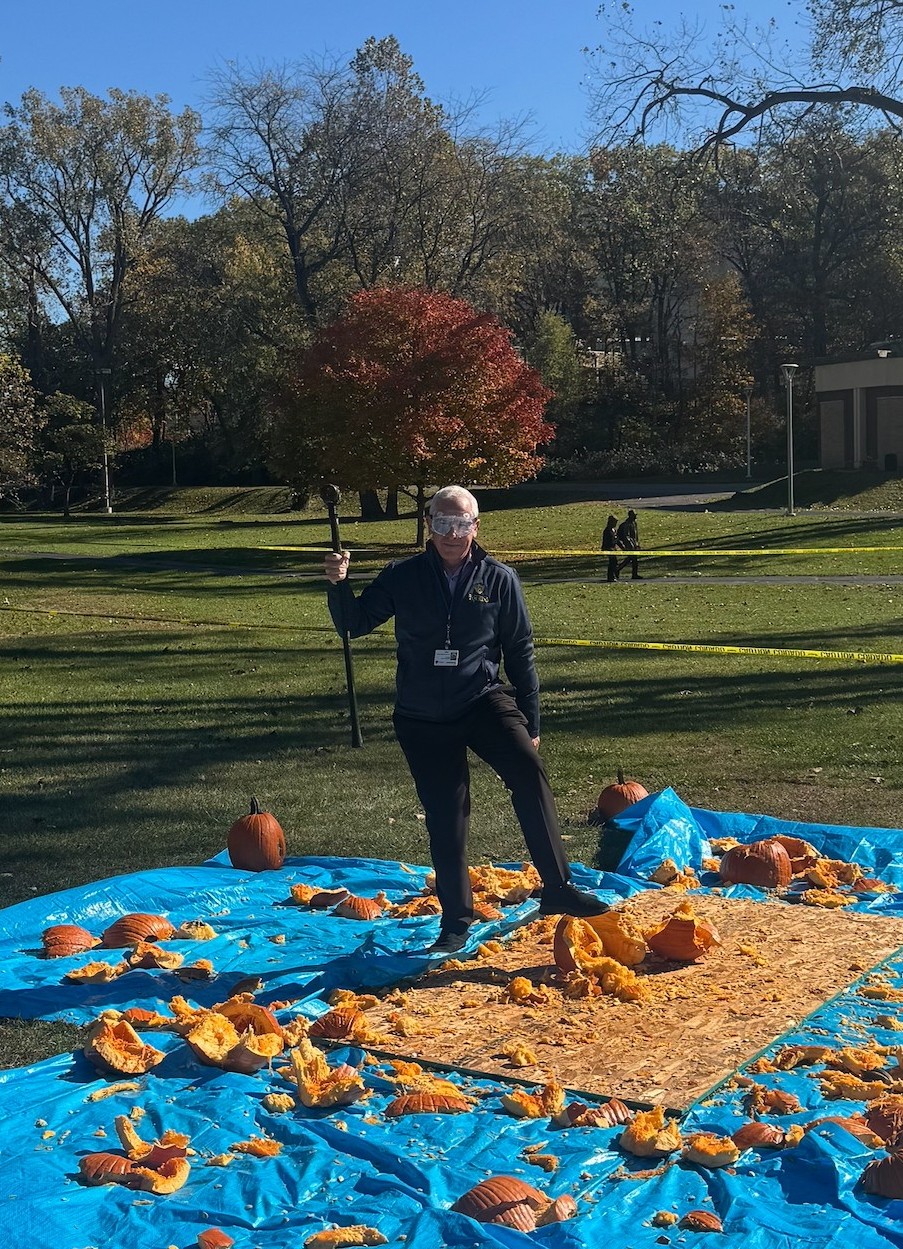
Abigail Ambrose (another graduate student) and I had organized the Pumpkin Fling as the latest campus event for the Department of Physics & Astronomy’s outreach program. We decided to revitalize the program in the fall of 2024 after it had been dormant since the pandemic hit in 2020. After such a long hiatus, revitalizing the program ended up looking a lot more like starting it from scratch. Our initial idea was to take physics and astronomy demos into local classrooms, which required us to take stock of our department’s available materials. We found several demos that were ready to use: a gravity well, an angular momentum stool, spectrum tubes and glasses, a cratering demo, and various liquid nitrogen activities. (See our curriculum document here.) Confident that we had enough demos to start, we began contacting local schools to gauge interest in hosting us. Ultimately, five schools invited us to present that spring. We spoke in both individual classrooms and assemblies, and our audience spanned 4th–12th grade. We received overwhelmingly positive feedback and were asked by all five schools to return this year. The positive word of mouth spread, as 30 schools have requested events this academic year, six times greater than we received last year.
In addition to our school visits, we have also made an effort to engage with the UT campus and broader Toledo communities. This includes October’s Pumpkin Fling, designed as a pre-midterm stress reliever. Students launched pumpkins 75 yards at a giant cornhole board for candy and smashed jack-o’-lanterns with a sledgehammer. The event proved to be popular with students and faculty alike; even the university president participated! With the assistance of our planetarium director, we have incorporated 10-minute graduate student research talks once a month into the Friday night public planetarium show. Finally, we use our observatories to host campus star parties and collaborate with a local wildlife refuge for public observing nights under darker skies. In all, we will perform 40 outreach events this academic year, in just the second year of the revitalized effort.
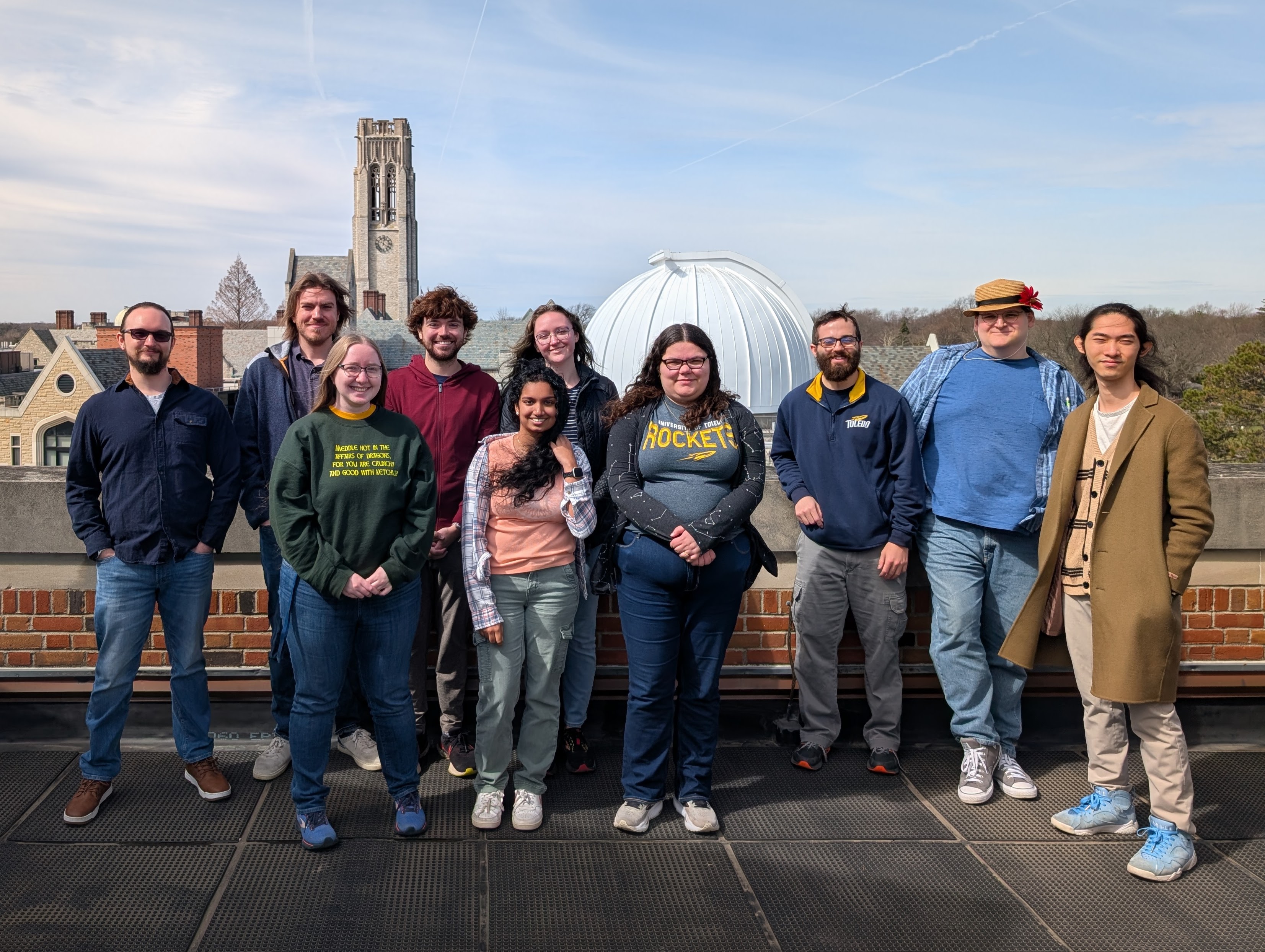
We have been overwhelmed by the success of the program, as it has grown far beyond what we initially hoped it could be. On several occasions we have tried to determine what has contributed most to our success. Broadly, we believe three key factors are responsible and would like to share them with you so that you can implement them yourselves.
First, you have to know your audience and allow that to shape the event. When we are in an elementary school, we bring our most interactive demos and often implement stations as well — anything to keep the kids moving and as hands-on as possible. When speaking, we try to anchor the science in real-world experiences: the pull of gravity after a jump, the way ice skaters control their spin through angular momentum conservation, and even the reality of binary stars like those Luke Skywalker sees on Tatooine. At this age, if we can simply get students excited about science for an hour, we have done our job. When we speak to high schoolers, we still try to make the demos as interactive as possible, but we are able to discuss the science in more practical detail. We have found that older students are very interested in what it is we actually do day-to-day and ask great questions about our long-term goals and the opportunities available to people in our field. We are often asked by teachers to focus on specific concepts they have either recently gone over in class or will be going over soon. We are happy to oblige, and we believe our willingness to do so is part of why every school we have visited has invited us to come back.
Second, be bold with your ideas. In the last two years, we have smashed pumpkins, had a bowling ball pendulum come perilously close to our faces, built a 10-foot-wide model Sun, repeatedly shocked ourselves with a Van de Graaff generator, and used liquid nitrogen to shatter more racquetballs and make more batches of ice cream than I can count. Thankfully we have been able to do all of these things because of the wonderful support of our department (the lack of a goat notwithstanding). Scientists are often perceived as people who conduct crazy experiments, build weird contraptions, and occasionally blow things up. We have found that leaning into that is a benefit, not a detriment.
Finally, and most importantly, you have to be enthusiastic. Our program is run completely on a volunteer basis. The result is that everyone involved has a genuine interest in science education. We have done events with four people in attendance, and we have done events with forty people in attendance. We have forgotten equipment, accidentally blown a hole in a ceiling light, shattered three liquid nitrogen dewars, and had demos stop working mid-presentation. Despite all of that, our program continues to grow. We strongly believe it is a testament to the enthusiasm of our volunteers. Our outreach program is proof that if you have a group of people who are willing to engage the public enthusiastically while demonstrating that science is interactive, tangible, and fun, then you will find the public excited to listen and left wanting more.