Impacted Members/Scientists: Request a membership waiver, seek meeting support, and other resources. Learn more. For the latest public policy updates, please visit this page.




3 February 2026
Read the February 2026 Issue of Physics Today

Hua Liu American Astronomical Society (AAS)
Physics Today, the flagship publication of the American Institute of Physics (AIP), is the most influential and closely followed physics magazine in the world. With authoritative features, full news coverage and analysis, and fresh perspectives on technological advances and groundbreaking research, Physics Today informs readers about science and its role in society. Members of the AAS, an AIP Member Society, automatically receive free print and online subscriptions to the magazine. Physics Today Online, the magazine’s internet home, presents an enhanced digital edition and provides a valuable online archive.
Highlights from the February 2026 Issue
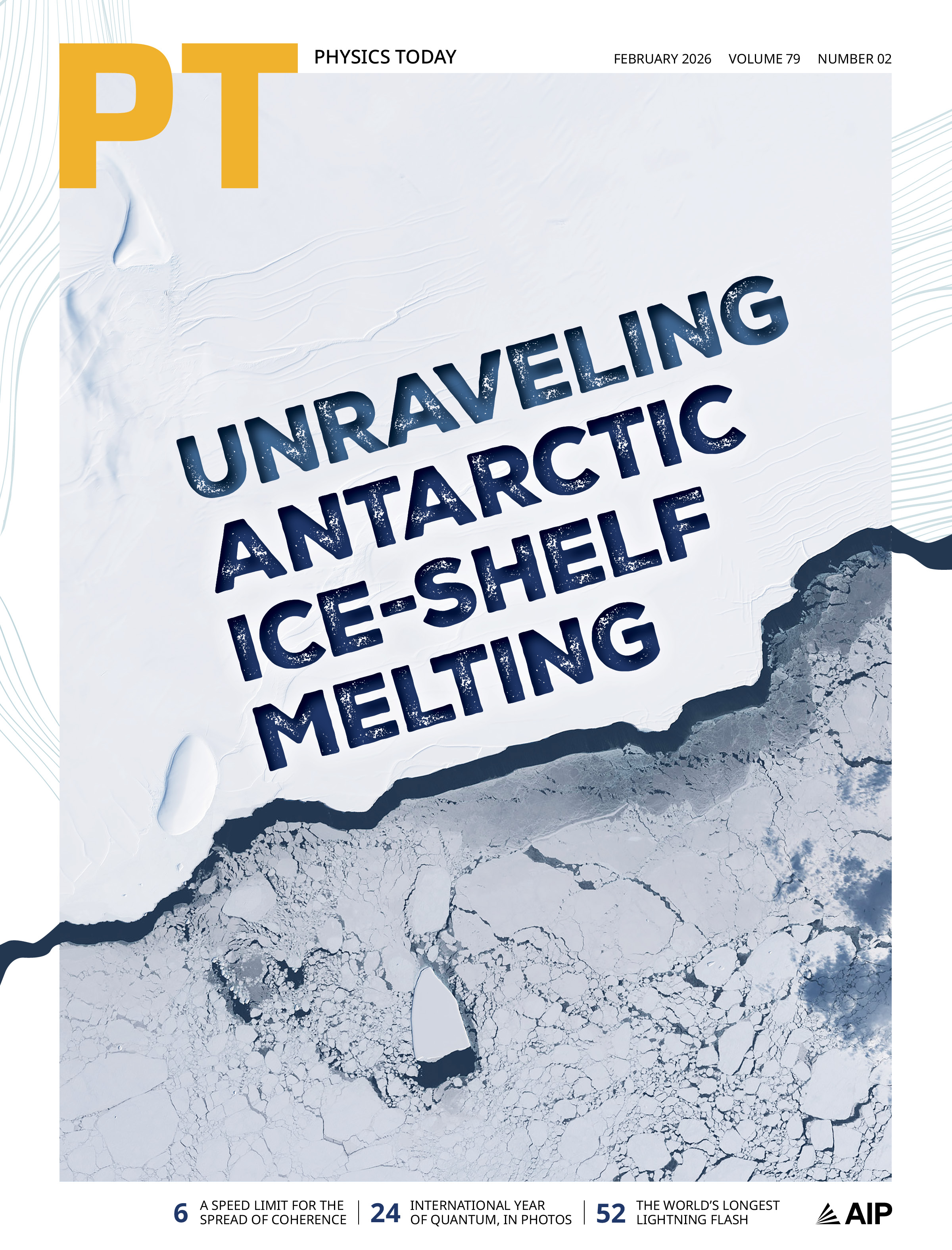
Unraveling the Mysteries of Antarctic Ice-Shelf Melting
Beneath the ice shelves of the frozen continent, a hidden boundary layer of turbulent ocean is determining Antarctica’s fate. — Catherine A. Vreugdenhil and Bishakhdatta Gayen
NASA’s Next Space Telescope Reaches Assembly Milestone
The Nancy Grace Roman Space Telescope will survey the sky for vestiges of the universe’s expansion. — Jenessa Duncombe
As Satellite Population Surges, so Does the Impact on Astronomy
Images captured by ground telescopes are getting contaminated by sunlight reflected off satellites. Space telescope data can get compromised too. — Sarah Wells
The arXiv Server to Require English Version with Submissions
The availability of free translation software clinched the decision for the new policy. To some researchers, it’s anathema. — Toni Feder
A Fundamental Limit to How Fast Coherence Can Spread
An ultracold atomic gas can sync into a single quantum state. Researchers uncovered a speed limit for the process that has implications for quantum computing and the evolution of the early universe. — Laura Fattaruso
Megaflashes: The World’s Longest Lightning Discharges
Lightning is sometimes described as just a big spark. But just how big can the spark get? Satellite sensors say … very! — Randall S. Cerveny, Michael J. Peterson, and Walter A. Lyons