Impacted Members/Scientists: Request a membership waiver, seek meeting support, and other resources. Learn more. For the latest public policy updates, please visit this page.




27 January 2026
What Physics Teacher Education Taught Us about Organizational Change
Annelise 'Skylen' Roti Roti
American Physical Society
Welcome to the AAS Education Committee Blog! Our blog features posts from astronomers and educators in the extended AAS community, curated by the AAS Education Committee. Subscribe here to receive future posts and other astronomy education news directly into your inbox every two weeks; also follow us on Bluesky and Instagram. We welcome guest article submissions! — AAS Education Committee.
What inspired physicists and astronomers to pursue their fields of study? When APS informally surveyed attendees at the Global Physics Summit and the Physics Education Research Conference in 2025, responses varied between everything from FallOut to Star Wars to famous scientists to family and friends. But there was one answer that came up many times: high school physics teachers.
If high school physics is such a pivotal place, then we must ask how we can support and prepare high school physics teachers. There are many answers to this question, including building robust preservice teacher pathways. This is the approach at the heart of the Physics Teacher Education Coalition (PhysTEC). For over 20 years, PhysTEC, a joint project of the American Physical Society (APS) and the American Association of Physics Teachers (AAPT), has invested funding, time, and project design expertise into building physics teacher education programs at institutions of higher education across the country. This blog post describes what PhysTEC staff do to help faculty make the organizational change necessary to build streamlined, valued, and sustainable programs.
PhysTEC has historically measured success in this effort by the number of certified teachers graduating from a particular university [1]. However, PhysTEC staff also look at success through a broader lens: success may look like one or ten teachers graduating, but it may also look like students who wish to teach staying in physics because they are supported in their career goals. We also consider a sustainability lens: do the cultural, structural, and procedural changes stick around after the initial change effort?
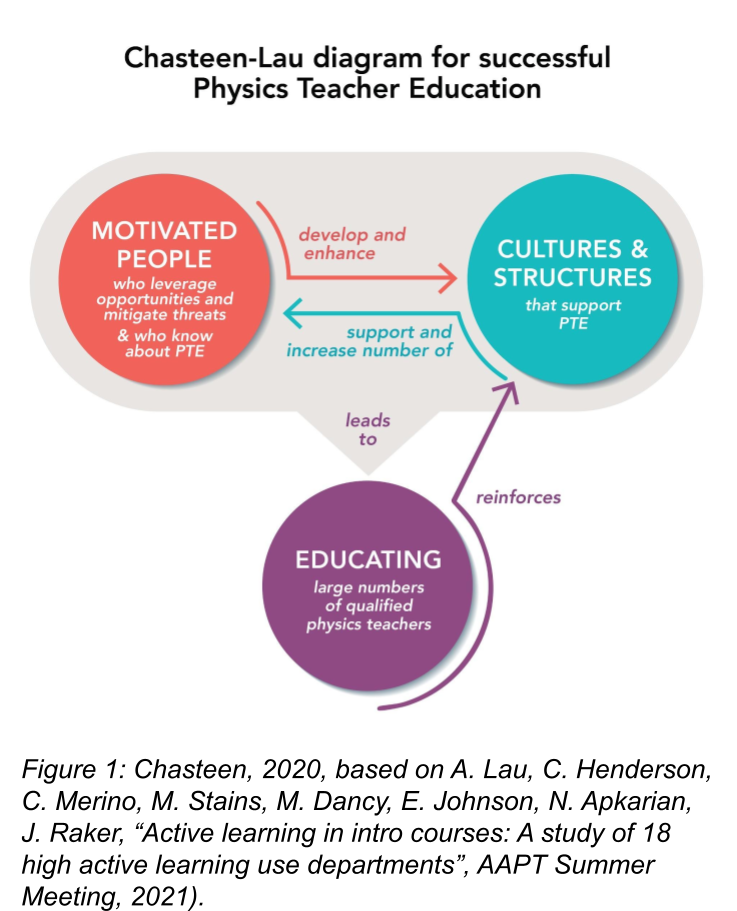
While the final recipes for sustainable change have significant local variance, there are certain program features [2] that work everywhere we have seen them implemented. We have observed, as per Figure 1, that building a physics teacher education program requires three key components: motivated people with knowledge about teacher education, structures that support teacher education, and cultures that encourage teacher education. Cultures might look like faculty being publicly and vocally supportive of teaching as a profession, students talking positively about teaching, and materials with factual information about teaching being readily available. Structures might include a streamlined degree path, jobs where high school teachers work with universities and mentor students, internal funding to support students, or policies that include teacher education as an activity that counts toward tenure and promotion.
In the PhysTEC case, the motivated person or team is/are most often physics faculty in partnership with education faculty. These motivated people, which PhysTEC staff sometimes call champions [3], have knowledge about the topic at hand and develop an awareness of the cultures and structures that can be leveraged to make changes that lead to the education of the next generation of high school physics teachers.
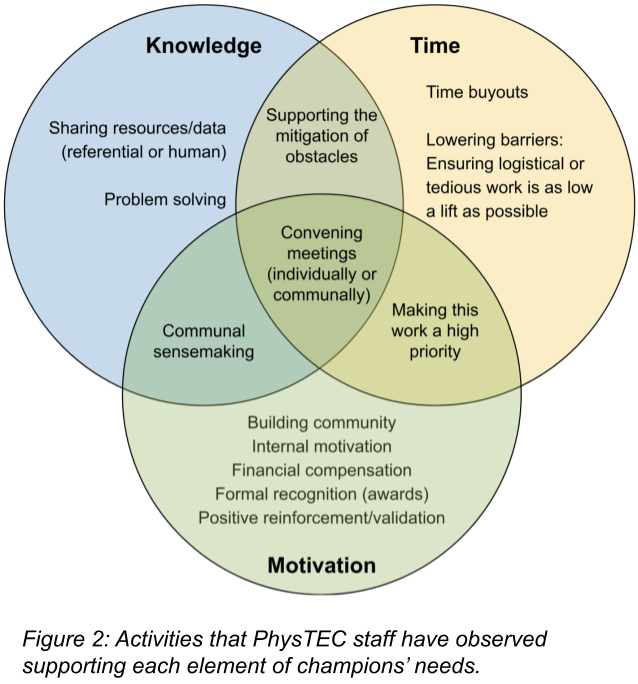
Champions tend to be busy people. Adapting the Brownell and Tanner, 2012 model [4], I argue that champions need motivation, knowledge, and time in order to be able to make change. Effective provision of these elements can manifest in many ways, and it is often up to staff or professional development organizers to find out what is needed and how to implement it [5-7].
Motivation is the element that most champions have in abundance already. That motivation is usually internal motivation and comes from a drive to have a larger impact on physics education [8, 9]. The PhysTEC project offers a handful of modes of recognition such as national awards, titles, funding, and letters of support, all of which serve the dual purpose of supporting motivation by creating a sense of priority and increasing the likelihood of success by increasing the reputation of the champion. We also support motivation by ensuring that champions are involved in the PhysTEC community via regularly scheduled videoconferences as well as invitations to national community convenings.
Champions also have strongly localized knowledge. They know, or can discover, the local strengths, weaknesses, opportunities, and threats that might impact their desire to develop a physics teacher education pathway. Thus, as funders and leadership development professionals, PhysTEC staff co-create goals and metrics of success with local champions that answer questions such as:
- Given PhysTEC’s mission of ensuring high school students have access to well prepared teachers, how do you want to contribute to that mission?
- What assets and allies do you have available to you?
- What opportunities exist that you could leverage to create the infrastructure you need?
- What are the top two or three obstacles to completing your goals?
Once a team’s goals are developed, we augment their localized knowledge with resources like national data, scheduled communal problem-solving conversations with their peers, and recommendations based on our awareness of the successes and struggles of teacher education efforts across the nation. When making recommendations, we make an effort to avoid being overly prescriptive. This allows the champions’ localized knowledge to shine and adapt ideas appropriately.
When it comes to time, we make time for faculty to work on building teacher education programs by offering financial support that includes time buyouts. We also schedule meetings to plan or do the work, help faculty find other financial resources, and sometimes offer site visits where we work to convince university leadership to create time for faculty to build their program.
This is not to say that providing everything in Figure 2 is all it takes to create lasting change every time. There are many unforeseen challenges that can put organizational change at risk. The most common one we have seen is transitions: when people leave and new folks need to be onboarded, or when funding is lost, or state or national policies change in a way that cannot be affected by the champions, the work done so far is put at risk. These are moments where we staff try to step up and support the champions or program. We help by validating frustration, offering meetings for on- and off-boarding to support the new champion or champions, and discussing goals with the new local leadership. There are times where a physics teacher education program cannot be saved, but it is worth the effort.
If you are trying to enact organizational change, I hope you will consider adapting some of the activities that I have described here to your situation. My team and I on the PhysTEC project have seen these activities support over sixty universities in the development of physics teacher education pathways. If you have any questions about how PhysTEC implements the support we offer to champions, please email [email protected].
PhysTEC has been supported by NSF award numbers 0075528, 0108787, 0833210, 0808790, 1719518, 1707990, and 2325980.
References
[1] PhysTEC (2025) National Report Card on Physics Teacher Preparation. https://phystec.org/report-card/
[2] Chasteen S (2021) 2021 Comprehensive II Site Sustainability Evaluation Study. https://cdn.sanity.io/files/4wurd6lm/production/cd51820663c37691557e926fde682633706b6a01.pdf
[3] Meltzer EDE, Plisch M, Vokos S (2012) Transforming the Preparation of Physics Teachers: A Call to Action. https://cdn.sanity.io/files/4wurd6lm/production/dc86821f248f83bd57448df03db3bfc99721bf25.pdf
[4] Brownell S, Tanner KD Barriers to Faculty Pedagogical Change: Lack of Training, Time, Incentives, and…Tensions with Professional Identity? https://doi.org/10.1187/cbe.12-09-0163
[5] Professional Development in Science Education | NSTA. https://www.nsta.org/nstas-official-positions/professional-development-science-education
[6] Bond MA, Blevins SJ (2020) Using Faculty Professional Development to Foster Organizational Change: a Social Learning Framework. TechTrends, 64(2):229–237. https://doi.org/10.1007/s11528-019-00459-2
[7] Caffarella RS, Zinn LF (1999) Professional Development for Faculty: A Conceptual Framework of Barriers and Supports. Innovative Higher Education, 23(4):241–254. https://doi.org/10.1023/A:1022978806131
[8] Roti Roti A (2025) How did YOU get into Physics Teacher Education/PER? https://docs.google.com/presentation/d/1TKJSPi3sc4opL9Y3TiIxMSlS0-sfxB344YkDTpc_Rxs/view
[9] Chasteen S (2021) 2021 PhysTEC Online Conference Evaluation Report. https://cdn.sanity.io/files/4wurd6lm/production/ff74c94efbb9e3e08c8109ad69cadb3425b0d76a.pdf