Impacted Members/Scientists: Request a membership waiver, seek meeting support, and other resources. Learn more. For the latest public policy updates, please visit this page.




3 September 2025
Read the September 2025 Issue of Physics Today

Hua Liu American Astronomical Society (AAS)

Physics Today, the flagship publication of the American Institute of Physics (AIP), is the most influential and closely followed physics magazine in the world. With authoritative features, full news coverage and analysis, and fresh perspectives on technological advances and groundbreaking research, Physics Today informs readers about science and its role in society. Members of the AAS, an AIP Member Society, automatically receive free print and online subscriptions to the magazine. Physics Today Online, the magazine’s internet home, presents an enhanced digital edition and provides a valuable online archive.
Highlights from the September 2025 Issue
Fluctuating Tariffs Exacerbate US Science Funding Woes
For new faculty and others ordering big-ticket items, the import taxes can be a gut punch. — Toni Feder
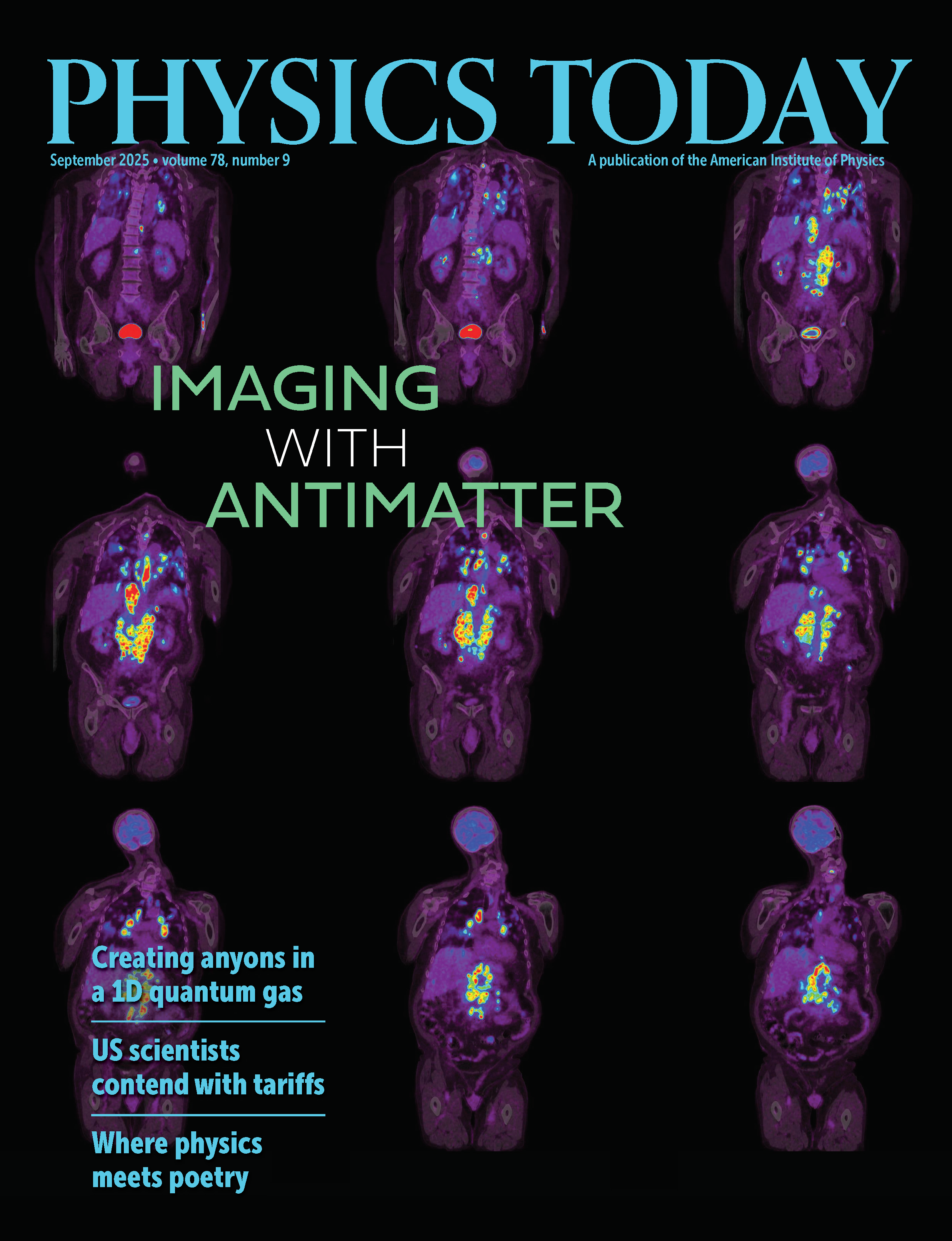
Medical Imaging with Antimatter
Positron emission tomography’s ability to image the body’s biochemistry, not just its anatomy, makes it a powerful tool for detecting diseases. — John Sunderland
From Radio with Love: A Cold War Astronomical Collaboration
To construct an interferometer with a baseline spanning the planet, US radio astronomers reached out to their Soviet counterparts. — Rebecca Charbonneau
Where Physics Meets Poetry
Defying the often-perceived incompatibility between the two subjects, some physicists are using poetry to communicate science and to explore the human side of their work. — Maia Chandler
Anyons Abound in 1D Quantum Gases
The statistical behavior of the unusual particles, which are neither fermions nor bosons, is coming under experimental control. — Johanna L. Miller
A Radio Telescope Array Takes Shape with Private Funds
At a time when federally supported science is in flux, the Deep Synoptic Array-2000 project in Nevada is moving toward construction with a combination of university and philanthropic support. — Sarah Scoles