Impacted Members/Scientists: Request a membership waiver, seek meeting support, and other resources. Learn more. For the latest public policy updates, please visit this page.




17 September 2025
High School Students Presented at AAS Meeting
Kalee Tock
Stanford Online High School
Welcome to the AAS Education Committee Blog! Our blog features posts from astronomers and educators in the extended AAS community, curated by the AAS Education Committee. Subscribe here to receive future posts and other astronomy education news directly into your inbox every two weeks; also follow us on Bluesky and Instagram. We welcome guest article submissions! — AAS Education Committee.

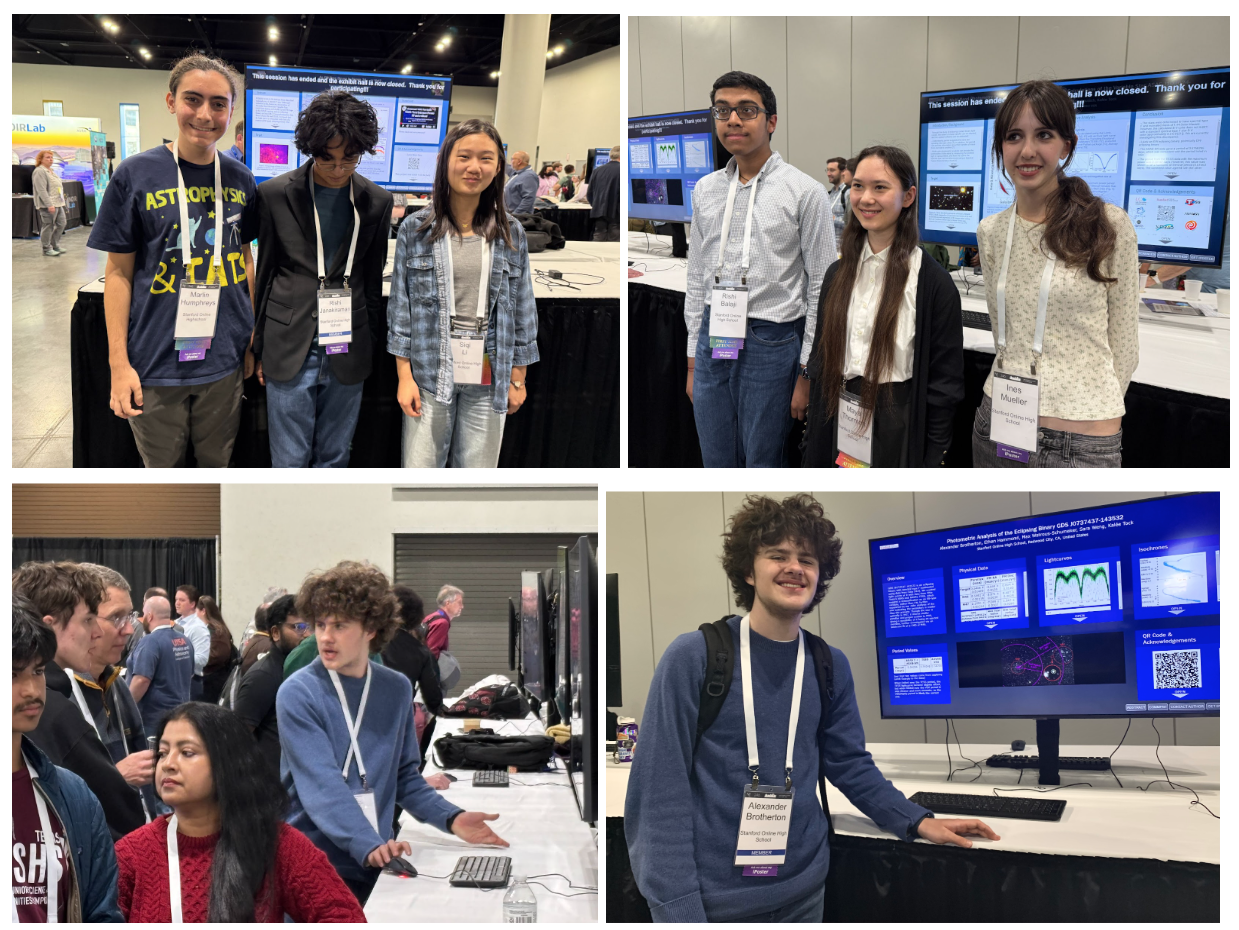
Eight students from Stanford Online High School traveled to the June 2025 American Astronomical Society (AAS) meeting in Anchorage, Alaska, to present their research projects in a dedicated high school poster session! Special thanks to all who made this possible: the American Astronomical Society education team, Las Cumbres Observatory Global Sky Partners, NASA Exoplanet Watch, the Astromancer by Skynet suite of analysis tools, the Journal of Double Star Observations, the American Association of Variable Star Observers, and Stanford Online High School!
In the Stanford Online High School Astronomy Research Seminar, students first complete double star projects in which they study the relationship between two stars that appear close together in the sky. Are they moving together? If so, maybe they were born together in the same gas cloud and ejected from their stellar nursery together at the same time. Studying the motions of stars like this helps us understand the dynamics of the galaxy. Some of the pairs of stars might even be orbiting each other, but many of the timescales are long: the stars can take centuries if not millennia to complete one orbit. To determine if this is happening, we plot the motion of a star from the reference frame of a different star. Over time (where “over time” means over the last few hundred years), the star’s motion is tracing out the beginnings of what might be an arc around its companion. Sometimes the historical measurements go back as far as the 1700s or 1800s, when a cold astronomer huddled next to a telescope in the middle of the night, writing down measurements with stiff fingers. These days, thanks to the Las Cumbres Observatory (LCO) Global Sky Partners, students are able to request images via a web portal and perform measurements when the images are returned the following morning.
Double star projects allow students to build essential skills such as finding target stars in images, making astronomical measurements, and looking up historical data for the star in various databases and catalogs. There are many ways in which inspired students can take double star projects further if they choose to do so. For example, they might investigate or refine characteristics of the stars’ orbits, playback the stars’ motions to determine whether they were ever co-located, or explore more advanced imaging techniques such as speckle interferometry to study pairs of stars that are too close together to resolve in a normal image. However, no matter how in-depth their investigation becomes, double star projects provide students with valuable experience in the scientific review process as they publish their studies in the student-friendly Journal of Double Star Investigations.
Following their double star projects, teams of students in the Stanford Online High School Astronomy Research Seminar embark on investigations of variable stars. Variable stars are ideal for high school projects because each star is unique, offering students the chance to uncover intriguing nuances in astrophysics. By exploring variable stars, students can contribute meaningful updates to the American Association of Variable Star Observers database, enhancing the understanding of phenomena like Cepheid pulsation modes and the characteristics of companion stars in eclipsing binary systems. This hands-on experience not only deepens students’ astrophysical knowledge but also allows them to make a valuable scientific contribution.
For example, one team of four students investigated a Cepheid pulsator located in a starfield that also contained a nebula and several star clusters in addition to their target. Using data from the Transiting Exoplanet Survey Satellite (TESS), the students discovered that the star was pulsing not in a single mode, but in two overlapping modes. They also uncovered a slight but intriguing discrepancy between the distance derived from the star’s parallax and the distance calculated from a period-luminosity relationship. Finally, they collected images in six different colors from LCO and characterized the color changes that accompany the star’s changes in brightness.
Another team of students, calling themselves the “Schwarzchildren,” studied an eclipsing variable star in the field of a star cluster. During their investigation, using Skynet’s Clustermancer software, they found a faint suggestion of a second star cluster in the field, which they named the “Ghost.”
Another team found fortuitous variable stars in the fields of NASA Exoplanet Watch exoplanet targets!
The students benefited immensely from their participation in the AAS conference. The astronomers who interacted with them were motivated by a genuine interest in the projects and topics. This fundamentally different purpose gave the presentations a completely different feel and flavor from a science fair. Rather than performing for a grade or accolade and being judged on their knowledge, the students communicated their results to scientists who wanted to learn from them and, in some cases, replicate or draw upon the students’ results to enhance their own work. The students also gained valuable feedback and useful ideas for further exploration of their targets. For example, one of the student teams learned a new technique for querying the TESS database, which gave complementary information to the method they had used previously and provided insight into the lightcurves that they had generated. Another of the student teams had to think on their feet to respond to a challenge posed by one of the visitors to their poster. The students said the experience was impactful because it made them realize that they were being addressed as scientists rather than as students.
Given the unique and unpredictable direction of each project and the generally time-consuming nature of scientific research, these are not the sorts of projects that can be shoehorned into an existing curriculum or given to students as a fully independent project. However, research programs are becoming more common in high schools, and any high school physics teacher with a semester available to dedicate to research in astronomy could get involved. High school teachers interested in starting an astronomical research program at their school might consider taking Dr. Rachel Freed’s Double Star Astrometry Course together with a small group of students as a pilot; this program would confer some of the essential skills and knowledge necessary to scale up to a classroom.