Impacted Members/Scientists: Request a membership waiver, seek meeting support, and other resources. Learn more. For the latest public policy updates, please visit this page.




3 July 2025
ViewSpace’s Image Tours: Discover the Hidden Stories in NASA’s Space Images!
Alexander Cotnoir
Space Telescope Science Institute
Welcome to the AAS Education Committee Blog! Our blog features posts from astronomers and educators in the extended AAS community, curated by the AAS Education Committee. Subscribe here to receive future posts and other astronomy education news directly into your inbox every two weeks; also follow us on Bluesky and Instagram. We welcome guest article submissions! — AAS Education Committee.
“When we try to pick out anything by itself, we find it hitched to everything else in the universe.” These words, written by writer, naturalist, and conservationist John Muir, beautifully capture an idea that resonates across science, art, and education: everything is connected. This theme of interconnection comes to life vividly in images from NASA’s space telescopes, which reveal how gas, light, dust, stars, and entire galaxies coexist and shape one another, even if light-years apart. You can explore these cosmic connections in depth by exploring ViewSpace’s new Image Tours, developed by NASA’s Universe of Learning team.
For those who look closely, telescope images reveal stories that help us understand different phenomena — such as how stars are born and die, how galaxies evolve, how elements are recycled, and how forces like gravity and radiation shape what we see. These images don’t give us all the answers, but provide important insights into the inner workings of our universe. To help the public uncover these deeper connections, ViewSpace’s new interactive Image Tours guide users through the science behind each image — illuminating the interwoven stories that define our universe.
What exactly are ViewSpace’s Interactive Image Tours?
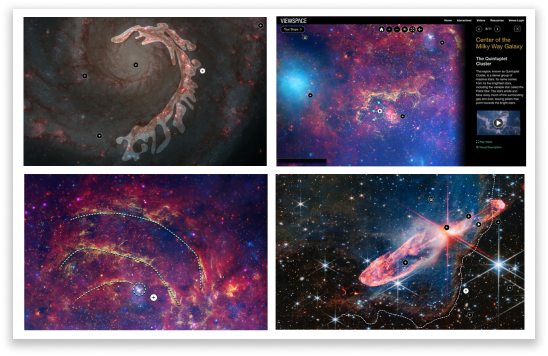
If you are seeking free, hands-on, and accessible tools to engage lifelong learners in exploring cosmic connections, ViewSpace’s new Interactive Image Tours are for you!
These self-guided digital tours offer a fresh way to interact with iconic NASA space images — like the heart of our Milky Way or the Whirlpool Galaxy. Each Image Tour is designed for a variety of learning environments, with a particular focus on supporting learning at public venues like museums, planetariums, and libraries. Image Tours invite learners of all ages to dive into astronomy at their own pace by exploring stunning images, igniting their excitement about science.
Each Image Tour features a stunning telescope image users can explore through zooming, panning, and interactive Tour Stops — points of interest that offer further explanations through text, graphics, sound, and/or videos.
Users can explore Tour Stops sequentially using a navigation menu or freely zoom and pan around the full image, exploring points of interest in any order. In the spirit of self-guided learning, users can also turn off all labels and overlays, making the experience perfect for open-ended exploration.
This flexibility makes the Image Tours ideal for a wide range of learning styles, allowing both linear and non-linear exploration. To support blind and low-vision learners, each Tour Stop also includes an extended visual description detailing the layout and features within each scene, ensuring the experience is accessible to a broader range of learners.
Suitable for both self-guided and facilitator-led learning
In addition to being accessible via viewspace.org, ViewSpace’s Image Tours are available through a free Interactive Image Tours App that turns any internet-connected tablet or touchscreen into an interactive kiosk. A second app, featuring ViewSpace’s Image Sliders, is also available. ViewSpace’s Image Sliders let users compare multiple images, such as views from different telescopes, time-lapse observations, or graphs and scientific illustrations, using a slide bar, labels, and a short science story. Image Sliders help learners see how celestial objects appear across different light wavelengths or change over time — revealing clues about what these objects are made of and how they evolve. Both apps can be locked using Kiosk Mode (on Windows), Guided Access (on iPadOS), or Pinning (on Android) to keep users focused and prevent them from exiting the interactives.
If you have the opportunity, you can set up the two apps on adjacent devices to provide different ways to explore space images. One station can highlight storytelling within a single image through Image Tours, while a nearby Image Sliders display would reveal the same object (if available) or a different one from multiple perspectives, such as different wavelengths or timeframes.
Tips for using ViewSpace’s Interactives
While ideal for solo or group exploration, ViewSpace’s interactives are also powerful tools for facilitator-led outreach. Whether you’re introducing astronomy for the first time or deepening understanding for repeat visitors, here are some ideas for engaging participants using ViewSpace’s interactives:
- Use them to introduce key science concepts: Tired of using static images or confusing graphs? Instead, use Image Tours and Image Sliders to illustrate foundational topics, such as the electromagnetic spectrum or how we categorize exoplanets. By combining imagery, interactive features, and narrative-style descriptions, ViewSpace’s interactives make abstract ideas more concrete and exciting!
- Try an “Observe, Think, Wonder” activity: One way to introduce an Image Tour is through an Observe, Think, Wonder routine. First, turn off Tour Stop labels and invite learners to closely explore the image by zooming and panning. Then, guide them through:
- Observing — What do you notice? What shapes, colors, or patterns stand out? What feelings or impressions arise? Note: Encourage learners to note specific details without any interpretation or inference.
- Thinking — What do you think about what you noticed? Note: Encourage participants to interpret their observations and make inferences.
- Wondering — What questions do you have? What are you curious to learn more about?
Note: This process engages learners in core science skills — close observation, interpretation, hypothesis generation, and peer discussion — mirroring how scientists approach data and formulate ideas. After discussing participants’ responses, turn the Tour Stops on to answer any additional questions and encourage participants to share anything that surprised them.

Time to get started!
Visit our About the Interactives page on viewspace.org to learn how to navigate ViewSpace’s interactives. Whether you’re designing a museum exhibit, leading a talk, or staffing a public star-gazing event, ViewSpace’s growing collection of Interactive Image Tours and Interactive Image Sliders offer engaging, hands-on ways to explore the universe — helping learners feel more connected to the wonders of space!
As of May 2025, three Interactive Image Tours are available (with more in development), including:
- Center of the Milky Way Galaxy — Explore activity around the galaxy’s core through Hubble, Spitzer, and Chandra space telescope data.
- Herbig-Haro 46/47 — Witness how newborn stars sculpt their environments through imagery from the James Webb Space Telescope.
- The Whirlpool Galaxy — Journey through an iconic spiral galaxy using Hubble Space Telescope data.