Impacted Members/Scientists: Request a membership waiver, seek meeting support, and other resources. Learn more. For the latest public policy updates, please visit this page.




24 June 2025
BLUEshift Africa: Accelerating Towards the Future of Undergraduate Astronomy Education in Africa

Linda Strubbe Strubbe Educational Consulting

Tom Rice American Astronomical Society (AAS)
We are delighted to share that the first BLUEshift Africa Workshop on Undergraduate Astronomy Teaching took place on 22-23 March, at the African Astronomical Society (AfAS) Conference in Johannesburg, South Africa. BLUEshift Africa is a project of the American Astronomical Society (AAS), funded by a Venture Grant from the American Institute of Physics. Twenty-three early-career African scientists from nine countries (South Africa, Ethiopia, Zambia, Nigeria, Kenya, Uganda, Zimbabwe, Botswana, and Mozambique) participated in a two-day in-person workshop designed and led by Dr. Linda Strubbe (Strubbe Educational Consulting). The workshop focused on evidence-based, inclusive teaching practices, designed to strengthen undergraduate astronomy teaching in Africa.
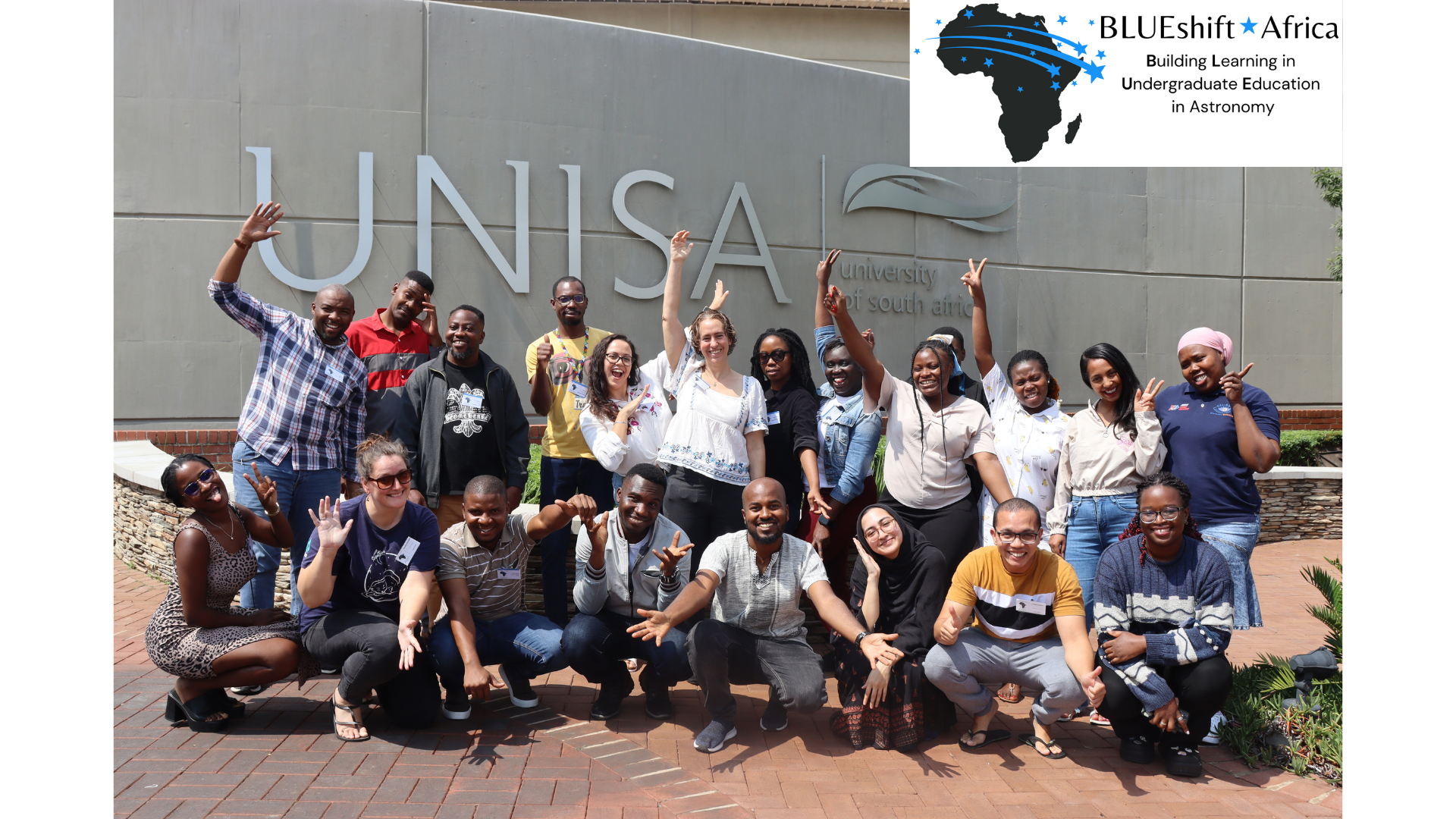
This project aligns with a rapid phase of growth of astronomy in Africa. African scientists are poised to advance astronomy with the numerous world-class astronomical facilities recently constructed on the continent, and the African astronomical community’s Vision 2024 highlights the need for investment in university astronomy teaching.
The cornerstone of the BLUEshift Africa project is two 2-day workshops on undergraduate astronomy teaching for early-career scientists (2025 and 2026), followed by online Communities of Teaching for workshop participants (and beyond). The project began with a pilot study on undergraduate astronomy teaching in Africa, and will close with a panel discussion for AfAS and AAS members in late 2026. The main goals of the workshop are to help participants learn to teach astronomy in more interactive and inclusive ways and to build a community around university-level astronomy teaching in Africa. Workshop topics include research-based principles of teaching and learning, teaching to promote equity and inclusion, and active learning techniques such as the Think-Pair-Share method.
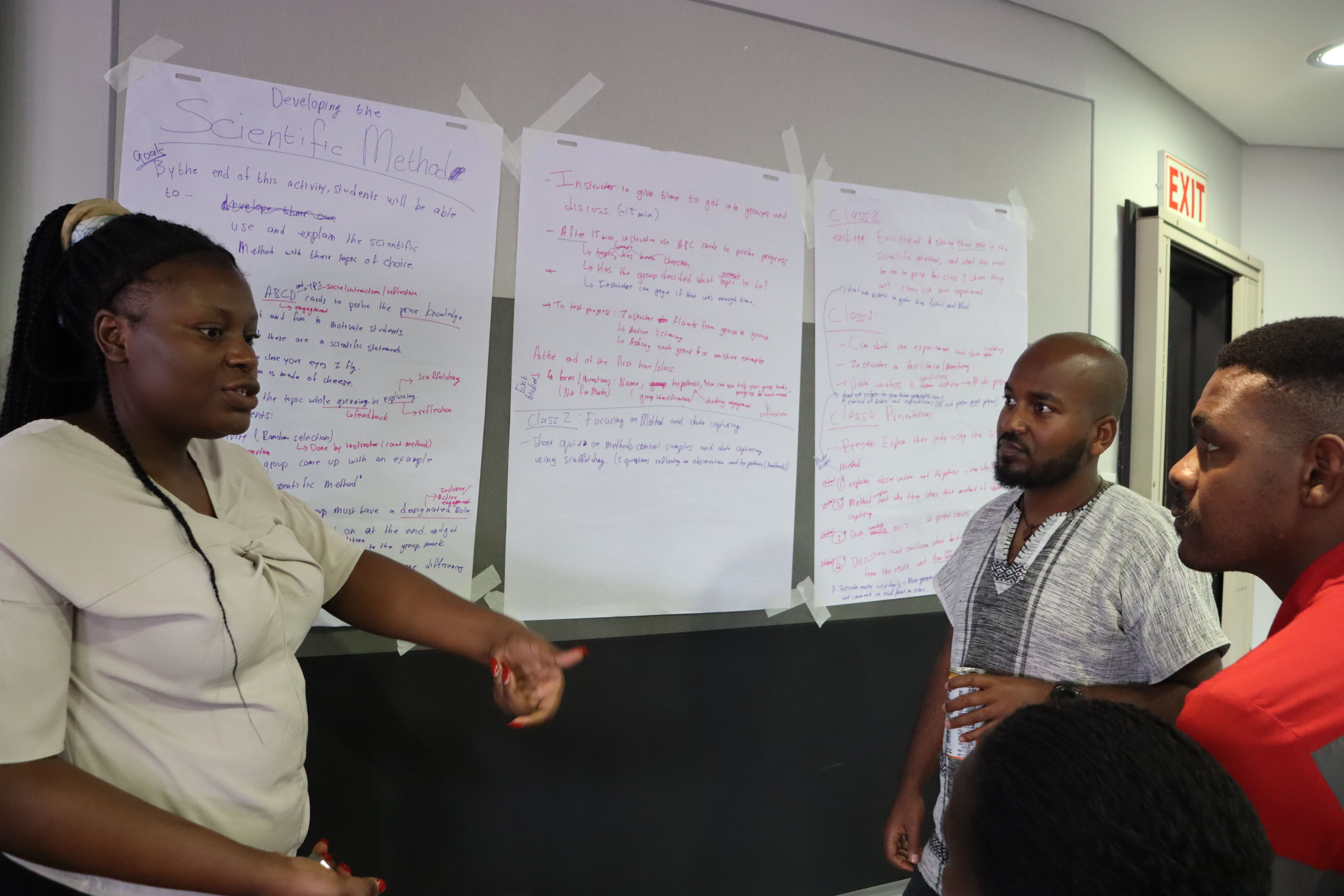
Workshop participants engaged deeply with the workshop, sharing ideas in rich discussions, with great thoughtfulness and care in how to bring the best for their students. "The BLUEshift workshop was incredibly helpful,” said participant Mehbuba Ahmed (Associate Researcher at the Space Science and Geospatial Institute, Ethiopia). “As an astronomy teacher, I gained practical strategies and fresh perspectives to better engage my students. In short: valuable, practical astronomy teaching tools; inspired learning; enhanced student engagement." According to the post-workshop survey conducted by our external evaluators at Pivot Global Education Consulting, 100% of participants strongly agreed that they learned things they feel motivated to try in their teaching, and 95% gave the workshop 5 stars out of 5.
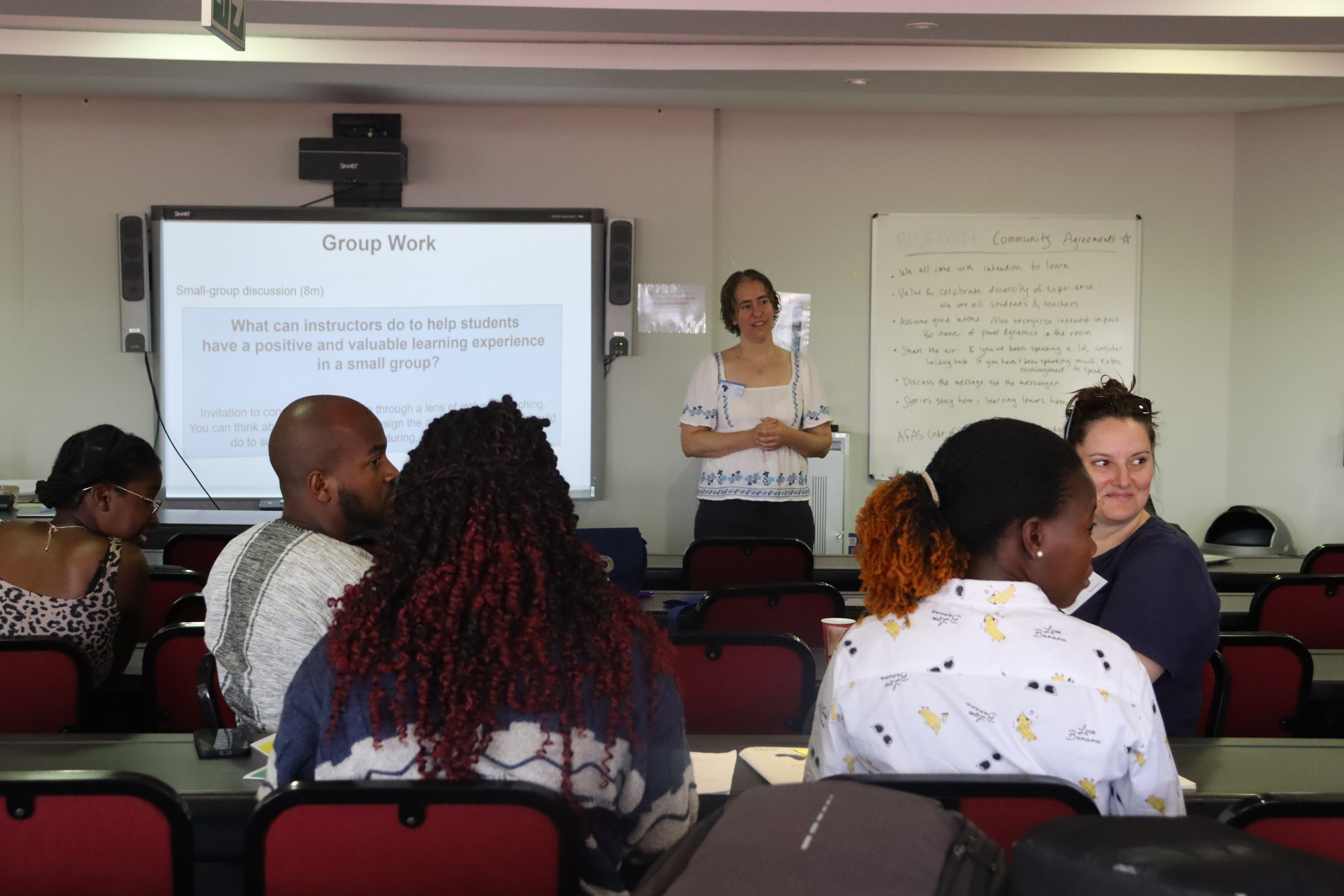
This is a special time for astronomy in Africa, thanks to investment in new world-class astronomical facilities around the continent, such as the High Energy Stereoscopic System, the African Very Long Baseline Interferometry Network, and soon, the Square Kilometre Array. The African scientific community has a strong desire to play leadership roles in these facilities. A growing number of African universities are offering postgraduate programs in astronomy, and the International Astronomical Union (IAU) held its General Assembly in Africa for the first time in the IAU’s 100-year history last August. In the vision to increase the number of African astronomers and related STEM professionals, strengthening undergraduate astronomy education is a crucial and often overlooked piece. The BLUEshift Africa project speaks to the African astronomical community’s Vision 2024, which highlights “a need to improve teaching capacity” and recommends “organizing teaching skills development workshops.”
The second BLUEshift Africa workshop will be held at the 2026 AfAS Conference in Botswana. We are excited about this project and welcome you to contact Dr. Strubbe if you would like to learn more.
Dr. Linda Strubbe, an Independent Educational Consultant and Astrophysicist (Strubbe Educational Consulting), conceived of the BLUEshift Africa project and is leading the effort. She is the recent co-winner of the IAU Astronomy Education Prize for her leadership on the Pan-African School for Emerging Astronomers (PASEA) project, in collaboration with fellow prize recipient Dr. Bonaventure Okere. Dr. Strubbe has a PhD in Astrophysics from the University of California, Berkeley (2011), and has worked on astronomy education in Africa for 13 years. She was a Postdoctoral Fellow at the Canadian Institute for Theoretical Astrophysics (CITA), a Science Teaching & Learning Fellow at the University of British Columbia’s Carl Wieman Science Education Initiative, and a Postdoctoral Researcher at the American Association of Physics Teachers (AAPT).
Dr. Tom Rice, the AAS Education Program Manager, supports the BLUEshift Africa project and provides guidance as the AAS Project Liaison.
We gratefully acknowledge project contributions by: Dr. Tshiamiso Makwela (IAU-OAE, MPIA, UCT) for collaboration on project visioning and survey design; Dr. Charles Takalana (AfAS, IAU-OAD) and Yunus Manjoo (AfAS) for workshop coordination at AfAS; Dr. Electra Eleftheriadou (Educational Consultant and Coach) for collaboration on workshop design; Prof. Saalih Allie and the PHASER group (UCT) for survey feedback; Pierre Paquette (Astronomie-Québec), Kaoutar Saadi (Oukaimeden Observatory), and Dr. Jamal Chafi (Université Cadi Ayyad) for French translation; and Joyce Achampong and Patrice Ajai-Ajagbe (Pivot Global Education Consulting) for project evaluation.