Impacted Members/Scientists: Request a membership waiver, seek meeting support, and other resources. Learn more. For the latest public policy updates, please visit this page.




24 June 2025
Archiving Astronomy Education Resources on the Web
Joshua Tan LaGuardia Community College
Colin Wallace University of North Carolina, Chapel Hill
Welcome to the AAS Education Committee Blog! Our blog features posts from astronomers and educators in the extended AAS community, curated by the AAS Education Committee. Subscribe here to receive future posts and other astronomy education news directly into your inbox every two weeks; also follow us on Bluesky and Instagram. We welcome guest article submissions! — AAS Education Committee.
Since January 2025, there have been substantial changes to certain websites of federal agencies of the United States. Some scientists and educators who have come to depend on these resources have expressed concern that important educational, historical, and scientific information and resources may suddenly and without warning become unavailable. Is there any way to recover what has been lost or to preserve what currently exists before it disappears? Fortunately, the answer is “yes.” In this blog post, we describe how to archive websites and how to search the catalogue of previously archived sites. While this information applies to any website, we focus on those that may be important for astronomy education.
Archiving internet-based resources can be done with the help of the Internet Archive, a nonprofit dedicated to preserving online material for posterity. Using its “Wayback Machine,” you can see previous versions of websites that have been archived by volunteers. For example, UCAR (the University Corporation for Atmospheric Research, a nonprofit consortium of colleges and universities focused on research and training in Earth system science) used to host interactive educational materials on their website. Although these are no longer available in their previous form, you can still find this legacy material in the Wayback Machine. Typing the URL in the search bar will reveal a calendar of captures, which can be selected to reveal the lost content.
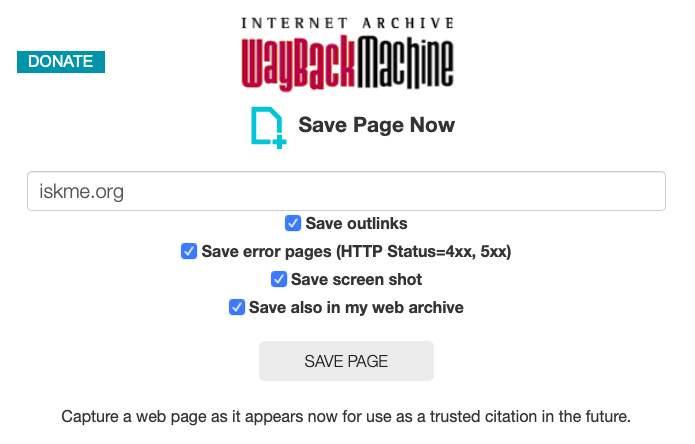
If you would like to help save a particular website, you can use the “Save Page Now” feature of the Wayback Machine, which is also available via browser extensions and smartphone apps. Simply enter the relevant URL and click on “save page,” and wait for the scraper to complete the task. The archive software will attempt to create a date- and time-stamped mirror of the webpage, which will be accessible through the Wayback Machine.
Ongoing efforts to preserve at-risk data sets are being coordinated by the Data Rescue Project, a nonprofit advocacy group working to uncover mirrors and archives of lost datasets and identify the materials most in need of archiving. It is also worth noting that the AAS archives newsletter content remains available on the AAS website. With the recent cancellation of an NSF grant supporting the PhET simulations and the untimely death of Kevin Lee, who developed and ran the Nebraska Astronomy Applet Project, we encourage all astronomy educators to back up and save the most important education resources currently available on the web.