Impacted Members/Scientists: Request a membership waiver, seek meeting support, and other resources. Learn more. For the latest public policy updates, please visit this page.




4 March 2025
Your March 2025 Issue of Physics Today Is Now Available

Hua Liu American Astronomical Society (AAS)
Physics Today, the flagship publication of the American Institute of Physics (AIP), is the most influential and closely followed physics magazine in the world. With authoritative features, full news coverage and analysis, and fresh perspectives on technological advances and groundbreaking research, Physics Today informs readers about science and its role in society. Members of the AAS, an AIP Member Society, automatically receive free print and online subscriptions to the magazine. Physics Today Online, the magazine’s internet home, presents an enhanced digital edition and provides a valuable online archive.
Highlights from the March 2025 Issue
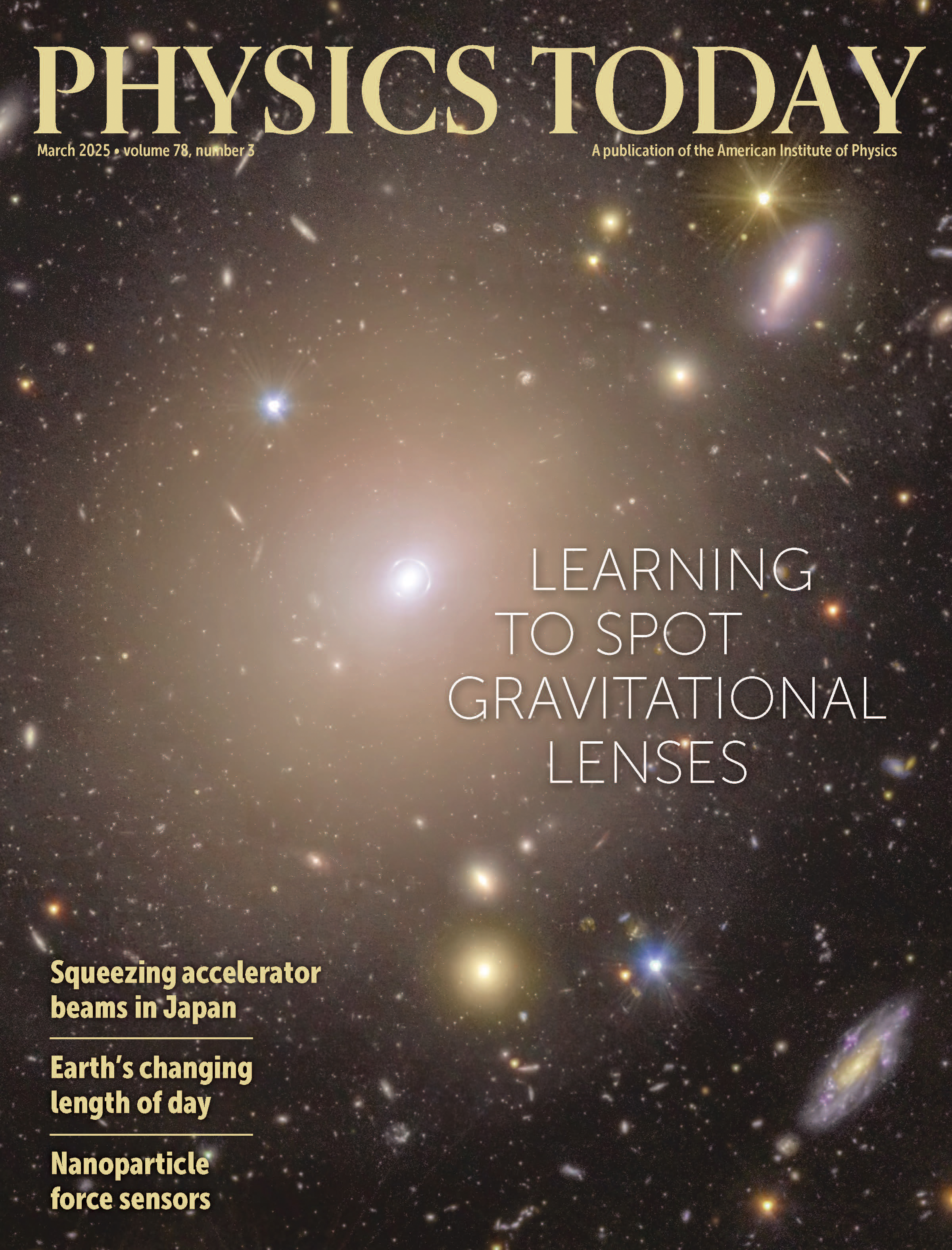
Learning to See Gravitational Lenses
In the 1970s and 1980s, iconoclastic astronomers used diagrams, computer models, and their own intuition to convince the community that they had observed celestial objects that noticeably bend background light. — Sebastian Fernandez-Mulligan
France’s Oppenheimer
Frédéric Joliot-Curie was one of the first to conceive of the nuclear chain reaction. But the ardent advocate of nuclear disarmament paid a high price for his political convictions. — William Sweet
Researchers Share Computational Tricks at Unique Los Alamos Conference
Scientists encompassing multiple disciplines and security clearance levels spent more than a month discussing how to efficiently capture both small- and large-scale phenomena in calculations. — Sarah Scoles
Japan Accelerator Pursues Nanobeams to Boost Luminosity
Squeezing beams of electrons and positrons for the Belle II experiment at the SuperKEKB facility proceeds with halting progress. — Toni Feder
How Pluto Got Its Biggest Satellite
Pluto and Charon may have briefly merged before being bound in orbit. Other objects in the outer solar system may have assembled into binaries in a similar fashion. — Jennifer Sieben