Impacted Members/Scientists: Request a membership waiver, seek meeting support, and other resources. Learn more. For the latest public policy updates, please visit this page.




5 February 2025
ZARTH to Catch ‘Em All
Ashish Mahabal Caltech
Welcome to the AAS Education Committee Blog! Our blog features posts from astronomers and educators in the extended AAS community, curated by the AAS Education Committee. Subscribe here to receive future posts and other astronomy education news directly into your inbox every two weeks; also follow us on Twitter and Instagram. We welcome guest article submissions! — AAS Education Committee.
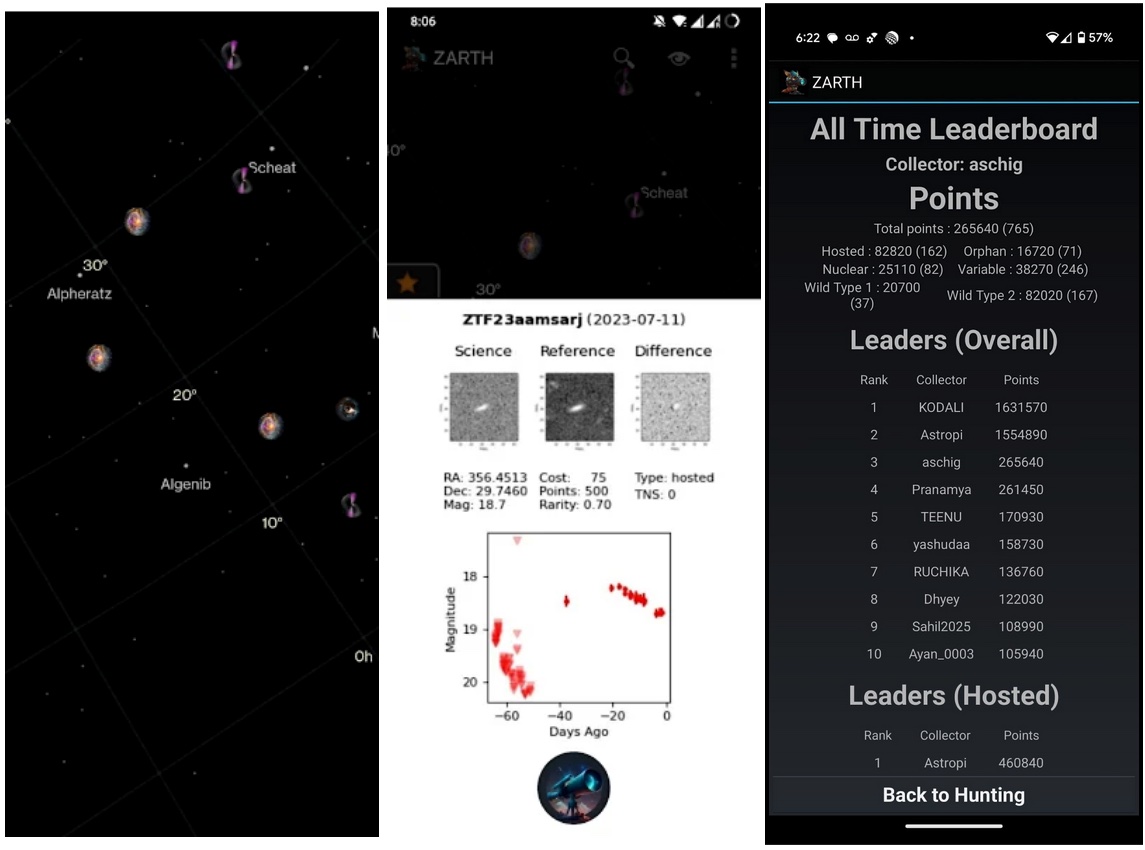
ZARTH (https://zarth.caltech.edu/) is an engaging, free-to-play game inspired by the mechanics of Pokemon GO. It introduces players to a universe where various types of cosmic transients — ranging from supernovae (exploding/dying stars) and tidal disruption events (stars that get too close to a blackhole and get ripped apart) to active galactic nuclei (centers of galaxies that outshine them) and diverse variable stars (e.g. binary stars, pulsating stars, flaring stars and so on) — become collectible entities, each offering a unique glimpse into the cosmic ballet of the universe.
Every night, we introduce a few tens to a couple hundred fresh transients from the Zwicky Transient Facility (ZTF; https://ztf.caltech.edu/). Through an immersive AR interface, players can explore these transients — up to a million times fainter than what is visible to the naked eye — superimposed on a detailed Sky Map, learning about their brightness, classification, and rarity by interacting with them. By tapping on a transient, players can access detailed information, including its light curve and high-resolution images from ZTF, fostering both entertainment and education.
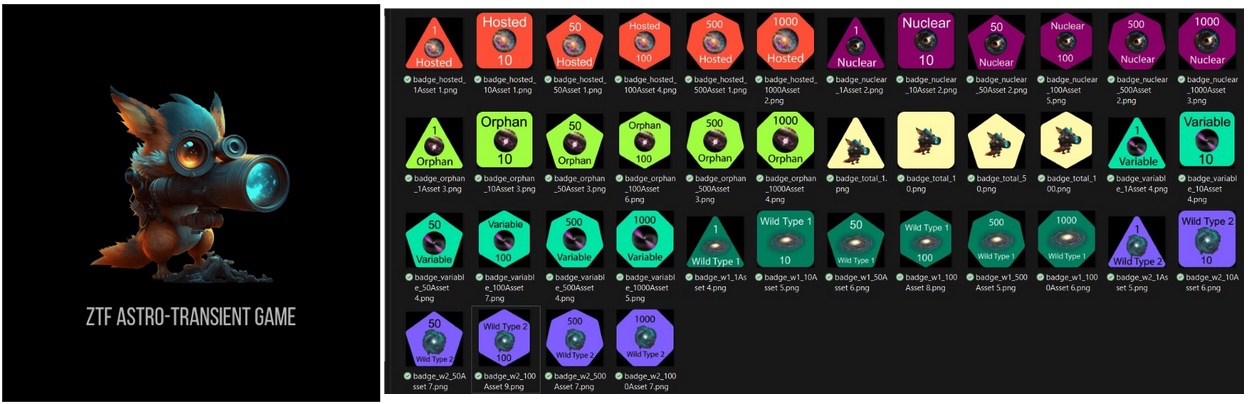
Gamification: ZARTH leverages gamification to enhance player engagement. With a gallery, leaderboards, badges for social media bragging rights, daily streak, and competitive points-based gameplay, it encourages exploration and learning. Players navigate through a budget-based acquisition system to collect rare transients, refreshed daily, adding a strategic layer to the game.
The game delineates six transient categories to enrich player exploration, including Hosted, Nuclear, Orphan, Variable, and two Wild Types, each offering a nuanced look into the transient universe. These classifications not only add depth to the gameplay but also serve as a foundation for educational endeavors.
- Hosted – Host galaxy seen, the transient is off-center, and likely a supernova. Or perhaps an off-center tidal disruption event (TDE), or an active galactic nucleus (AGN). A closer inspection of the light curve can generally reveal the actual class.
- Nuclear – Host galaxy seen, and the transient is close to its center. It could be a TDE or an AGN, but it could also be a (nuclear) supernova.
- Orphan – No obvious galaxy is seen, and the source is not persistent. Either a rare short-lived transient or a variable whose quiescent state is below the detection limit.
- Variable – A persistent source that has passed the ZTF alert criteria (this likely has the largest variety).
- Wild Type 1 – One of two ambiguous classes. Sources here received very high confidence in more than one of the above four classes.
- Wild Type 2 – Similar to Wild Type 1, but with somewhat lower confidence received.
Educational Possibilities: Currently the game is purely outreach. There are many ways in which educators can engage their students in competitive and non-competitive ways, in small groups or large, as they collect transients of different types.
Here is one possibility: Select one of the four main transient types for a week or month-long study. The educator introduces its properties and relevant data types. Students use mobile devices to collect this specific transient type in ZARTH, encountering 10 to 50 daily. They spend 10 to 30 minutes daily reviewing images and light curves to grasp the variety. At the study's end, the educator assesses their collections from game records.
Another possibility is around the wild types — understanding possible reasons for their ambiguous classifications. This can, in fact, lead to good citizen science projects that can lead to the improvement of the classification algorithms. This introduces students to real-world scientific data analysis, potentially inspiring future astronomers.
Extensions and Future: It would be possible to incorporate transients from other surveys or other types of sources, e.g., exoplanet candidates from TESS. ZARTH exists on Androids as a native app. On iPhones, it is a progressive web app, and that will soon also be made available on desktops and laptops.
We do not store any user data. Users log in through Google authentication, create an in-game name, and catch away. After beta-testing by ZTF volunteers and a few others, the game was released in July 2023. On average, it was being played in a new country every day for the first 50 days. Much of the game was developed by four undergrads doing projects: Dhruv Pindawala (IIT Mandi), Dhyey Thummar (IIT Gandhinagar; SURF), Anika Arora (Caltech; SURF), and Naman Dharmani (IIT Gandhinagar; SURF), in addition to important help from many others.
Play, enjoy, and tell us where we can take it collectively.