Impacted Members/Scientists: Request a membership waiver, seek meeting support, and other resources. Learn more. For the latest public policy updates, please visit this page.



16 December 2024
Education Committee Announces Six Winners of 2025 EPD Mini-Grants
Mallory Conlon Yerkes Observatory

Tom Rice American Astronomical Society (AAS)
The AAS Education Committee is pleased to announce the recipients of the 2024–2025 award cycle for our Education & Professional Development (EPD) Mini-Grant program. We are proud to provide full or partial funding to the following six programs, four of which will take place as workshops or splinter sessions at the winter AAS meeting in National Harbor, Maryland, one of which will take place as a workshop at the summer AAS meeting in Anchorage, and one of which was offered independently in October 2024. To stay in the loop, you can sign up for the AAS Education Biweekly Newsletter. Please congratulate these winners and support their exceptional work by attending their workshops at future AAS meetings and beyond!
EPD-Sponsored Workshops at AAS 245
You can sign up for these workshops when you register for AAS 245 in National Harbor, which takes place in January 2025. Act soon, as the late registration deadline is 6 January 2025! If you have already registered, you can easily add these workshops to your registration by logging back into the registration site.
Sunday, 12 January
The following two activities appear as workshop events in the AAS meeting schedule and require pre-registration in order to attend.
Increasing Student Learning and Inclusion in Your Classroom: Strategies from the Faculty Teaching Institute
Sunday, 12 Jan | 9:00 am – 5:00 pm ET
Principal Investigators: Edward Prather, Colin Wallace, and Rica French
This workshop will engage participants with how to successfully combine principles of learning, course design structures, and multiple instructional strategies to create classes that support students of all backgrounds and actively engage learners in collaborations to deepen their knowledge and abilities, resulting in significant learning gains and retention of students. The workshop is specifically designed to provide participants with a safe and supportive environment that increases their agency, fosters open discourse, and promotes reflection on their identities, beliefs, and local context. This workshop is appropriate for all members of the AAS, at all points in their career paths.
Addressing Light Pollution on Your Campus: Introducing the Campus SHINE Initiative
Sunday, 12 Jan | 1:00–5:30 pm ET
Principal Investigator: Vayujeet Gokhale, Michelle Wooten, Daniel Caton, and James Lowenthal
This workshop will provide participants with professional development resources and educational materials with the aim of improving outdoor lighting on their campus. In particular, participants will be introduced to the Campus SHINE (Safe and Healthy Illumination for the Nighttime Environment) document, which describes the process of building a team of faculty, staff, and students to assess campus lighting and develop plans to improve it. Participants will learn about advocating for responsible lighting principles and learn methods of quantifying light pollution. Additionally, participants will be provided with examples of campus lighting management plans, student government resolutions, and images of good and bad lighting.
Monday, 13 January
Note that the following two activities appear as splinter events in the AAS meeting schedule and do not require pre-registration.
ExoCore: Reinforcing Open Science Across Exoplanet Research
Monday, 13 Jan | 10:00 am – 12:00 pm ET
Principal Investigators: Tansu Daylan, Nathan Whitsett, Bryce Wedig, and Aavik Wadivkar
Transition to Open Science (TOPS) is a NASA initiative to train the scientific research community on open science's ethos, methods, and outcomes. This experience directly engages participants with the NASA-funded project called ExoCore, a curriculum being developed to become a part of TOPS-developed Science Core curricula focused on open-science practices in exoplanet research. Participants will be guided through the ExoCore open-science curriculum in a hands-on half-day session. The workshop will include mini-lectures, discussions, and hands-on exercises.
New Data-Driven Classroom Investigations from Rubin Observatory
Monday, 13 Jan | 12:30–3:30 pm ET
Principal Investigators: Ardis Herrold, Edward Prather, and Justine Schaen
Rubin Observatory’s Education and Public Outreach team has released two new classroom-tested online investigations: “Exploding Stars" and "Stellar Safari." These interactive investigations are designed to increase the learning for a diverse population of students, contributing to making the science classroom more inclusive and equitable. During this experience, participants will work with each other to experience the tools, science cases, and learning sequences of the investigations. The workshop is designed to provide participants with a safe and supportive environment that increases their agency, fosters open discourse, and promotes reflection on their identities, beliefs, and local context. This workshop is appropriate for all members of the AAS, at all points in their career paths, including grad students, post-docs, middle school and high school teachers, informal educators, college faculty, research scientists, amateur astronomers, and administrators. Any instructor of any level of experience will benefit, regardless of whether their classes are large or small, or in-person, virtual, or hybrid.
EPD-Sponsored Workshops at AAS 246 (June 2025)
Embracing Ungrading: Transforming the Classroom Experience in Physics and Astronomy
You can experience this workshop at the AAS 246 Summer Meeting in Anchorage, Alaska!
Principal Investigators: Mariah MacDonald and Dhanesh Krishnarao
Although deeply rooted in our curriculum and society as a whole, grades have been shown to be harmful to — and unpredictive of — student learning and ability. More alarming, grades encourage students to optimize their points by taking what they perceive as the easiest path, leading to rushed assignments, academic dishonesty, lower motivation, and additional barriers to learning. Ungrading, the practice of intentionally not assigning grades, seeks to improve student learning and engagement by emphasizing feedback, reflection, and collaboration. We propose to host a workshop at the 246th AAS meeting in Anchorage AK to help educators transition a traditional classroom to an ungraded classroom. This workshop will explore and guide the implementation of ungrading in any course, but with a specific focus on high school and college physics and astronomy courses. We will provide a comprehensive understanding of the motivations behind ungrading and its potential benefits. Through hands-on activities, participants will learn numerous methods to transition assignments and assessments to ungraded formats. Participants will leave the workshop with a transformed class structure and numerous classroom materials that are ready for immediate implementation. This workshop will be open to all educators, including those currently teaching and those simply interested in learning more about these equitable and innovative practices.
EPD-Funded Activities Outside of AAS Meetings
LightSound
This experience took place in October 2024.
Principal Investigator: Allyson Bieryla, Sóley Hyman, and Dawn Davies
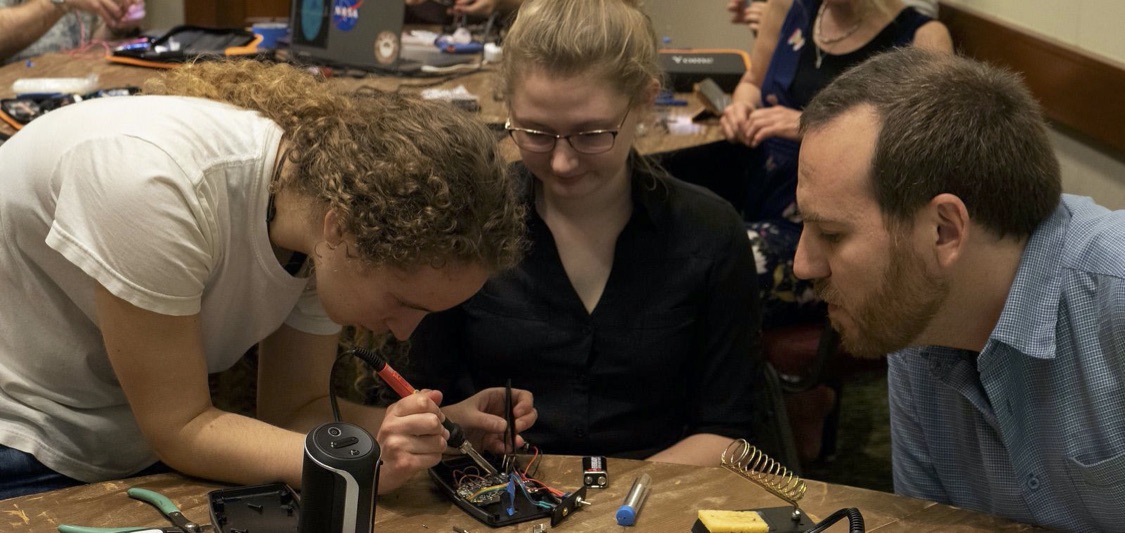
The LightSound device is a tool designed to convert light to sound to allow blind and low-vision individuals a way to engage with solar eclipses. LightSound was developed in 2017 and used during several solar eclipses in North and South America. Over 1000 devices have been built and distributed through this project. The device is applicable beyond solar eclipses, and this proposal aims to engage AAS members looking to make their education, outreach, or future eclipse activities more accessible to the blind and low-vision community. Participants will learn to build a device during the workshop and learn how to run a workshop in their own community. Participants will keep the LightSound devices that they build.
Congratulations again to the grant recipients! Please stay tuned via the AAS Education Biweekly Newsletter for information on upcoming opportunities, including future workshops and the next Call for Proposals for the EPD Mini-Grant program in Summer 2025.