Impacted Members/Scientists: Request a membership waiver, seek meeting support, and other resources. Learn more. For the latest public policy updates, please visit this page.




23 September 2024
Democratic Merit: What Separates Good from Great in Astronomy?
Julie Posselt
University of Southern California
Welcome to the AAS Education Committee Blog! Our blog features posts from astronomers and educators in the extended AAS community, curated by the AAS Education Committee. Subscribe here to receive future posts and other astronomy education news directly into your inbox every two weeks; also follow us on Twitter. We welcome feedback and topic suggestions, as well as guest article submissions! — AAS Education Committee
This blog post is part of a special series arising from the June 2024 Education Special Session at AAS 244, Towards Equity in the Classroom: Implementing Progressive Pedagogical Practices. This session and this blog series highlight progressive pedagogical teaching practices that break from traditional lecture classroom techniques to increase student engagement, learning, and belonging across diverse groups of students.
One of the most consequential elections in United States history is quickly approaching. Among the questions this election asks Americans to consider is: How much do we value the people and activities that promote a healthy, diverse democracy? Over the last 15 years, I have been fortunate to conduct research within astronomy and STEM that has permitted me the privilege of seeing, firsthand, how some academic departments ask themselves versions of the same question:
- What practical actions can we take to make good on the diversity, equity, and inclusion (DEI) recommendations in reports emerging from astronomy, physics, and STEM?
- How should we train students in the skills and dispositions that large collaborations in astronomy require?
- How can we promote diversity in admissions following the Supreme Court’s ruling in Students for Fair Admissions v. Harvard?
- What does it really mean for us to create an inclusive department climate?
- How might we value contributions to inclusive learning environments?
If you or your department are among the growing number that are asking such questions, you may find the concept of democratic merit useful in developing answers.
Introduced by Harvard Law Professor Lani Guinier in a short book titled Tyranny of the Meritocracy: Democratizing Higher Education in America, democratic merit broadens narrow conceptions of excellence to include the skills, knowledge, and lived experiences that enable healthy democratic engagement. It challenges what Guinier calls the conventional “testocratic” system of selection and training, which emphasizes performances of decontextualized knowledge. Historically, a testocratic philosophy has been reflected in admissions, by anchoring decisions to accept or reject on standardized test scores, and in coursework, by anchoring grades on scores from mid-term and final exams.
I have yet to see any advocate of democratic merit recommend abandoning the assessment of academic learning; however, they do regard academic merit as necessary but insufficient for the nature of 21st-century academic work. I similarly argued in my 2020 book, Equity in Science, that the quality of how we engage with each other in the scientific enterprise cannot be separated from the quality of our research. With other proponents of democratic merit, I agree that educators have a role in selecting and cultivating people who will lead with and for diversity — both in society and the professions within it.
Figure 1 below displays specific skills, knowledge, and dispositions that my research team and I have observed in academic departments that are informally incorporating democratic merit into the qualities they seek in prospective students, the qualities they cultivate in students, and what they assign value to in course assessment practices.
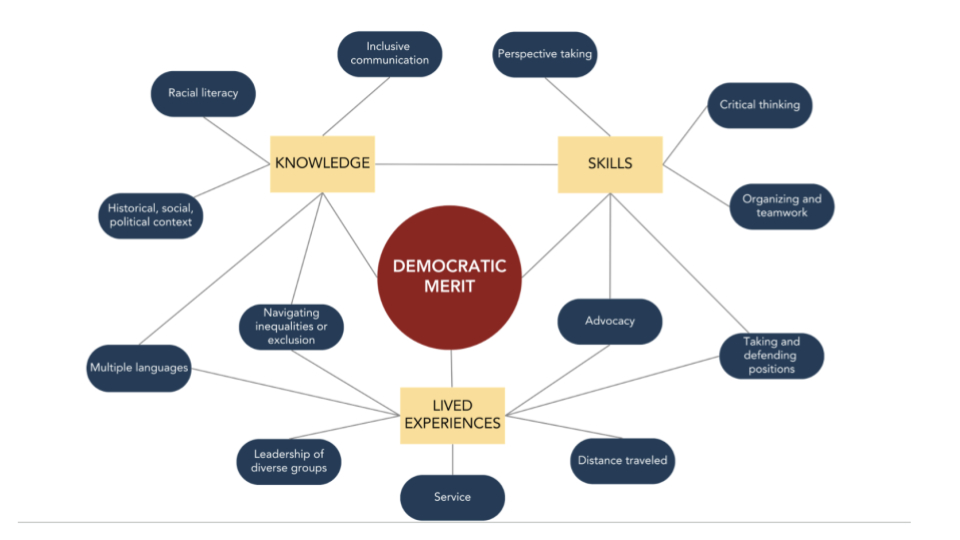
For example, when a student applies to a graduate program having developed some experience and skills in organizing, leadership of diverse groups, and intergroup communication, they are equipped to be a better academic citizen than a student who lacks these qualities. Because most academic programs have many more academically qualified applicants than they have spaces to award, it is perfectly reasonable to add qualities associated with democratic merit to our admissions procedures to further distinguish among them. One astrophysics program that my team studied for two years has formally made “contributions to the community” an admissions criterion, for example. They added it as a line on their rubric, incorporated it into the committee’s deliberations, and within their interview protocol, asked finalists to reflect on this.
In the classroom, we send an important message to students about what we value through what we assess. And, indeed, there is a growing movement to incorporate into course activities and grading schemes the cultivation and consideration of things like how well a student led a small group project (not just the quality of the output) or whether they demonstrated critical thinking in the arguments presented within a paper. Here are eight ways that you can cultivate and recognize democratic merit:
- Organize class time to practice these qualities, and let students know that you are being intentional about doing so.
- Don’t be afraid to offer more structure than is typical for group activities and assignments. Structure for the small-group collaborations you would like to see.
- Design activities whose objectives include both content knowledge and procedural knowledge.
- Actively affirm the lived experiences with which your students enter the classroom.
- Encourage personal reflection and peer feedback about challenges experienced and lessons or growth through them.
- As an instructor, be mindful of the example you set, including your efforts to grow.
- Assign short readings from the social sciences to accompany the usual curriculum.
- Normalize discussions about the operations of the scientific enterprise within your courses.
Again, none of this takes away from demonstrating competence in technical skills, although the skills of democratic engagement are arguably essential to the technique of a truly great scientist today.
In closing, the current legal environment makes consideration of democratic merit in our selection practices more important than ever; this is a set of qualities that can help us create positive conditions for diversity, even if we are not able to include applicant racial status in deliberations. Although here I have written about its relevance for admissions and coursework, the ability of democratic merit to help distinguish good from great scientists means that we should also explore its relevance in other selection contexts, such as faculty hiring, tenure, promotion, and academic awards. We are stunting America’s future in science to do anything less, for the skills, knowledge, and experience that come with diversity, after all, also produce the best science.