Impacted Members/Scientists: Request a membership waiver, seek meeting support, and other resources. Learn more. For the latest public policy updates, please visit this page.




Suggested Advocacy Actions
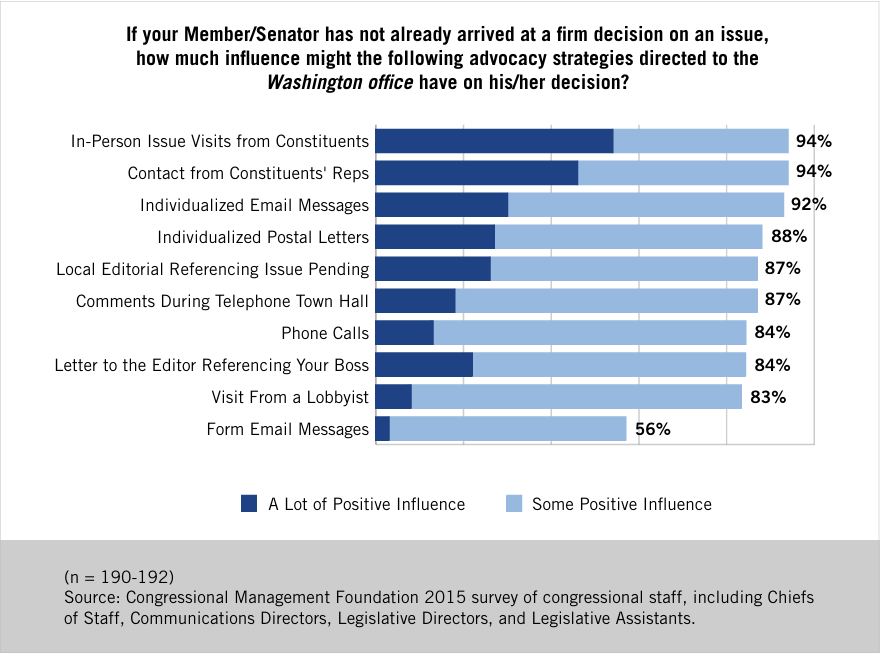
Thank you for your interest in science advocacy. There are many ways to make your voice heard in support of scientific funding and programs. The sections below offer some practical actions you can take to connect with policy makers and influence decisions in Congress. From sending a quick email to holding an in-person meeting with your representatives and/or staff, every action counts. The image below illustrates which advocacy strategies have the most impact on policy decisions according to congressional staff.
Write to Your Members of Congress
You can use our action alerts to send a message in just a few minutes, but a personalized email is likely to have more impact. Please refer to our spreadsheet here to find the email addresses for the science staffers representing your Senators and Representative (note that you must be logged in to the AAS website to access this sheet). If you cannot find a staffer for your congressional office using the link above, please reach out to [email protected], and we will provide the name and email of the appropriate staffer(s).
Once you send a message to your members of Congress, you can amplify your message by sharing on your social media why strong federal support for science and space research matters to you. Tag your representatives and use #SaveScience to spread the message far and wide!
Here are some resources that you might find helpful in crafting your message:
- NSF impacts in your state fact sheets
- NASA state-level economic impact report fact sheets
- FASEB state and district-level information about NSF, DOE SC, NIH, and USDA funding
- AAAS Federal R&D Dashboard
- APS Federal R&D Enterprise Visualizer
- Planetary Society: NASA Science spending across the US
Call Your Members of Congress
Your voice matters! A phone call is 28% more likely to influence your member of Congress compared to an email. Use the “Phone” button on our action alerts or a service like 5 Calls to call your members of Congress and explain why funding science and space is crucial for America's future. It only takes a few minutes, and it can have a huge impact. If you are nervous about speaking to someone, don’t worry! Most calls will go to voicemail, especially if you call on the weekend or after 6:00 pm ET (but the office will still listen to your voicemail).
Request a Meeting with Your Congressional Office
Request a meeting on Zoom or at a local district office with your members of Congress or their staff. You could even invite them to visit your institution! Ninety-four percent of congressional staff say that a meeting with a constituent influences their decisions, and in-person issue visits have the most positive impact on a policy maker's decision (see image above). Personal connections help policy makers see firsthand how federal investments in science make a difference. To request a meeting, you can either find a form on your member’s website, or email [email protected], and we’d be happy to assist you! We have a set of slides that outline the best practices for a Hill meeting, available here, to help you get started. We also encourage you to coordinate with your institution’s government affairs office, and consider doing this meeting as a group with other constituents at your institution/department.
Write an Op-Ed
Consider writing an op-ed for a local newspaper. You could write about a myriad of topics, including: the severe economic impact of reduced STEM funding, the “brain drain” of scientists to other countries, the loss of opportunities in the STEM workforce pipeline, American leadership in the space sciences, national security and innovation, and/or the personal importance of science to you and your career. Here are some resources for writing an op-ed, including suggested talking points. You can also check out Science Homecoming, a grassroots nonprofit science organization, for more information. The Science Homecoming site offers free tools, templates, and volunteer editor support to help scientists write short hometown op-eds that highlight the impact of science on everyday life. Consider also signing up for the McClintock Letters, an effort to publish over 1,000 op-eds and letters to the editor in local newspapers about the importance of federal funding for science. As always, feel free to reach out to [email protected] if you have any questions during the process.
Host an Advocacy Event
Spend some time broadening your advocacy efforts by helping others get engaged. Host a short co-working session at your institution or online where you can help others engage in the above advocacy actions, including writing to their member of Congress, preparing a script for a phone call, and requesting a meeting with your congressional office. In future years (usually between February and April), you can work together to fill out constituent appropriations requests for your congressional offices. As always, reach out to [email protected] if you have any questions during the process.
Post on Social Media
Share about your experiences and advocacy efforts on social media. Speaking up on social media brings more attention to current issues and inspires others to get engaged!